
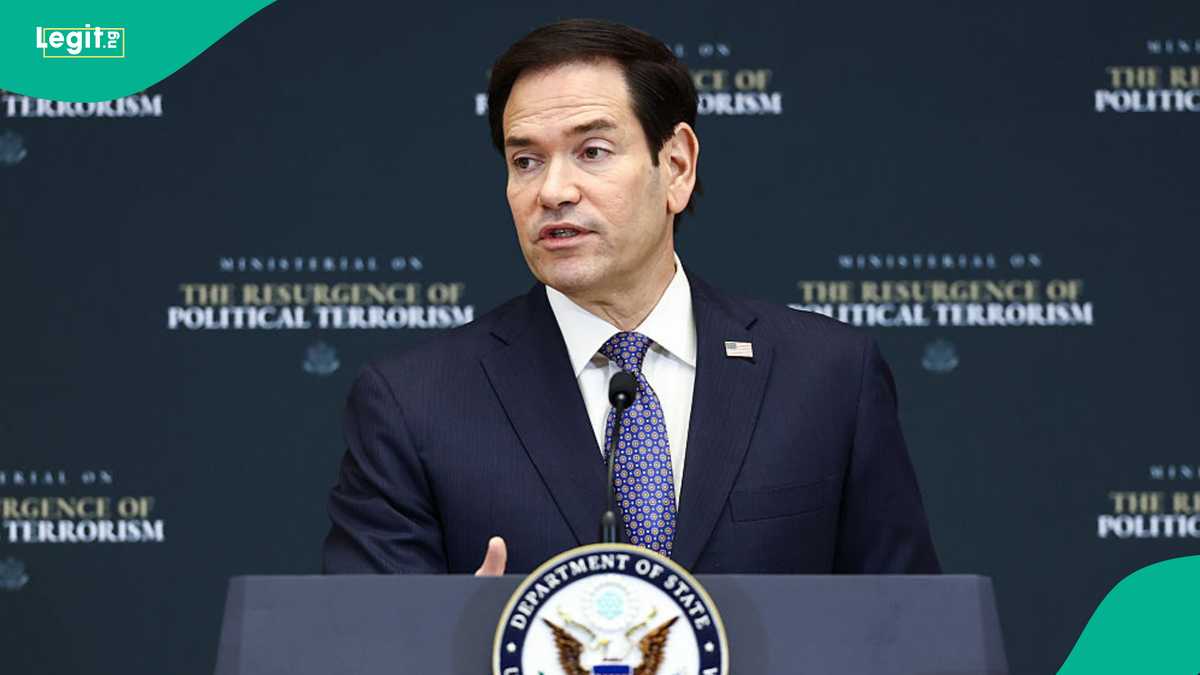

- A viral X post claimed Marco Rubio said people who criticise Israel would be denied a US visa, drawing over 4 million views
- The clip came from Rubio’s remarks at an antisemitism conference in May 2025, but the viral caption went further than anything he actually said
- The White House pushed back on the claim, with a senior communications official calling it a lie and saying it does not reflect US policy
Legit.ng journalist Ridwan Adeola Yusuf has over 5 years of experience in fact-checking.
Washington, USA – A viral post claiming America’s Secretary of State Marco Rubio declared that anyone who criticises Israel will be denied a visa to the United States (US) has spread rapidly online.
The US and Israel have been engaged in a major military conflict with Iran since late February 2026, characterised by coordinated airstrikes, regional missile exchanges, and shifting diplomatic efforts.


Source: Getty Images
The post reignited debate over Washington’s immigration screening practices and its support for Israel.
The publication, shared on X (formerly Twitter), read:
“Marco Rubio: ‘If you criticise Israel you will be denied a visa to the United States.'”
It had gathered more than 4 million views and over 4,000 comments at the time of writing, with many users directing criticism at Rubio over the alleged remarks.
Watch Marco Rubio’s video below via X:
What Rubio actually said
The claim is misleading. The video clip circulating online comes from Rubio’s pre-recorded address at the Israeli Ministerial Conference on Combating Antisemitism on May 28, 2025.
In the official State Department transcript, Rubio said:
“Under President Trump, the United States will stand with the Jewish people. We have implemented a vigorous new visa policy that will prevent foreign nationals from coming to the United States to foment hatred against our Jewish community.”

He did not, at any point in the speech, say that criticising Israel would result in a visa refusal.
Earlier in the same address, Rubio argued that there is “no nuanced separation of hatred of Israel and hatred of the Jewish people,” framing certain forms of anti-Israel rhetoric, including calls for violence, the destruction of Israel, or some boycott campaigns, as expressions of antisemitism.
The viral caption, however, converts this position into a sweeping blanket rule that does not exist anywhere in his remarks.
White House calls it a lie
The President Donald Trump administration itself rejected the characterisation.
According to MEAWW on Monday, August 3, shortly after the clip began circulating in 2025, White House Deputy Communications Director Alex Pfeiffer dismissed it as “spreading lies,” adding that “it isn’t our policy” and that “Secretary Rubio doesn’t even say that in the video.”
Rubio’s stated policy targets foreign nationals who “foment hatred” against the Jewish community in the United States, a standard the administration has applied broadly in visa screening decisions affecting individuals accused of promoting antisemitism or supporting designated terrorist organisations. That is a considerably narrower framing than the blanket anti-criticism rule the viral post describes.

Verdict on US visa approval claim
The claim that criticising Israel automatically bars someone from entering the United States is false.
It misrepresents both what Rubio said at the conference and the policy the administration has publicly defended.
Read more on visa applications
Trump visa rule risks $400 billion
Earlier, Legit.ng reported that a new policy introduced by President Trump’s administration restricting how long international students can remain in the US could cost the US economy up to $400 billion in annual economic output, according to a report by the Peterson Institute for International Economics (PIIE).
The rule, issued in July and set to take effect in September, scraps the longstanding “duration of status” arrangement, which allowed students to remain in the country for the full length of their studies without a fixed deadline.
Under the replacement policy, most international students will receive a stay of up to four years, after which they must apply for an extension to continue studying or to remain for post-graduation work.
Source: Legit.ng