
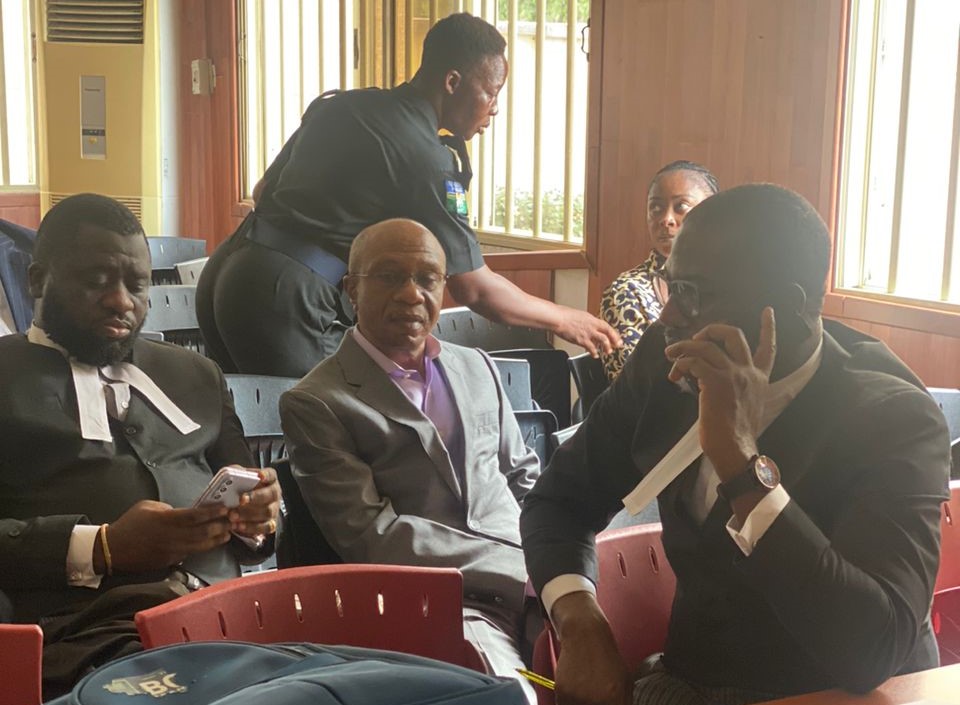

The Economic and Financial Crimes Commission (EFCC), on Monday, presented newspaper publications in the naira redesign fraud trial of former Governor of the Central Bank of Nigeria (CBN), Godwin Emefiele.
Eighth prosecution witness Jegede Olusegun, who is a staff member of the National Library, presented newspaper bundles before the FCT High Court in Maitama.
The piles of newspapers comprised various editions of ThisDay, Vanguard, Punch, Daily Sun and The Nation newspapers.
EFCC presented them at the request of Mr Emefiele’s lawyer, Olalekan Ojo, a Senior Advocate of Nigeria (SAN).
Mr Ojo did not explicitly explain the need for the publications.

However, earlier in October, the EFCC had presented video clips that documented the suffering of Nigerians as a result of the naira redesign led by Mr Emefiele.
Mr Emefiele is standing trial on four counts, including illegal redesign of naira notes, disobedience to the direction of law, and illegal act causing injury to the public.
The former CBN governor has denied the charges.
On Monday, Mr Olusegun, during cross-examination by Mr Emefiele’s lawyer, said he did not author the newspapers.
He said his duties only included certification of newspapers, attending to the information needs of the public and readership culture campaigns.
The witness could not confirm whether all the newspapers were privately owned.
However, he noted that Punch, ThisDay and Vanguard were privately owned but could not tell who the owners The Nation and Daily Sun were.
When asked if he could vouch for the truth contained in the newspapers, he said, “I can beat my chest that they are true.
“On the issue of content, I cannot say if it is 100 per cent true. What I can say is that I certify the newspapers,” the witness said.
He was then discharged, and the trial judge, Maryanne Anenih, adjourned proceedings until 13 May (Wednesday).
Witnesses’ previous testimonies
Seven prosecution witnesses had taken the stand to testify before Mr Olusegun.
In November 2024, the fifth prosecution witness, Kingsley Obiorah, a former deputy governor of the CBN, said the bank’s board never recommended the naira redesign to former President Buhari.
Mr Obiorah, who testified virtually, said he once served as Special Adviser to Mr Emefiele on economic matters.
He said the CBN board first heard of the naira redesign policy in mid-December 2022.
Request for documents
Chinedu Eneanya, the seventh witness, took the stand in October 2025, focusing his testimony on the approval of the controversial redesign of the naira notes in 2022.
Mr Eneanya, an EFCC detective, said the redesigned currency notes the CBN produced in late 2022 were not the versions that then-President Muhammadu Buhari approved.
In February, when Mr Eneanya was still giving his testimony, Mr Emefiele’s lawyer requested all documents related to the case.
On Monday, when the Director of Public Prosecutions of the Federation (DPPF), Rotimi Oyedepo, presented the newspapers, Mr Ojo complained that it did not form part of the front-loaded documents.
Mr Oyedepo, also a SAN, pointed out that the documents were presented at the instance of the defence. But Mr Ojo said the prosecution was presenting the documents through a witness, hence, the need for the filing of additional proof of evidence.
Mr Ojo urged Mr Oyedepo to undertake filing the additional evidence. The DPPF acquiesced, which allowed the trial to continue.
The naira redesign trial is one of the several cases Mr Emefiele has faced before different judges since his removal from office by the President Bola Tinubu administration in June 2023.
The cases stemmed from his activities as the CBN governor, a position he held for about eight years dating back to when he was first appointed by then-President Goodluck Jonathan in June 2014. His first term of five years was subsequently renewed by President Buhari.
One of the cases involved an alleged fraudulent withdrawal of $6.2 million from CBN vault during Mr Emefiele’s time in office. The humongous amount of money was allegedly paid out in cash under the pretext of funding foreign election observers’ expenses for the 2023 polls. The then-Seceretary to the Government of the Federation (SGF), Boss Mustapha, appeared in the trial as a prosecution witness in February 2024, denying that he or Mr Buhari approved the withdrawal.
Naira redesign crisis
The unpopular Naira redesign policy marks one of the darkest periods of former President Buhari’s administration, causing a severe shortage of currency notes and inflicting significant hardship on many Nigerians during the first two months of 2023.
READ ALSO: Another judge orders arrest of convicted ex-minister Saleh Mamman
Mr Emefiele and Mr Buhari remained adamant in implementing the policy even as it triggered chaos and widespread disruption amid preparations for the 2023 general elections. They touted the policy as a measure to stop vote buying during the elections.
But despite the policy being in force, cases of vote buying were recorded during the 25 February 2023 presidential and National Assembly elections.
Mr Buhari staunchly defended the policy to the extent of ignoring an interim order of the Supreme Court suspending its implementation. On 8 February 2023, the Supreme Court ordered that both the old notes and their newly designed versions should remain legal tender pending further hearings in the suit. But in violation of the court’s order, Mr Buhari, in a broadcast on 16 February 2022, restored the validity of the old N200 notes and insisted that the old N500 and N1,000 banknotes had ceased to be valid.
The case was finally laid to rest when the Supreme Court gave its final judgement on 3 March 2023.
It nullified Mr Buhari’s directive withdrawing the old naira notes and extended their validity till 31 March. The Supreme Court also adjudged Mr Buhari a disobeyer of court order, citing his violation of its earlier interim order suspending the implementation of the naira redesign policy.