
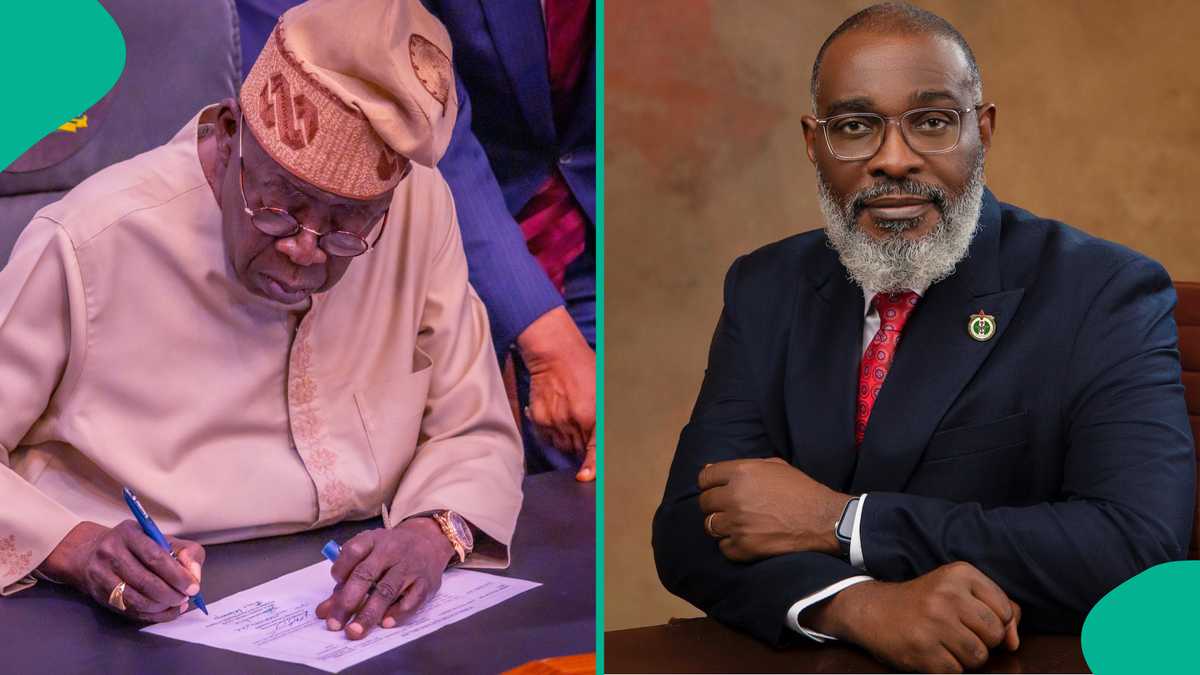

- The Centre for Humanitarian and Homeland Advancement has reacted to President Tinubu’s appointment of a Special Adviser on Homeland Security
- The centre rejected claims by some critics that the appointments reflect failure in Nigeria’s security management
- The group also described the appointee, retired Major General Adeyinka Famadewa, as a highly experienced retired general whose expertise is suited to strengthening Nigeria’s security architecture
Abuja, FCT – The Centre for Humanitarian and Homeland Advancement has defended President Bola Tinubu over the appointment of retired Major General Adeyinka Famadewa as Special Adviser on Homeland Security, rejecting criticism that the move reflects an institutional failure to address Nigeria’s security challenges.
The centre’s comment follows remarks by Femi Otubanjo, a research professor at the Nigerian Institute of International Affairs, who reportedly said the appointment was “wrong” and amounted to an admission that the administration had failed to contain worsening insecurity.


Photo credits: @aonanuga1956
Source: Twitter
Famadewa’s appointment: Centre says criticism is misplaced
In a statement issued on Friday, May 15, the Centre’s executive director, Dr Maurice Ayobami, said the criticism was “misguided” and reflected a limited understanding of modern security governance.
He argued that the creation of the homeland security advisory role represents an institutional adjustment to evolving threats rather than evidence of weakness in Nigeria’s security architecture.
“Serious governments evolve,” Ayobami said, adding that security structures globally are being redesigned to respond to more decentralised and technologically driven threats.
Famadewa’s appointment reflects changing nature of security threats
The Centre said Nigeria’s security environment has become increasingly complex, citing terrorism, banditry, cybercrime, transnational organised crime, and sabotage of critical infrastructure as emerging challenges requiring improved coordination.
It added that modern security management now depends on stronger intelligence integration and faster inter-agency response mechanisms.
Ayobami said interpreting the appointment as a duplication of existing structures was inaccurate, insisting the role is intended to enhance coordination rather than replace statutory security agencies.

Famadewa defended
The Centre also defended the choice of retired Major General Adeyinka Famadewa, describing him as a “tested security professional” with extensive operational and intelligence experience.
It said Famadewa previously contributed to intelligence coordination reforms within the Office of the National Security Adviser, including work linked to the establishment of an intelligence fusion framework.
According to Ayobami, his military background and experience in security coordination make him well-suited to the advisory role at a time of evolving threats.
The Centre cautioned against what it described as the politicisation of security reforms, urging critics to assess the appointment within the broader context of national security restructuring.
It said Nigeria’s security challenges are rooted in long-standing structural issues, including porous borders, arms proliferation, and socio-economic pressures, which require continuous institutional innovation rather than fixed approaches.
“No responsible government confronted with evolving threats would continue operating with static frameworks,” Ayobami said.
The group called for more constructive engagement with government reforms, saying the country’s security challenges require coordination, institutional strengthening, and policy innovation rather than partisan interpretation.


Photo credit: @Imranmuhdz
Source: Twitter
Ribadu holds meeting with US VP J.D. Vance, Secretary of State
In another report, Nigeria’s National Security Adviser, Nuhu Ribadu, recently held high-level security discussions with United States Vice President J.D. Vance and US Secretary of State Marco Rubio over efforts to combat terrorism in West Africa.
The meeting, which took place this week, focused on strengthening security cooperation between Nigeria and the United States as both countries intensify efforts against terrorist groups operating across the region.
Source: Legit.ng