
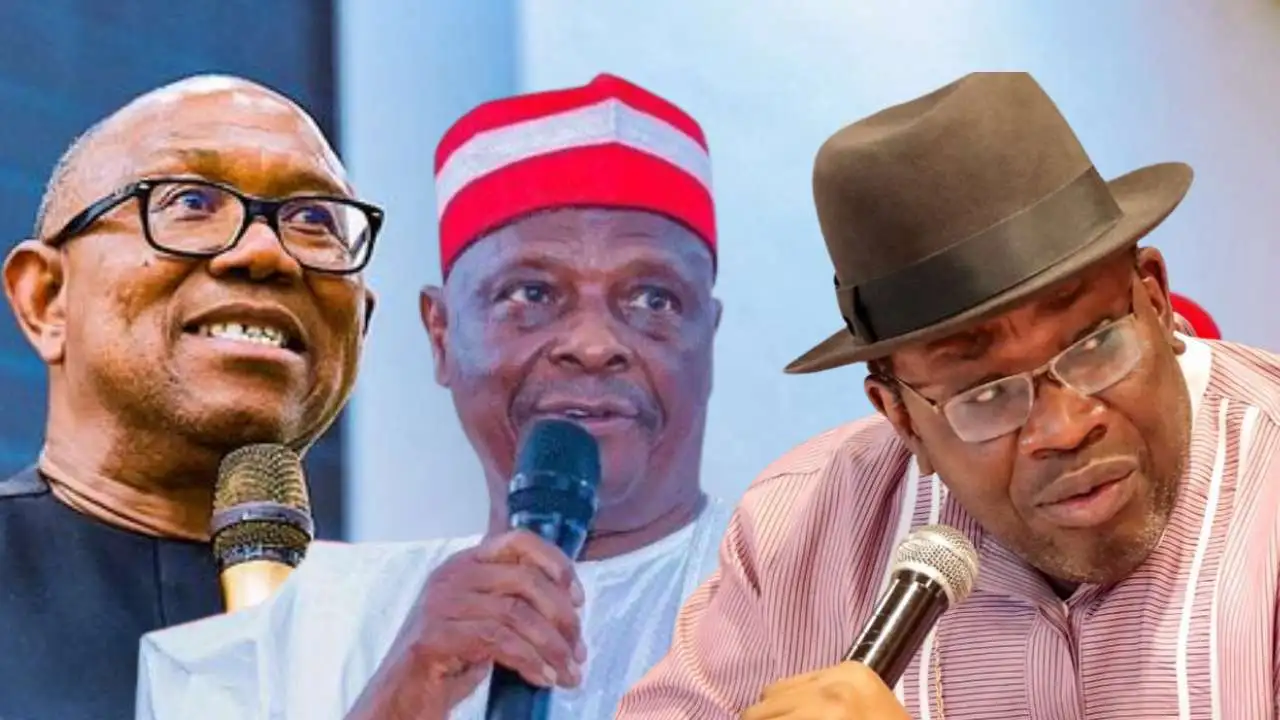

Nigeria’s political space is witnessing the rise of a new player that could reshape the battle for power in the 2027 general elections.
In the build-up to the polls, the Nigeria Democratic Congress (NDC) appears to be emerging as the “Third Force” in the nation’s political equation after the ruling All Progressives Congress (APC) and the African Democratic Congress (ADC), where political actors are seeking shade.
ADC had overshadowed the PDP, which is currently embroiled in a leadership crisis, following the exit of some of the latter’s top shots who moved to the former within months. Some of the defectors include former Vice President Atiku Abubakar, former Senate President David Mark and former Sokoto governor Aminu Tambuwal.
Former APC National Chairman, John Odigie-Oyegun and former Minister of Transportation, Rotimi Amaech, also moved from the APC to the ADC. There were also Nasir El-Rufai, senators like Ireti Kingibe (FCT), Enyinnaya Abaribe (Abia) and others who also fused into the ADC. Peter Obi, former Anambra State governor, and his Kano counterpart, Rabiu Kwankwaso, joined from the Labour Party and NNPP, respectively.
The LP, regarded as the “third force” in the 2023 election cycle, when Mr Obi and his “Obidients” joined it, has arguably shrunk in size and membership, no thanks to a debilitating leadership crisis, which tore it into two factions.

In the last few days, some political heavyweights have joined the NDC, one of Nigeria’s 22 political parties.
The NDC’s real breakthrough moment came on Sunday, 3 May, when Messrs Obi and Kwankwaso formally joined the hitherto little-known party.
Two days later, on Tuesday, 5 May, 17 members of the House of Representatives defected to the NDC. On the same day, two senators, Rufai Hanga and Victor Umeh, also joined the party, while the Senate Minority Whip, Tony Nwoye, followed suit the next day.
Many others may likely join to get slots in the next few weeks that INEC gave parties to hold primaries to produce their candidates for the 2027 polls.
But where is NDC coming from?

The man behind this new platform is a former governor of Bayelsa State and current senator representing Bayelsa West, Seriake Dickson.
Mr Dickson, who left the PDP in March, serves as the NDC’s national leader. His decision to quit one of Nigeria’s biggest parties raised eyebrows at the time, but it is now clear that it was part of a broader political calculation.
He is working with an interim leadership team led by Protem National Chairman Cleopas Zuwogeh. Other key officials include Ikenna Enekweizu (National Secretary), John Odey (National Treasurer), Mainasara Sani (National Financial Secretary) and Reuben Egwuaba (National Legal Adviser). Together, they are trying to build a party structure from the ground up in record time.
The NDC has an interesting origin story. Its emergence is tied to a mix of political ambition, legal drama, and growing dissatisfaction within existing opposition parties.
Although it was officially registered in February 2026, its journey began as far back as 2017 when its promoters first applied for registration. The process stalled for years until a court order compelled INEC to approve it.
The process stalled because INEC, under Chairman Mahmood Yakubu, halted the registration of new political parties at that time.
That court-backed registration has now sparked controversy. A group that pushed for the registration of the All Democratic Alliance (ADA) has challenged the process, claiming that the NDC did not follow the standard steps required for registration.
ADA leader Umar Ardo called the NDC a “ghost” party, claiming that when 171 groups applied for registration last year, the NDC wasn’t even among the 14 shortlisted by the commission.
“It is shocking that a political association that neither submitted an application nor appeared among the shortlisted 14 or final eight could suddenly emerge with a registration certificate,” Mr Ardo stated.
The NDC’s registration actually came about in a very unusual way. It was based on a court order from a legal application that had been sitting in the system since 2017. While the ADA feels like the NDC “jumped the queue,” the NDC insists its registration is legal and valid.
Mr Dickson has since dismissed ADA’s allegation as “misguided” and “sponsored propaganda.” He insisted that the NDC was part of the 171 associations that applied for INEC registrations.
“The truth about NDC is in the public domain: The application commenced in 2017, when Dr Ardo wasn’t even dreaming of registering a political party. The process stalled because INEC, under Dr Mahmood Yakubu, halted the registration of political parties,” he wrote.
The dispute is likely to end up in court and could have serious implications. If the courts uphold the registration, the NDC will gain stronger legitimacy. But if the challenge succeeds, it could create uncertainty for the party at a critical stage of its growth.
Regardless, what perhaps makes the NDC interesting is its philosophy. While some Nigerian parties have used the slogan “Power to the People” for decades, Mr Dickson and his team have introduced a slight but very important change. They chose the Victory Sign, the famous two-finger “V” gesture. For the party, the two fingers represent the two essential pillars of a great nation: the people and democracy. As Mr Dickson puts it, having power is fine, but using that power to actually serve is much better.
It also serves as a universal sign for peace, suggesting that the NDC wants to be a calm, stable alternative to the chaotic “warfare” often seen in other major parties.
With “Service to the People” as its motto, the NDC and its leaders are promising a party that focuses on fairness, respect for Nigeria’s different regions, and a truly independent judiciary and press. It is a pitch aimed directly at Nigerians who are tired of politicians who only care about winning and not about governing.
The new bride
But what makes the NDC story compelling is not just its formation, but the speed at which it is attracting powerful figures and positioning itself as a serious alternative to the APC and the PDP.
Messrs Obi and Kwankwaso, two of the nation’s political gladiators and former presidential candidates, are influential in different parts of the country and have strong followings, especially among young voters in the South and in the North.
Their move did not happen in isolation. It followed weeks of tension within the ADC, their former party.
They had been searching for a stable home after the ADC got tangled in messy legal battles.
The ADC had been seen as a possible platform for a united opposition. However, internal leadership disputes and legal battles weakened that plan.
The situation became more complicated after the Supreme Court gave the ADC temporary relief but sent its deeper leadership crisis back to the Federal High Court. This left many politicians unsure about the party’s future.
With the deadline set by the Independent National Electoral Commission (INEC) for submission of party membership registers fast approaching, the uncertainty became too risky to ignore.
It was in this atmosphere that Messrs Obi and Kwankwaso made their move. Before announcing their defection, both men held a private meeting with Mr Dickson and other NDC leaders at his residence in Abuja. That meeting, though closed to the public, now appears to have been a turning point.
The high-speed race to 2027
The NDC does not have the luxury of time. Because it was only officially registered in February 2026, its members have had to move at lightning speed.
Right now, they are in the middle of their first-ever nationwide meetings. They held ward meetings on 1 and 2 May, local government meetings on 4 May, and, afterwards, a national convention.
The rush is understandable. INEC has set a deadline of 10 May for all parties to submit their official list of members, and the party must meet the deadline. The NDC is working day and night to make sure that when that deadline hits, they have a list that includes some of the biggest names in the country.
Politically, the NDC is positioning itself as a home for those who feel left out or frustrated by existing parties. Mr Dickson has publicly invited politicians from across the country, including members of other opposition parties and even those in the APC who are unhappy with the current direction of things.
However, building a strong national party is not easy. The APC and PDP have spent years developing networks across all states, with deep financial resources and established political machinery. The NDC is trying to catch up in a much shorter time.
Its success will depend on several factors. It needs to attract more influential figures, build strong grassroots support and present clear policies that address the everyday problems Nigerians face, from the cost of living to insecurity.
What people say about NDC
The National Chairman of the APC, Nentawe Yilwatda, dismissed the notion of the NDC posing a threat, insisting that the ruling party remains unshaken despite the wave of defections and political realignments ahead of the 2027 general elections.
Mr Yilwatda said movements between opposition parties pose no threat to the APC, stressing that the ruling party remains united and politically stable.
“If someone defects from ADC to NDC, the NDC opposition party, how does that affect APC? It doesn’t. Let them sort out their problems. APC is still solid, still united, and we are moving forward with strong numbers,” he said.
He also argued that the growing number of aspirants purchasing and submitting APC expression of interest and nomination forms reflects the party’s popularity and acceptance among Nigerians.
According to him, the APC remains the most organised political platform in the country, with structures and logistics unmatched by rival parties.
“The party is too organised for what we are seeing. You can’t see this level of organisation, logistics, and preparation in any party in Nigeria. This can only be APC,” he stated.
The Director of the Centre for Human Rights and Accountability Network (CHRAN), Franklin Isong, told PREMIUM TIMES that the emergence of more political parties is healthy for Nigeria’s democracy because it creates more opportunities for citizens to participate in the political process and aspire to elective offices.
Mr Isong said the high cost of nomination forms in major parties such as the APC and PDP has made it difficult for many Nigerians to contest elections through those platforms.
“First of all, we are a political party democracy where one must belong to a political party to be able to aspire to occupy any elective office. And therefore, we encourage multiple parties. We encourage parties to come up for people to have the opportunity to aspire,” he said.
According to him, the monetisation of politics in dominant parties has narrowed participation to mostly wealthy politicians.
“If you look at what is happening today in the major parties like APC, you will see that the nomination form has been pegged at N100 million for the President and the rest of it. So people may not have enough funds to contest in the APC and PDP,” he added.
Mr Isong argued that the emergence of parties like the NDC would open up the political space and provide alternatives for politicians who feel excluded from existing platforms.
“People who intend to aspire for offices may not have the opportunity in APC, and so the same thing may happen to other parties, but when you have a plethora of political parties in the country, it gives options and opens up the political space,” he said.
READ ALSO: NDC has no court case threatening its registration Seriake Dickson
He also urged INEC to remain neutral and ensure equal opportunities for all political parties.
However, despite supporting the emergence of more political parties, Mr Isong dismissed suggestions that the NDC represents a fresh ideological movement, describing it as a gathering of familiar political actors who have moved across several parties over the years.
“I don’t think the party represents a great ideology. It’s a recycled political platform; it is just like people pouring old wine into a new bottle,” he said.
“For me, NDC is not a new party. It has no new ideology. All they have there are recycled politicians who want a platform to aspire,” he added.