
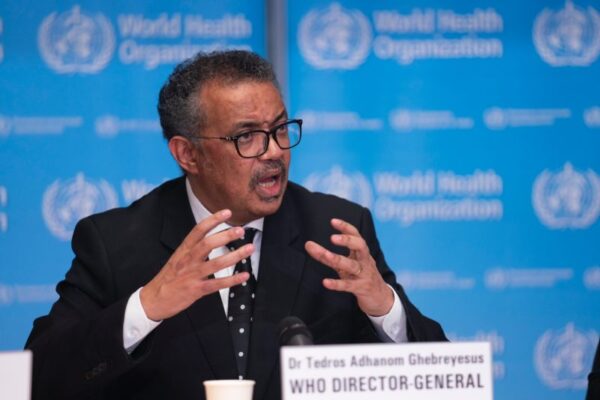

The Director-General of the World Health Organisation (WHO), Tedros Ghebreyesus, says the organisation has stabilised its finances and completed major restructuring following sudden funding cuts.
Mr Ghebreyesus said this on Monday at the 79th World Health Assembly in Geneva, noting that WHO is now projecting that 90 per cent of its base budget for 2026–2027 was funded.
“The reforms began nine years ago as part of the WHO transformation, the most ambitious agenda in the organisation’s history, anticipating future funding shocks,” he said.
He said the reforms helped WHO cushion the impact of recent financial constraints and maintain operations across priority areas.
The WHO chief also highlighted ongoing global health threats, including an Ebola outbreak in the Democratic Republic of the Congo that had spread to Uganda, and a hantavirus outbreak in Spain.

“Today, I want to address concerns about WHO’s future by telling you what we’ve done, what we’re doing, and what we will do to build a stable and resilient WHO,” he said.
He said the transformation focused on three key areas: core technical functions, emergency response, and financing, aimed at making WHO leaner, more effective and less dependent on earmarked donor funding.
According to him, reforms in science and norms have improved efficiency, including the creation of a Science Division in 2019 and the WHO Academy in Lyon in 2024.
He said the academy now offered more than 400 courses in 23 languages.
He also said WHO had strengthened global health data systems through the WHO Health Data Hub and an AI-enabled analytics backbone, alongside modernised standards such as ICD-11.
On emergency preparedness, Mr Ghebreyesus said WHO had established new mechanisms, including the Hub for Pandemic and Epidemic Intelligence in Berlin, the Pandemic Fund, and the WHO BioHub in Switzerland.
He added that Member States had also adopted reforms to the International Health Regulations and the WHO Pandemic Agreement to strengthen global health security.
On financing, he said WHO had shifted toward increasing assessed contributions from member states to reduce dependence on voluntary, earmarked funding.
“When founded in 1948, WHO relied entirely on assessed contributions,” he said.
“By 2017, these had fallen to 20 per cent of the base budget, while voluntary funding rose to 80 per cent.”
He said Member States had approved plans to raise assessed contributions to 50 per cent by 2031 to strengthen independence and resilience.
READ ALSO: WHO warns global preparedness failing amid rising pandemic threats
Mr Ghebreyesus said restructuring efforts in the past 16 months included programme prioritisation and workforce reductions, but noted that WHO was now in a stable position.
He urged Member States to honour funding commitments and approve further increases in assessed contributions scheduled for 2027, 2029 and 2031.
He also called for reforms to global health governance and endorsed efforts aimed at reducing donor dependency and promoting equity in global health systems.
(NAN)