
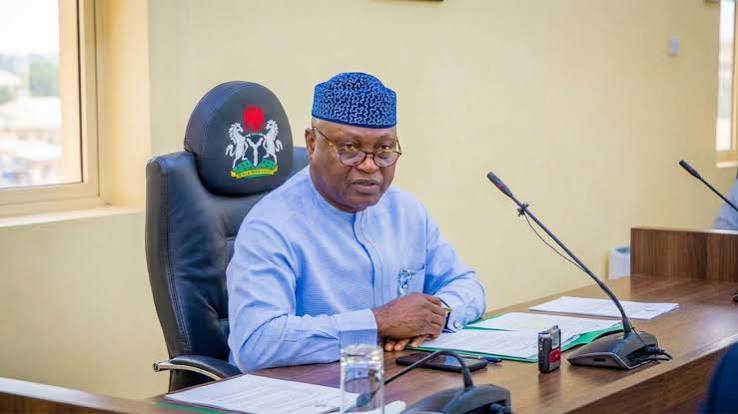


When Ekiti State Governor Biodun Oyebanji unveiled a six-point agenda titled “Roadmap to a Prosperous Ekiti” during his 2022 election campaign, residents aligned their hopes with the promises, expecting the government to address their basic needs and improve living standards.
The governor’s agenda focused on youth development and job creation; human capital development; agriculture and rural development; infrastructure and industrialisation; arts, culture, and tourism; and governance.
Since assuming office in October 2022, the Oyebanji-led administration has embarked on projects aimed at addressing the social and economic needs of residents, including the recruitment of Amotekun officers, renovation of the State Secretariat, and provision of broadband connectivity, among others.
In August 2024, Mr Oyebanji commissioned road projects in Ado-Ekiti as part of his administration’s infrastructure agenda, including the Hospitals Management Board-Doctors Quarters Road, Obisesan/Oke Ala Road, and Jimoh Aliu-Adewunmi Street.
By September 2025, the state government reported spending about N200 billion on road construction, with over 126 kilometres of roads completed and additional projects ongoing across the state.

Similarly, in 2025, health workers in Ekiti State commended the administration’s investments in healthcare infrastructure and service delivery.
The government also reported in early 2026 that it had revitalised primary healthcare centres and expanded access to healthcare services in communities across the state, offering free medical services to over 1,000 residents in June of the same year.
But have his overall performances over the past years matched the promises he made before the last election?
Ahead of the state’s governorship election on Saturday, PREMIUM TIMES spoke with residents about Mr Oyebanji’s performance against the expectations they had when he assumed office.
In separate interviews, many residents praised Mr Oyebanji’s administration for its infrastructural development, particularly road construction, and healthcare improvement, but expressed disappointment in other areas of governance since 2022.
Seun Folorunso, a mechatronics engineer, said the government recorded significant success in infrastructure, noting that many roads had been constructed and rehabilitated in recent years.
“There are many strategic projects, such as the airport, the Ekiti Ring Road, the Ekiti Business District, the Ekiti Knowledge Zone, and many more that have continued to receive attention. They all have long-term economic value,” Mr Folorunso said.
He also acknowledged the government’s investments in education, healthcare, agriculture, and rural development, noting that they had largely met his expectations.
Similarly, Samson Adeniyi, an entrepreneur, said the administration represented an improvement on previous governments, citing its contributions to road construction in the state capital.
“Now I live in Ado-Ekiti, the capital, and I have seen a number of infrastructure projects, especially roads, completed,” Mr Adeniyi said, adding, however, that the governor could have extended similar development efforts to other parts of the state.
Olowoyo Nafisat, a teacher, hailed the governor’s contributions to agriculture, rural development, and youth empowerment during the early years of his administration.
“Talking about his promises in Ekiti State, he has really tried because we now have better roads. There have also been positive changes in agriculture and rural development.
“I will rate him seven out of 10. He created empowerment opportunities for some youth, although I never benefited from them,” Ms Olowoyo said.
She, however, lamented what she described as inadequate security in the state, noting that insecurity had heightened residents’ fears in both urban and rural communities.
“Our expectations were mainly on security. I will rate him five per cent out of 100 in that area because there is no solid security in the state generally,” she said.
Ms Olowoyo, who also runs a natural drinks business, said living standards had not improved since the governor assumed office in October 2022, citing rising prices of goods and services.
“The standard of living in Ekiti is not good. His overall performance is three out of 10 because money does not circulate easily and things are not easy, yet the cost of living is high,” she added.
The educationalist also expressed dissatisfaction with the administration’s performance in job creation, especially for youths, which formed part of the governor’s campaign promises.
Meanwhile, in May 2026, the government said it distributed 1,000 laptops to youth to promote digital literacy in the state.
Agnes Akinola, a fashion designer, said unemployment remains one of the major challenges facing young people in Ekiti State, despite the government’s efforts in other sectors.
She noted that many youths continue to leave the state for larger cities in search of better opportunities because private-sector job creation has yet to reach a transformative level.
“Youth unemployment remains a concern. Many young people still migrate to larger cities in search of better opportunities. Private-sector job creation has not yet reached a transformative scale,” she said.
Ms Akinola, a resident of Oke-Ureje, called on the government to prioritise employment generation through both public and private-sector initiatives, while also sustaining salary and pension payments.
According to her, greater investment, improved infrastructure, stronger support for agriculture and public services, and better healthcare and education would help create jobs, stimulate economic growth, and improve residents’ welfare and living conditions.
Blessing Adepoju, a student of Afe Babalola University, Ado-Ekiti (ABUAD), acknowledged the administration’s achievements but questioned its prioritisation of some sectors over others.
The student lamented the poor condition of the road leading to the university, saying the governor should have included it among his infrastructure priorities.
“Our school road, Poly Road, is very bad. They said it has been under construction since May last year, yet it is still not completed. It may be a federal road, but it links the university, a polytechnic, and a hospital,” Ms Adepoju said.
She also complained about the erratic power supply in the area, describing it as another area that needed government intervention.
“They have been promising electricity to part of the student area, Aba, since last December. There is a transformer, but there is no power supply. They said the only thing delaying activation is the switch, but we have remained in the dark since then.
“This is a period when insecurity is rising across the country. Electricity should be available to make the environment safer and more secure. I expect the governor to focus on projects and amenities that make life easier and more convenient for students across the state.
“I have friends in other parts of the state, including FUOYE in Oye-Ekiti, EKSU in Ado-Ekiti, and BOUESTI in Ikere-Ekiti, and they all complain about similar challenges that make life difficult for students. We are the future, and he should look into these issues,” Ms Adepoju said.
Moyinoluwa Tawose, a hair stylist and student at the Federal University, Oye-Ekiti, commended the administration for improving road networks, upgrading schools and hospitals, and implementing youth-focused agricultural programmes.
However, Ms Tawose joined other residents in expressing concerns about unemployment.
“But jobs for youths are still difficult to find, and the cost of living remains high. He has delivered about 60-70 per cent of his promises and made some visible efforts.
“I expected steady leadership, better roads, real jobs through agriculture and infrastructure development, and continuity without unnecessary distractions. I expected him to quietly build on past achievements.”
She added that many residents had experienced little improvement in their living conditions due to inflation and unemployment.
Emmanuel Omotade, a welder residing in Oye-Ekiti, said the administration introduced youth empowerment, entrepreneurship, and agricultural employment programmes, but noted that they were insufficient to meet the employment needs of the state’s growing population.
“Investments have been made in education, healthcare facilities, teacher development, and primary healthcare revitalisation. Salary and pension payments have generally been more stable than in some previous periods.
“However, unemployment and underemployment remain major concerns, and many young people still migrate to larger cities in search of opportunities.
“Job creation, industrialisation, and significant economic transformation have not yet reached the level many residents expected. The state’s economy is still largely driven by civil service activities rather than private-sector growth,” Mr Omotade said.
On his part, Tolu Adebayo, a gamer and tech expert, raised concerns about rising insecurity in the state, noting that security challenges could overshadow the governor’s achievements in infrastructure development.
“Many promises on large-scale job creation and industrialisation are still lagging and have not been fulfilled. Security concerns and the slow impact of development in rural communities make the work appear only partly completed.
“I would give him a 50 to 55 per cent delivery rate. There have been visible gains, but not enough transformative change,” he said.
Mr Adebayo added that he looked forward to improvements in security and the provision of agricultural inputs to farmers.
“I wanted him to transform Ekiti quickly through agriculture, but the national economic situation made that difficult,” Mr Adebayo said.