
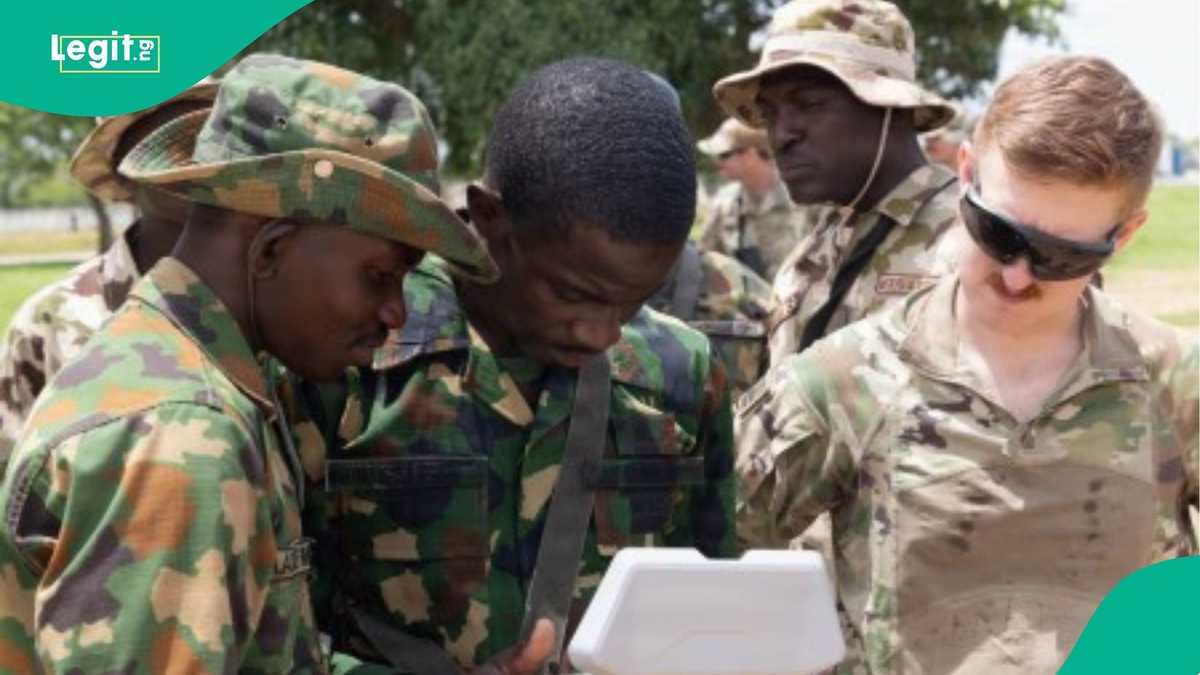

- US and Nigerian forces are running a joint training programme at Operating Location Bauchi covering drone operation, casualty care, and weapons handling
- Sgt. Mark Murphy of the 13th Combat Sustainment Support Battalion led about 10 Nigerian Air Force Special Forces members through hands-on drone training at the base
- US Army Capt. Gabriel Feingold said training topics are chosen by Nigerian forces from a list of available US expertise, not a fixed curriculum
US and Nigerian military personnel are conducting joint training exercises at Operating Location Bauchi in northern Nigeria, with sessions covering a wide range of skills from emergency medical care to unmanned aircraft systems (UAS).
The programme falls under a broader US-Nigeria security cooperation mission that includes combined training, advising, intelligence sharing, and professional exchanges.

Source: Twitter
Rather than following a set curriculum, training topics are drawn from available US expertise and areas that Nigerian partners flag as priorities.

US Army Capt. Gabriel Feingold, a logistics officer with the US Army Southern European Task Force, Africa, and the operations officer at OL Bauchi, said the process is straightforward: US units present a menu of training subjects, and Nigerian leadership picks what they find most useful.
“We bring them a list of several different training topics, and they select what they think would be most beneficial for them,” Feingold said.
Drone Training Draws Strong Interest
Among the subjects offered, unmanned aircraft systems generated the most enthusiasm from Nigerian counterparts. Sgt. Mark Murphy, an intelligence analyst with the 13th Combat Sustainment Support Battalion, led roughly ten members of the Nigerian Air Force Special Forces Regiment through a UAS session at the base.
The session opened with about 45 minutes of classroom instruction before moving to hands-on practice.
Murphy walked participants through how the system works, how US personnel have used it at OL Bauchi, and techniques for folding the collected data into actual operations.
“They were really excited with being able to get hands-on time with it,” Murphy said. “They were excited about doing more training with it in the future.”
For Murphy, the session also reinforced what he sees as a core duty of noncommissioned officers in the US Army.

“I love training Soldiers. I think it’s one of the main jobs of the NCO Corps within the Army, to train Soldiers and make them ready,” he said
He added that the basic principles of instruction apply regardless of the subject or who is in the room.
“It just goes back to the importance of teaching Soldiers fundamentals that can be applied to any kind of discipline,” Murphy said.
Beyond the Classroom
Other training conducted at Bauchi has included Combat Lifesaver and Tactical Combat Casualty Care courses, weapons familiarisation, camouflage, water treatment, explosive ordnance disposal, and small-unit tactics.
Feingold noted that the shared training has had a visible effect on day-to-day relations between US and Nigerian personnel. “It helps build relationships between Soldiers and the partner force, especially at the lower levels,” he said.
Murphy observed the same shift following the drone session. Nigerian participants who already worked alongside US service members at the base became noticeably more approachable afterwards. “Now it’s a lot easier to interact with them,” he said. “They come up, they say hi to me, they talk about the training that we did.”
US and Nigerian service members also regularly play basketball and volleyball together when conditions allow. Feingold said both the sport and the formal training sessions contribute to a working relationship that extends beyond individual duties. Additional training opportunities are being developed as both sides continue to identify areas for shared instruction.
Source: Legit.ng