
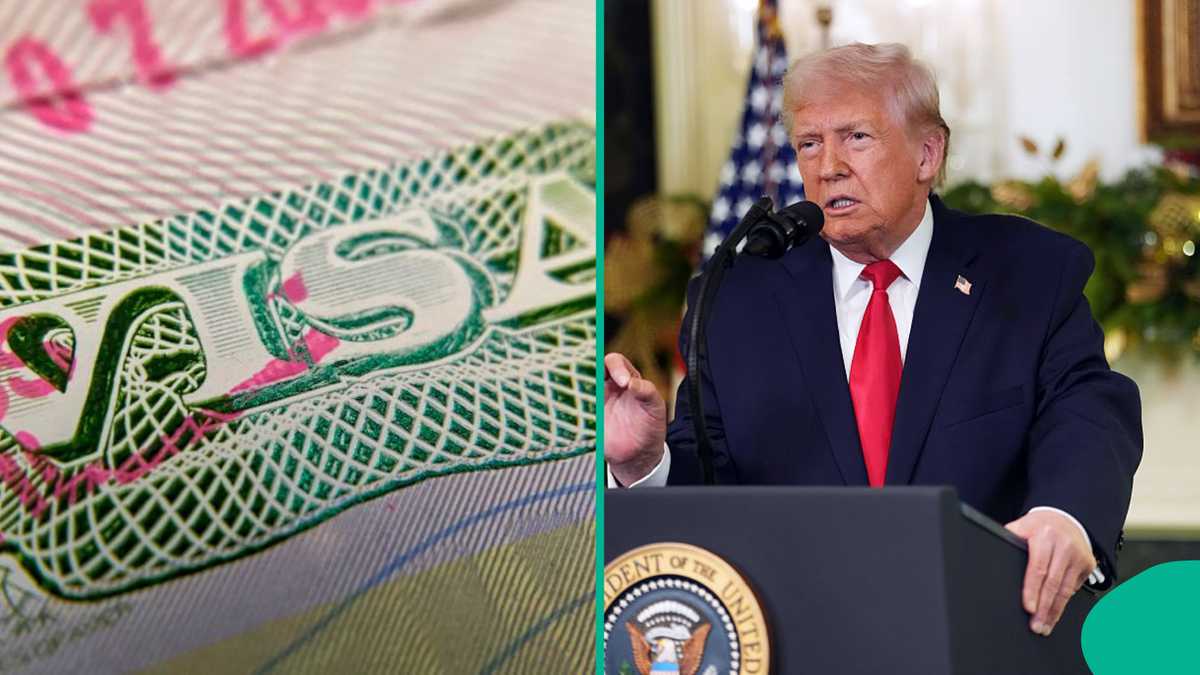

- President Donald Trump’s administration published a proposed rule in the Federal Register on Monday to permanently codify a $103,265 fee on new H-1B visas
- A federal judge already blocked the fee in June, ruling it illegal, while an appeals court and a separate court are still reviewing legal challenges
- The proposal opens a 30-day public comment period and could be finalised before the end of 2026
Legit.ng journalist Adekunle Dada has over 8 years of experience covering metro, government policy, and international issues
Washington DC, USA – President Donald Trump administration has moved to make its six-figure fee on H-1B visas a permanent fixture, publishing a proposed regulation in the Federal Register that sets the charge at $103,265 per new visa application.
The rule, posted online Monday, August 24, 2026, and due for formal publication on Tuesday, launches a 30-day public comment window. If the process moves quickly, a final rule could be in place before the end of the year.


Source: Facebook
As reported by Reuters, the fee originated in a presidential proclamation President Trump issued in 2024, which expires in September 2025, one year after it was signed.
That order directed the Department of Homeland Security to convert the measure into a lasting regulation, and Monday’s proposal fulfils that instruction.
Courts block the fee
The road to making the fee permanent is complicated by active litigation. A federal judge ruled in June that the original fee was illegal and barred the administration from collecting it.
A Boston-based appeals court is reviewing that ruling, while a separate court is examining a challenge brought by the US Chamber of Commerce, the country’s largest business lobbying group.
The Chamber, alongside Democratic-led states and a coalition of unions and employers, has argued that Trump’s authority to restrict the entry of foreign nationals does not extend to overriding the law that established the H-1B programme.

Critics also contend that only Congress can authorise the government to raise revenue through fees or taxes.
Trump administration has pushed back on both arguments, insisting the charge is not a conventional tax and that courts have limited authority to second-guess presidential decisions on border entry.
As of late February, roughly 70 employers had paid the fee on about 85 visa applications, according to court filings.
What is at stake for H-1B programme
The H-1B visa programme allows US employers to hire foreign nationals in specialist roles, with 65,000 places available each year and an additional 20,000 reserved for workers holding advanced degrees.
Visas are approved for periods of three to six years. Before Trump’s proclamation, fees on individual applications typically ranged from about $2,000 to $5,000, depending on a range of factors.
Supporters of the programme, including technology firms and research institutions, say it fills genuine gaps where qualified American workers are not available.
Trump and other critics argue that companies exploit the system to replace American employees with cheaper foreign labour.

Employer registrations for H-1B visas fell sharply last year to about 344,000, a drop of more than 25% compared to 2024 and less than half the 794,000 sought in 2023, according to data from US Citizenship and Immigration Services.
In a separate action, the Department of Homeland Security earlier in August also introduced fees of up to $4,500 on applications to extend the stay of existing H-1B workers or to transfer employees from overseas operations to the United States.
Any legal challenges currently in the courts could be broadened to include the newly proposed rule once it is finalised.
US judge strikes down Trump immigrant visa ban
Meanwhile, Legit.ng also reported that a federal judge in New York ruled against a Trump administration policy that suspended immigrant visa issuance for applicants from 75 countries.
Judge Jeannette Vargas said the policy was “patently unlawful” and went beyond the legal powers of Secretary of State Marco Rubio.
The suspension affected applicants from Africa, Latin America, the Middle East, South Asia, and the Caribbean, among other regions.
Source: Legit.ng