
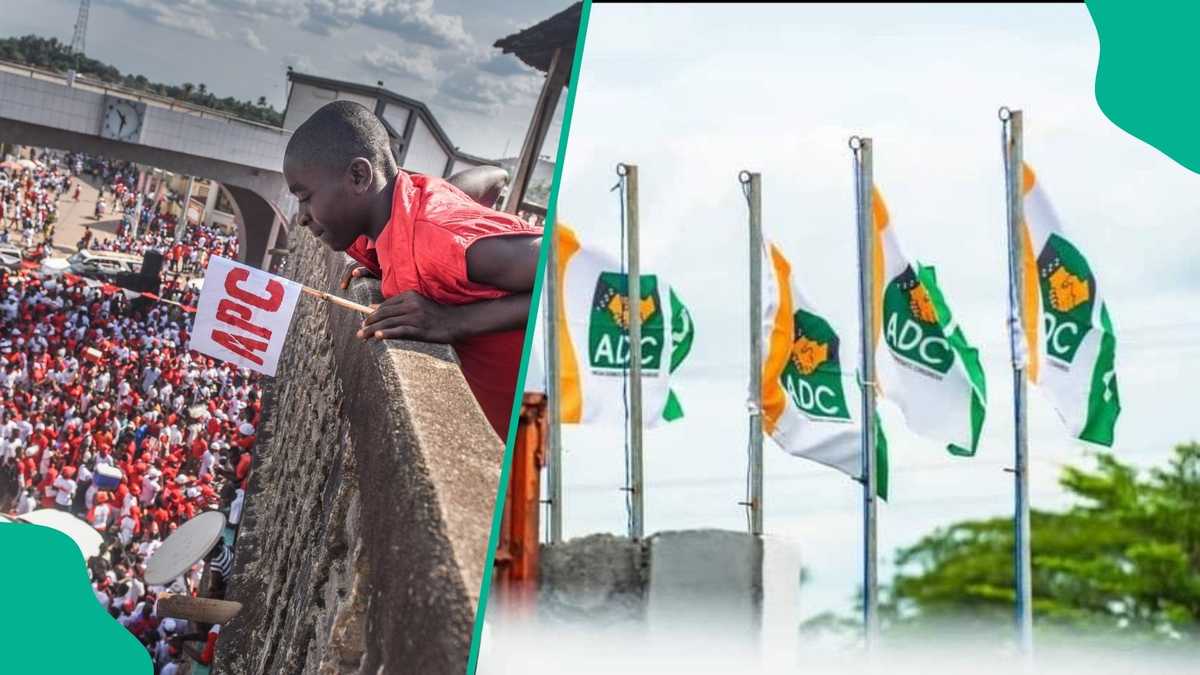

- ADC chieftain Kalu Kalu publicly challenged President Bola Tinubu to name the primary and secondary schools he attended
- APC member Alwan Hassan pushed back, arguing that the Constitution only requires a school certificate or its equivalent
- The public spat on Channels TV reignited a long-running debate over educational qualifications for elective office in Nigeria
A fresh political row over President Bola Tinubu’s educational background broke out on national television on Monday, drawing sharp exchanges between members of the ruling All Progressives Congress (APC) and the opposition African Democratic Congress (ADC).
The argument played out on Channels Television’s Politics Today programme, where ADC chieftain Kalu Kalu directly challenged Tinubu to publicly disclose the primary and secondary schools he attended, suggesting that Nigerians deserve clarity on the matter before the 2027 general elections.

Photo Credit: @OfficialAPCNg
Source: Twitter
APC defends Tinubu’s credentials
APC member Alwan Hassan mounted a defence of the President, pointing to the Nigerian Constitution as the reference point for what qualifications are required for anyone seeking elective office. According to Hassan, the Constitution does not demand a university degree or a specific set of school certificates beyond a basic threshold. He argued that the constitutional requirement is a “school certificate or its equivalent,” and went further to say that the equivalent of such a certificate is simply the ability to read and write.

Hassan’s interpretation drew a clear line between what the law demands and what opposition figures have been pressing for, framing the controversy as a political attack rather than a genuine legal concern.
A recurring question ahead of 2027
The television exchange reflects a broader pattern of political jousting over educational documentation that has followed Tinubu since before his election in 2023. Critics have repeatedly raised questions about the authenticity and completeness of his academic records, while his supporters argue that the issue has been resolved legally and that the focus should remain on governance.
With the 2027 election cycle drawing closer, the debate over constitutional requirements for office appears set to remain a flashpoint between the APC and opposition parties, including the ADC, which ratified Peter Obi as its presidential candidate in May 2026.
INEC publishes 2027 presidential candidates’ credentials
This is coming days after the Independent National Electoral Commission (INEC) made public the full list of all 19 presidential candidates and their running mates who will contest the 2027 general election, clearing the path for campaigns to begin on August 19.

INEC released the information on Saturday, August 1, displaying the candidates’ Form EC9 in line with Section 29(3) of the Electoral Act 2026, which requires the commission to publish candidates’ personal particulars after receiving their nomination forms.
The publication gives members of the public and eligible persons the legal right to examine the information submitted by each candidate and raise any concerns about the details contained in the forms.
Below is the video of the interview on YouTube here:
Atiku’s camp rejects Tinubu’s defence of INEC
Legit.ng earlier reported that ADC chieftain Kenneth Okonkwo criticised President Bola Tinubu for defending INEC over bias allegations, saying the electoral body had not earned public confidence.
Okonkwo, who speaks for Atiku Abubakar ahead of 2027, cited concerns over security and governance as reasons Tinubu may struggle to win re-election.
The ADC spokesperson also accused the ruling APC of attempting to weaken opposition parties and undermine Nigeria’s democratic process before 2027.
Source: Legit.ng