
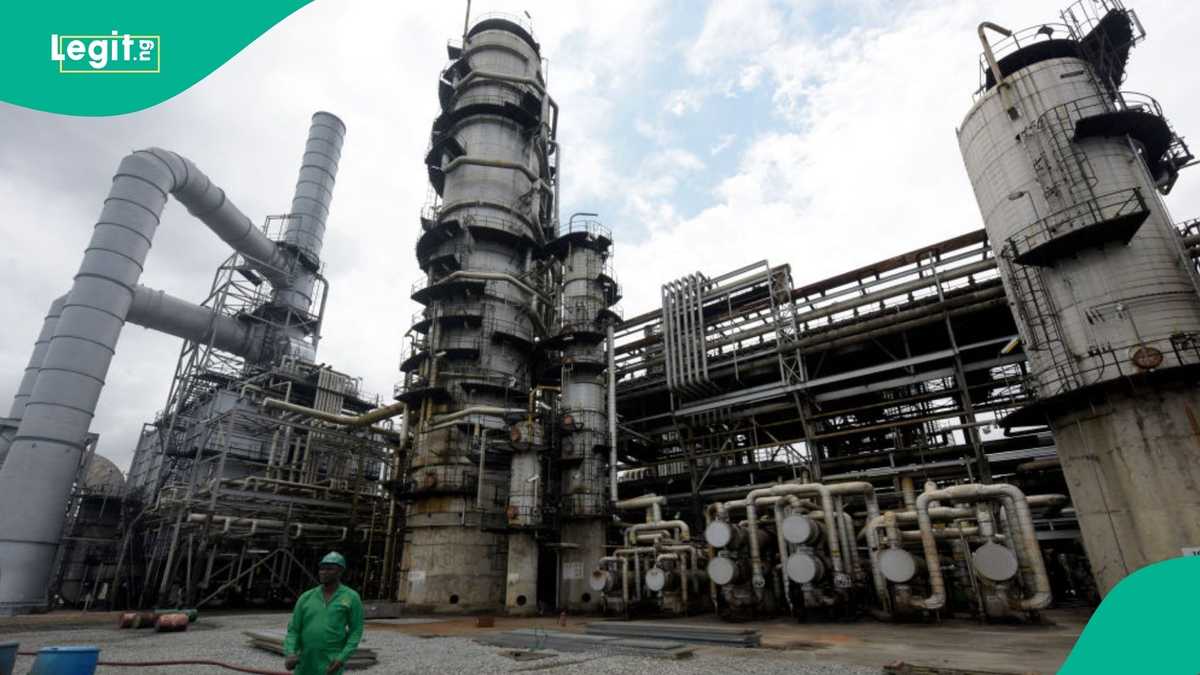

- President Tinubu pledges to revive Nigeria’s refineries for commercial viability and efficiency
- Tinubu assures detailed assessments will identify structural issues preventing refinery productivity
- NUPENG praises subsidy removal as a bold move towards redirecting savings into infrastructure projects
Pascal Oparada is a journalist with Legit.ng, covering technology, energy, stocks, investment, and the economy for over a decade.
President Bola Tinubu has assured Nigerians that the country’s refineries will be revived and repositioned to become commercially viable, insisting that simply getting the plants to operate is not enough.
The President committed on Thursday when he received the newly elected national executive of the Nigerian Union of Petroleum and Natural Gas Workers (NUPENG), led by its President, Comrade Salimon Akanni Oladiti, at the State House in Abuja.

Credit: State House
Source: Getty Images
According to a statement by Bayo Onanuga, Special Adviser to the President on Information and Strategy, Tinubu said the Federal Government would carry out detailed research and technical assessments of the refineries before implementing lasting solutions.

The assessments will examine the structural, operational, financial and managerial problems that have kept the facilities from delivering their full potential.
“The refineries that you mentioned are going to come back to work,” Tinubu said, stressing that the government was pursuing a broader structural reset of the refinery business.
‘Flame and smoke’ are not enough
Tinubu warned against measuring refinery performance simply by whether a plant is producing smoke or showing signs of activity.
He argued that a refinery should be judged by its ability to operate efficiently, generate value and remain financially sustainable.
The President also said he had inherited the assets and liabilities of previous administrations and accepted responsibility for addressing the problems surrounding the country’s refineries.
His comments come as Nigeria’s downstream oil sector continues to undergo significant changes following the removal of petrol subsidies and the expansion of private-sector refining capacity.
CNG programme gets fresh push

Beyond refining, Tinubu promised NUPENG greater involvement in the implementation of the Presidential Initiative on Compressed Natural Gas (CNG).
He urged the union to ensure that the programme delivers tangible benefits to ordinary Nigerians, particularly commuters seeking cheaper transportation alternatives.
The President also addressed local government autonomy, saying constitutional questions surrounding its implementation were being reviewed and could be fine-tuned.
NUPENG praises subsidy removal
NUPENG President Oladiti commended Tinubu for ending the petrol subsidy regime in 2023, describing the decision as courageous and necessary to stop what he called decades of financial drain.
He said the savings were being redirected towards infrastructure projects, including the Lagos-Calabar Coastal Highway and Sokoto-Badagry Superhighway.
During the meeting, NUPENG decorated Tinubu as its Grand Patron.

Credit: Novatis
Source: Getty Images
The President also paid tribute to late former NUPENG leader Frank Kokori, recalling their shared involvement in Nigeria’s pro-democracy struggle.
With the government promising to overhaul state-owned refineries while private investors expand refining capacity, Nigeria’s petrol market could be entering a new phase in which efficiency, profitability and domestic supply become the key measures of success.

Billionaire’s $1bn Refinery set to begin petrol production
Legit.ng earlier reported that Nigerian energy company Aradel Holdings Plc is targeting 2027 to begin producing petrol at its modular refinery in Rivers State, potentially adding another domestic source of fuel to Nigeria’s rapidly changing downstream market.
Temitayo Ogunbanjo, who oversees Aradel’s refining business, disclosed the plan on the sidelines of a conference in Abuja, saying the removal of petrol subsidies and deregulation of the downstream sector had created a clearer commercial path for local refiners to produce petrol.
Source: Legit.ng