
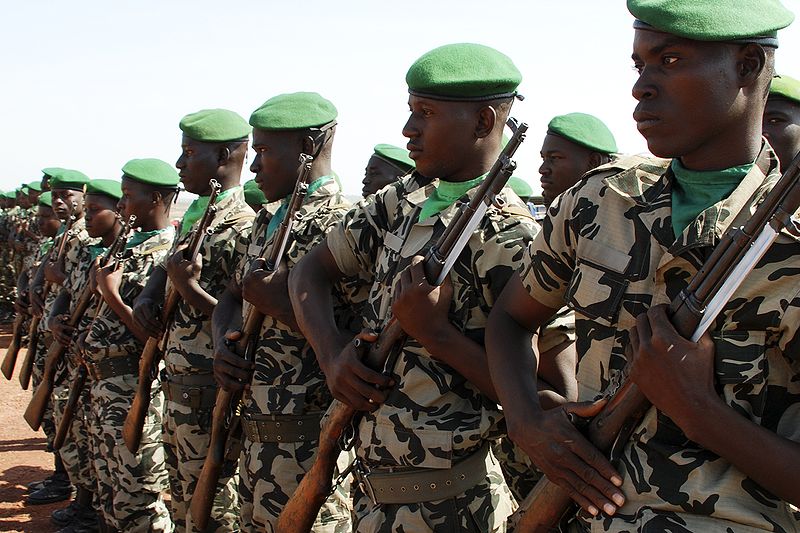

Dozens of weary Malian soldiers sat in rows under armed guard as separatist fighters filmed them in northern Mali following last month’s coordinated assaults across the country. Many of the soldiers were captured after the military position in Kidal was taken over by a joint force of separatists and jihadists.
In another footage, Al Jazeera’s Nicolas Haque reported that several captives identified themselves as members of the Malian army, police and paramilitary forces.
The situation gave the clearest signs yet of the scale of the security crisis confronting Mali’s military junta after simultaneous attacks by armed groups killed dozens of soldiers across the country.
According to the Al Jazeera report, around 130 Malian soldiers were being held by Tuareg separatist groups after Russian-backed Africa Corps fighters withdrew from key northern positions during the two-day offensives. Mr Haque said some of the detainees appeared injured and were being treated while held as “prisoners of war.”
PREMIUM TIMES reported that fighters of Jama’at Nusrat al-Islam wal-Muslimin (JNIM), an al-Qaeda affiliate, and the Tuareg-led Front de Libération de l’Azawad (FLA) launched coordinated assaults on military targets in Bamako, Kati, Gao, Sevare, Kidal and other strategic towns. The assaults began on 25 April and continued until the following day.

In one of the deadliest incidents, assailants attacked military facilities near Bamako, including the Kati military base, a heavily fortified installation that has historically served as the power centre of Mali’s military rulers. This newspaper reported that gunfire and explosions rocked the capital region as security forces struggled to contain the attacks, prompting fears that insurgents were attempting to penetrate Bamako itself.
The violence escalated further after Mali’s Defence Minister, Sadio Camara, was killed in a suicide bombing at his residence in Kati. The attack marked one of the most significant blows to Mali’s military establishment since the junta seized power in 2021.
Following Mr Camara’s death, transitional president Assimi Goita moved to personally assume the defence portfolio, according to reports. Also, authorities launched internal investigations into possible security breaches and alleged infiltration within the armed forces.
Jihadi analyst Philip Brant said the attacks reflected a rapidly expanding alliance between JNIM and Tuareg separatist forces. In a series of posts on X, Mr Brant quoted JNIM spokesperson Abu Hudheifah al-Bambari, also known as Bina Diarra, as announcing the start of a “total siege” on Bamako while warning civilians not to interfere between insurgents and the military.
Mr Brant also posted that the JNIM-FLA coalition seized the military base in Hombori in Mali’s Mopti region before later taking control of Tessalit in the north after negotiations reportedly led to the withdrawal of Malian troops and Russian Africa Corps fighters.
According to him, Africa Corps later conducted a resupply and evacuation mission in Hombori, including the extraction of wounded Malian soldiers, despite claims by insurgents that they had overrun the area.
The developments have intensified scrutiny of Russia’s growing military role in Mali following the expulsion of French forces and the collapse of relations between Bamako and Western allies. After Wagner Group operations were formally absorbed into Moscow’s Africa Corps structure, Russian personnel became central to Mali’s counterinsurgency campaign.
Following last month’s attacks, Africa Corps described the situation as an attempted coup allegedly backed by Western interests, accusing unnamed foreign actors of seeking to destabilise Mali’s military government.
Despite those claims, analysts say the coordinated attacks exposed major weaknesses in the junta’s security architecture and demonstrated the growing operational reach of insurgent groups across both northern and central Mali.
READ ALSO: Nigeria condemns killing of Malis defence minister
The humanitarian situation has also worsened. According to Al Jazeera, armed groups have imposed blockades on some major routes leading into Bamako and surrounding regions, disrupting food supplies and movement while deepening fears of further instability across the country.
The crisis now threatens to reverse years of military operations in northern Mali, where separatist rebellions, jihadist insurgencies and foreign military interventions have overlapped for more than a decade.