
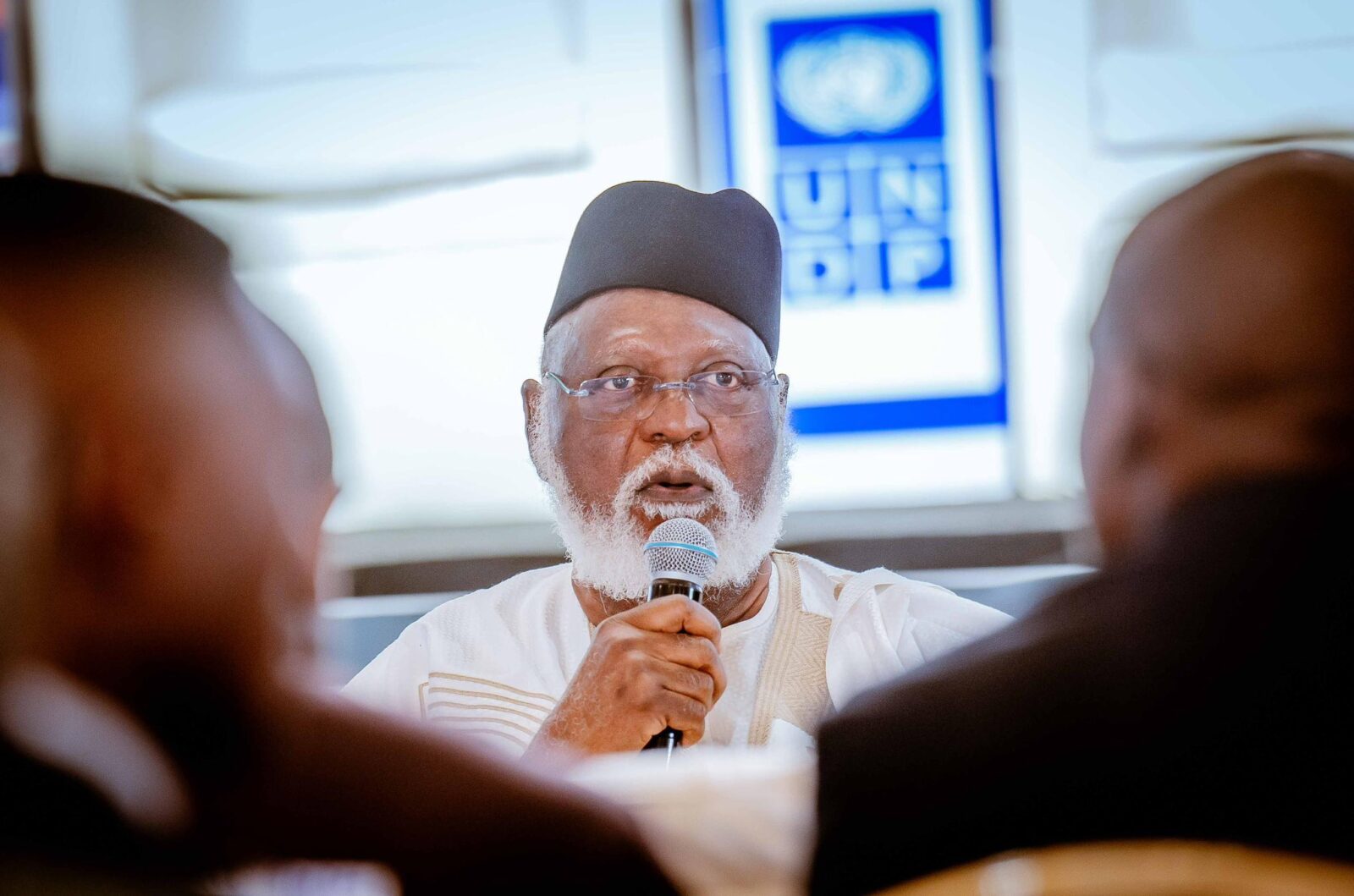


Former President Olusegun Obasanjo has identified four former military leaders whose actions, decisions and sacrifices, he said, were instrumental in shaping modern Nigeria, declaring that the country might not have survived in its present form without their contributions.
Mr Obasanjo spoke at the public presentation of three books and the 84th birthday celebration of former Head of State Abdulsalami Abubakar in Abuja on Saturday,
The books are ‘Call of Duty: An Autobiography of Gen. Abdulsalami Alhaji Abubakar,’ with a foreword by former military President, Ibrahim Babangida; ‘Nigeria’s Grand Patriot: Gen. Abdulsalami Alhaji Abubakar’; and ‘Mediating for Peace in Africa: A Festschrift in Honour of Gen. Abdulsalami Abubakar,’ reviewed by Ibrahim Gambari.
Mr Obasanjo singled out former Heads of State Yakubu Gowon, Murtala Mohammed and Abdulsalami Abubakar, as well as former military governor Adekunle Fajuyi, for what he described as their pivotal roles at critical moments in the nation’s history.
The former president, who described himself as both an eyewitness and direct participant in many of the events that defined Nigeria’s post-independence history, said the four military leaders were not perfect but made contributions without which Nigeria would be markedly different today.

“I would say four military leaders have made tremendous contributions to Nigeria of today, and without their contributions, we would not be where we are,” he said.
“They are not all perfect human beings. They all made mistakes, but they all made contributions without which we could not have been able to have Nigeria of today.”
Beginning with Mr Gowon, who led Nigeria during the civil war, Mr Obasanjo said the former military ruler’s mature handling of the post-1966 coup crisis helped preserve the country’s unity.
According to him, without Mr Gowon’s nationalistic approach to the political turmoil that followed the second military coup and culminated in the civil war, Nigeria’s history could have taken a dramatically different course.
He also paid tribute to former Head of State Murtala Mohammed, describing the late leader as a transformational figure who accelerated Nigeria’s return to democratic rule and elevated the country’s standing both domestically and internationally before his assassination in February 1976.
Mr Obasanjo further honoured the late Mr Fajuyi, a former military governor of the old Western Region, whom he described as a symbol of loyalty and courage.
Mr Fajuyi was killed alongside former military Head of State Johnson Aguiyi-Ironsi during the counter-coup of July 1966 after reportedly refusing to abandon his guest.
“Maybe more should be said about him in the future,” Mr Obasanjo remarked.
However, the former president reserved his most extensive remarks for Abdulsalam, whom he described as a patriot, nationalist, elder statesman and peacemaker whose leadership steered Nigeria through one of its most uncertain political transitions.
Abdulsalami became head of state in June 1998 following the sudden death of Sani Abacha. At the time, Nigeria was under intense domestic and international pressure over human rights abuses, political repression and the annulment of the 12 June 1993 presidential election, believed to have been won by Moshood Abiola.
Mr Obasanjo said Abdulsalami inherited a country engulfed in confusion and uncertainty but successfully navigated the transition that eventually led to the restoration of democratic rule in May 1999.
“You sagaciously managed the seeming confusion and uncertainty that followed Abacha’s death,” he said.
“You emerged from the clouds and carefully proceeded to untangle the nation politically.”
He recalled that one of Abdulsalami’s first actions was the release of political prisoners, including himself (Obasanjo), after years of detention under the Abacha regime.
The former president also recounted events surrounding efforts by the Abdulsalami Abubakar administration to secure the release of MKO Abiola, whose detention remained one of the most contentious issues in Nigeria’s political crisis of the 1990s.
According to Mr Obasanjo, Abdulsalami kept him informed about developments and regularly communicated messages intended for Mr Abiola’s family.
He revealed that Mr Abiola’s son, Kola, had already arrived in Abuja to receive his father before the unexpected occurred.
“I remember you telling me on the telephone, ‘Our man is dead,’” Mr Obasanjo recalled.
“‘Who is our man?’ was my question, and I screamed when you mentioned Abiola.”
Despite the shock of Mr Abiola’s death in detention in July 1998, Mr Obasanjo said Abdulsalami handled the aftermath with remarkable tact and restraint, preventing the country from sliding into deeper instability.
Sustaining democracy beyond 1999
Mr Obasanjo said Abdulsalami’s contribution to Nigeria’s democratic journey did not end with organising the transition programme that produced the Fourth Republic.
Rather, he argued, the former military leader played an important behind-the-scenes role in helping to stabilise the new civilian administration after power was handed over.
According to Mr Obasanjo, Abdulsalami maintained regular consultations with him after he became president in 1999, often arriving with written notes containing observations, concerns and suggestions on national issues.
“Not only did you initiate and ensure the restoration of democracy, but you sustained it,” Mr Obasanjo said.
“Can I forget how regularly you came with a piece of paper with all the points that you wanted to discuss with me about what was going on, about what should be done, about how you saw things?”
He added that those consultations helped strengthen democratic governance during the early years of the Fourth Republic.
Lessons in leadership and consultation
Reflecting on his own experience as military Head of State between 1976 and 1979, Mr Obasanjo said one of the most important lessons he learned was the value of seeking counsel from respected national figures.
READ ALSO: Why I admire Charly Boy – Obasanjo
He recounted how he frequently consulted prominent elder statesmen, including the late Sultan of Sokoto and Kashim Ibrahim, when confronted with difficult national decisions.
The former president cited several examples, including managing public concerns over the reduction of government support for pilgrims travelling to Mecca during the economic downturn of the late 1970s, securing acceptance for women’s participation in elections in Northern Nigeria, and calming opposition to the Land Use Act.
According to Mr Obasanjo, dialogue with respected traditional and community leaders often proved more effective than government coercion.
Background on Abdulsalami
Born on 13 June 1942 in Minna, Niger State, Abdulsalami served as Nigeria’s Head of State from June 1998 to May 1999.
His administration is widely remembered for overseeing one of the shortest but most consequential transitions in Nigeria’s history. Within 11 months of assuming office after Abacha’s death, he organised elections, facilitated the return to civilian rule and handed power to an elected government led by Mr Obasanjo on 29 May 1999.
Since leaving office, Abdulsalami has remained active in peacebuilding, conflict resolution and election observation efforts across Africa through various national and international initiatives.