
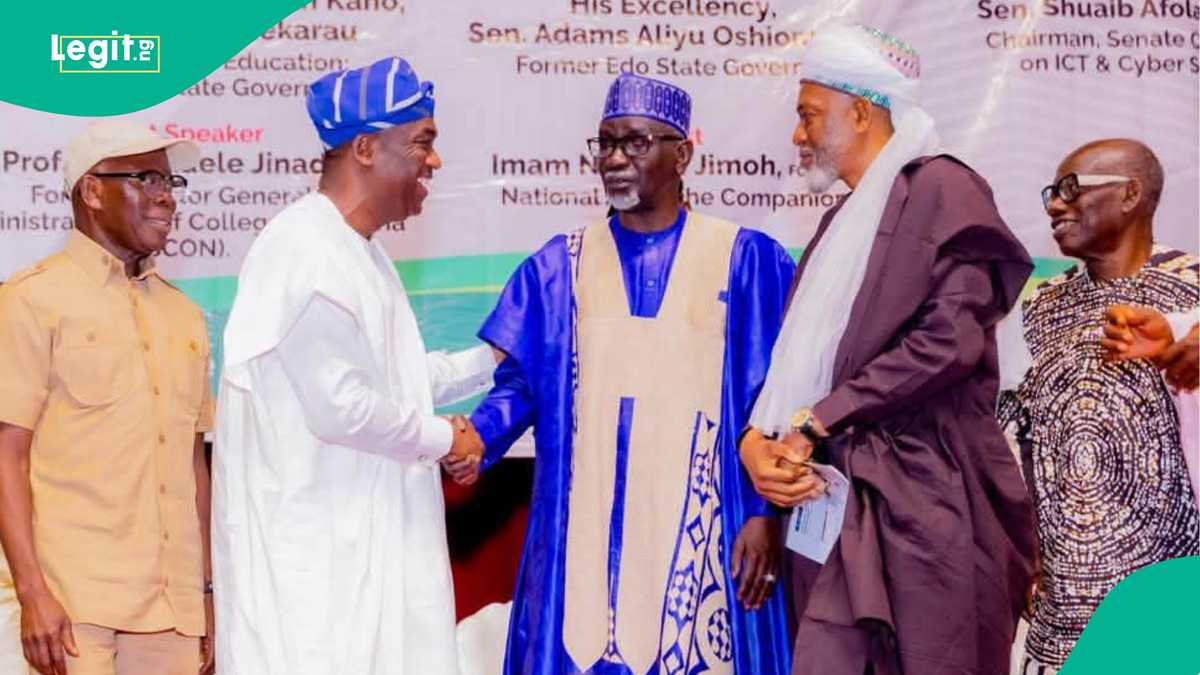

- Lagos Deputy Governor Obafemi Hamzat spoke at the 7th National Discourse of The Companion in Lagos, addressing Nigeria’s ethno-religious divides
- Former Edo governor Adams Oshiomhole warned that ethnicity has been weaponised by political elites as a substitute for ideas and accountability
- Former Kano governor Ibrahim Shekarau and Professor Liasu Jinadu also weighed in on how religion and ethnicity have shaped Nigeria’s democratic development
Legit.ng journalist Ridwan Adeola Yusuf has over nine years of experience covering politics, elections, public affairs, and governance in Nigeria and Africa.
Yaba, Lagos state – Lagos State Deputy Governor, Obafemi Hamzat, has urged Nigerians to build a national identity that rises above ethnic and religious differences, warning that allowing those divides to deepen poses a serious threat to the country’s unity.
Hamzat made the call on Sunday, August 23, at the 7th National Discourse of The Companion, an association of Muslim men in business and the professions, held at the University of Lagos main auditorium. The event, attended by Legit.ng, was themed ‘Nigeria’s Political Landscape and The Ethno-Religious Divides’.


Source: Original
Speaking as the Special Guest of Honour, Hamzat said both Islam and Christianity teach love and tolerance, and that religion should never be turned into a tool for discrimination. He said the challenge before Nigerians is not to erase their identities but to stop those identities from tearing the country apart.
“As Nigerians, we must learn to accommodate our differences while we are also promoting a common national identity. The experience of other multi-ethnic societies showed the dangers of allowing identity and class differences to fuel conflict among us,” he said.
Oshiomhole on ethnicity and leadership
Former Edo State Governor and Senator representing Edo North, Adams Oshiomhole, also addressed the gathering, calling on Nigerians, particularly young people, to stop allowing religion and ethnicity to define political choices. He argued that leadership should be judged by competence, values and ideas, not by where a person was born or what faith they practise.

The National Assembly member described the use of ethnicity in political mobilisation as deeply harmful, saying it shields leaders from accountability while doing nothing to improve lives.
“Our ethnicity shouldn’t be a source of challenge. It should give us all of the things that we need to be the greatest country, not only in Africa but in the world. Ethnicity has very little or no role to play, except to function as a tool in the hands of a segment of the political elite who substitute ethnicity in place of ideas,” he said on the sidelines of the event while speaking to Legit.ng.
Religion, history and the path forward
Former Kano State Governor and ex-Minister of Education, Mallam Ibrahim Shekarau, who chaired the occasion, called on Nigerians to deepen their understanding of their faiths, noting that all major religions promote love, justice and respect. He said there is no justification for conflict driven by religion in a country where all citizens, regardless of faith, share a common humanity.

Source: Original
The keynote lecture was delivered by former Director-General of the Administrative Staff College of Nigeria, Prof. Liasu Adele Jinadu, who traced the roots of Nigeria’s ethno-religious tensions to the colonial era. He argued that political elites have long exploited ethnic identities to build patronage networks and weaken state institutions, and called for a system that places citizenship and human development above ethnic interest.

National Amir of The Companion, Imam Nojeem Jimoh, said the discourse was convened partly to mark the 60th anniversary of Nigeria’s first military coup in 2026, an event he described as an experience carrying deep ethnic and tribal undertones from which the country has never fully recovered.
Check out the post on X showing attendees at the 2026 National Discourse below:
Read more Lagos news
Gumi’s ‘fatwa’ on clerics joining politics
Earlier, Legit.ng reported that Sheikh Ahmad Gumi came down firmly on one side of a growing debate among Nigerian Muslims, saying there is nothing wrong with religious scholars entering partisan politics.
Gumi argued that clerics who choose to engage directly with governance are doing more than those who confine themselves to offering prayers for politicians.
Source: Legit.ng