
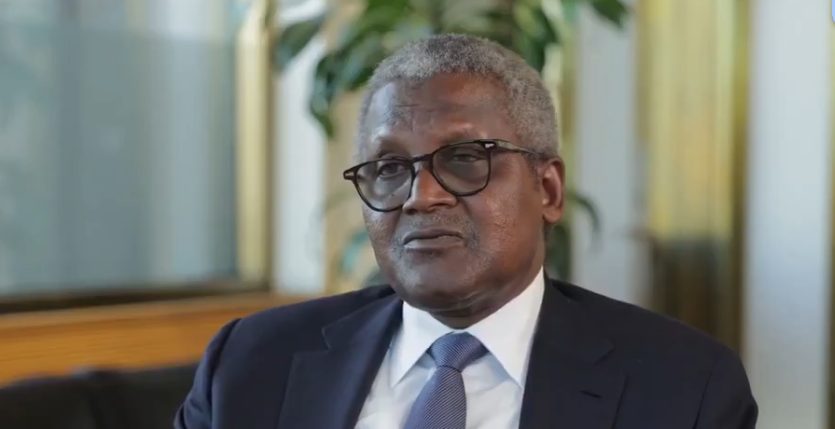

Africa’s richest man, Aliko Dangote, has once again revealed how the enormous scale of his $20 billion refinery project in Lagos forced him to abandon plans to buy English Premier League giants Arsenal.
Dangote made the disclosure during a podcast conversation with Nicolai Tangen, which was released on YouTube.
The billionaire businessman explained that he had seriously considered a takeover of the North London club at a time when Arsenal’s valuation stood around $2 billion. However, he ultimately decided that committing such a huge amount to football ownership could jeopardise the completion of his massive industrial projects, including the Dangote Refinery, fertiliser plant and petrochemical ventures.
“When I was really very focused on buying Arsenal, then I was also facing the challenge of making sure the refinery gets its own completion, the fertilizer, the petrochemical,” Mr Dangote said.
“At that time, Arsenal was worth just about $2 billion. Should I put my $2 billion in Arsenal and now allow the business to suffer? Or should I complete the business? Then I can continue to remain a very big supporter of Arsenal.”

The 69-year-old added that he eventually chose to remain a loyal supporter rather than pursue ownership of the Premier League club.
“So I decided to continue to support them, watch their games. Any time Arsenal plays, I always wear the jersey signed for me by the captain. I am a fan, it is better I remain a fan and continue to fund my business,” he added.
Dangote’s longstanding Arsenal dream
Mr Dangote’s admiration for Arsenal has been public knowledge for more than a decade.
Back in 2015, he told BBC Africa Sport that he intended to launch a takeover bid for the club once his refinery project began generating sufficient returns. At the time, the Nigerian billionaire was regularly linked with potential investment in European football, with Arsenal emerging as his preferred destination.
Five years later, during an interview with American financier David Rubenstein in 2020, Mr Dangote again confirmed his interest in the Gunners.
“It is a team that yes I would like to buy some day,” he said at the time.
“I’m not buying Arsenal right now, I’m buying Arsenal when I finish all my projects at hand (including the refinery under construction) then.”
However, Arsenal’s value has risen dramatically since then following renewed sporting and commercial growth under manager Mikel Arteta. The club are now estimated to be worth several billions more than when Mr Dangote first explored the possibility of a takeover.
Link to the interview on YouTube
Refinery project changed everything
Mr Dangote’s decision highlights the sheer magnitude of the refinery project, widely regarded as one of the largest single private investments in Africa’s history.
Located in Lagos, the Dangote Refinery was designed to reduce Nigeria’s dependence on imported petroleum products and strengthen industrial capacity across the continent. Alongside the refinery, Mr Dangote was simultaneously developing major fertiliser and petrochemical operations, projects that required enormous financial commitment and long-term focus.
The billionaire admitted that prioritising those businesses over football ownership became the only realistic option.
Despite stepping away from takeover ambitions, Mr Dangote remains deeply attached to Arsenal and continues to follow the club closely as a passionate supporter.
READ ALSO: How oil mafia fought hard to stop my refinery — Aliko Dangote
Message to young Africans
Beyond football and business, Mr Dangote also used the interview to encourage young Africans to believe in opportunities within the continent.
“My own advice to young African people is to work hard and also have the belief that the future is greater than the current situation that we’re in,” he said.
“Africa is a promising land and they should stay at home.”
His comments come at a time when many young Africans continue to seek opportunities abroad amid economic uncertainty across several countries on the continent.
For Mr Dangote, however, the refinery project stands as proof that long-term investment and belief in Africa can still produce transformational results, even if it meant sacrificing a dream of owning one of world football’s biggest clubs.