
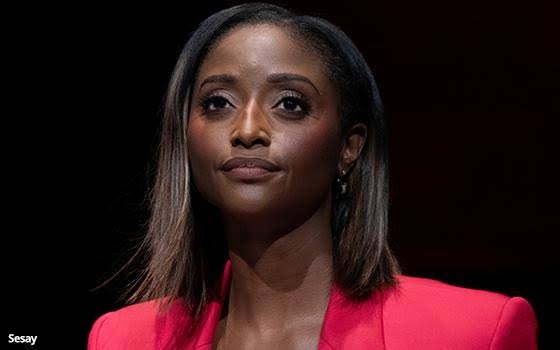


Award-winning British-Sierra Leonean journalist and former CNN International anchor Isha Sesay has spoken about her decision to become a single mother through in vitro fertilisation (IVF), revealing that years of career dedication, personal heartbreak and her mother’s prolonged illness shaped one of the biggest decisions of her life.
PREMIUM TIMES reported in 2022 that she publicly documented the emotional and physical challenges of fertility treatment, revealing that she underwent multiple IVF cycles, hormone injections, fibroid surgery and the difficult process of selecting a sperm donor.
Speaking with Larry Madowo on African Voices, Ms Sesay explained that although motherhood had always been part of her life plan, her successful journalism career gradually took precedence.
Asked why she decided to undergo IVF at the age of 46, the London-born Journalist admitted that the desire to have children had never disappeared.
“You know, candidly, I had wanted to have a baby. It was always on the list of things that I was going to do. And then I got to CNN. And it just became about the work,” she said.


Mother’s Illness
Reflecting on the turning point, she added that her mother’s devastating stroke forced her to reassess what truly mattered.
“It was when my mom took ill, and mortality and the finality of life smacked you in the face that you think, ‘What is it all for?’” The media executive said.
After years of waiting for the “right time” and later realising her biological clock was running out, Ms Sesay said she chose to pursue motherhood independently.
“I was like, ‘Give me that website, let me find a donor. Let me do this on my own.’”
The veteran broadcaster also addressed the intense public reaction that followed her announcement, saying she was surprised by how emotionally invested strangers became in her personal decision.
“I’m amazed by the depth of feeling people have about this decision. People who don’t know me, people I’ve never met. It’s really polarising for some people and really difficult for some people that I would choose to have a baby on my own.”
She rejected suggestions that her decision represented a rejection of men.
“Some people take it as though I did it as an affront or a rejection of men. It’s not a rejection of anyone. It is an embrace of my own autonomy.”
Leaving CNN
Ms Sesay also revealed that caring for her mother, renowned Sierra Leonean academic and politician Kadi Sesay, ultimately influenced her decision to leave CNN after 13 years with the global broadcaster.
“People always ask me, ‘Why did you leave CNN?’ I left because my mom had a stroke, and I was in a position where, effectively, business decisions were being made that did not align with my responsibilities to care for her.”
She stressed that her departure was amicable, “I decided to walk away. No hard feelings. I have tremendous love and respect for the decision-makers at the time.”
Her mother suffered a catastrophic stroke in December 2016 and remained in a semi-conscious state for several years before dying in June 2025.
Recalling the emotional journey, Ms Sesay said grieving had been a long and complicated process.
“I lost her last year in June. I’m still navigating the loss of my mother. She had a catastrophic stroke on December 1, 2016, and basically was in what you’d call a semi-vegetative state until we lost her last year. Nine years later.”
She continued, “In some ways, she was not present. Not gone, but not present. Then she passed on, and now she’s not physically here. It’s a very strange experience because it’s been grieving for nine years.”
Ms Sesay’s path to motherhood followed the breakdown of her marriage to fellow CNN journalist Leif Coorlim and a later relationship that she said was marked by “red flags”.
Rather than continue waiting for a partner, she chose to undergo IVF using donor sperm.
IVF Journey
Her journey, however, was far from straightforward.
After her first failed IVF attempt, she said she “cried for days”, while two unsuccessful embryo transfers left her approaching the third with “relatively low expectations”.
“If you’d told the 16-year-old me that at 46, I’d be divorced, single and having a baby on my own, by choice! I’d have shuddered and firmly said, “No!”
“Back then, I had very definite ideas about the future course my personal life would take, and it didn’t look like this. I imagined something way more straightforward and, dare I say it, conventional”.
“It was then, in the aftermath of our inevitable breakup, that it hit me. Not having a child would be the greatest regret of my life. And with my biological clock ticking down, if I was waiting for the right man to come along before I did it, well, I might find myself out of time.
READ ALSO: Beyond the Wound: Nigerian women bearing the weight of infertility stigma
“But with each passing day, I grew more fearful and anxious about my chances of being able to carry a child successfully. Those feelings only intensified when my doctor decided to halt my second attempt mid-cycle because my body was responding negatively to the medication.
“With two failed attempts to my name, I approached my third embryo transfer with relatively low expectations. In the two weeks that followed the procedure, my mind raced uncontrollably, and I battled the urge to take an early pregnancy test,” she said.
The journalist revealed her perseverance paid off when she welcomed her daughter in 2024.
The award-winning British journalist is best known for her 13-year career as an anchor and correspondent with CNN International. She reported on major global events and gained international recognition for her coverage of the 2014 abduction of the Chibok schoolgirls in Nigeria.
She later chronicled the story in her book Beneath the Tamarind Tree (2019). Today, she serves as the CEO of Areya Media.