
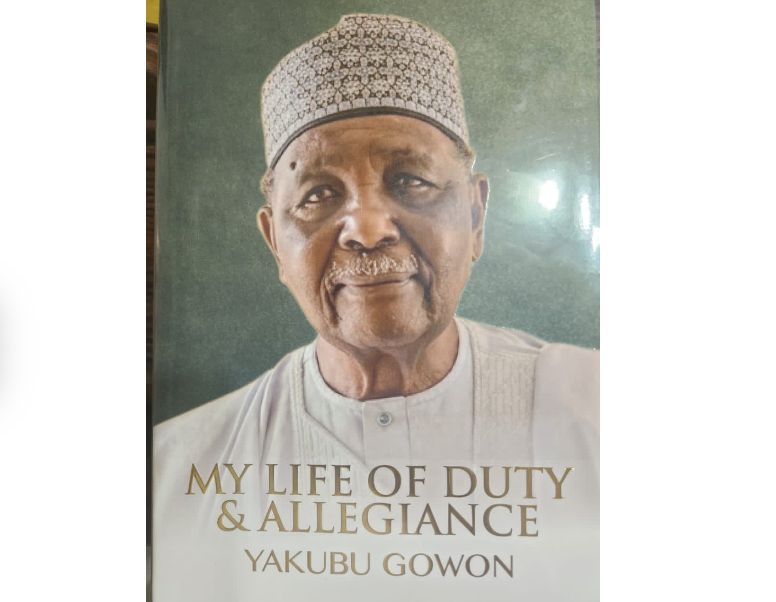

I consider being asked to review this monumental book a great honour which I do not take lightly. The size of the book may look intimidating, at over 800 pages but believe me when I say that when you start reading it, you will not like to put it down. It is a personal story told with sincerity and deep passion. For a man who has come through the furnace of so much suffering and pain, one would expect that the book will be the account of a man who has been a victim of treachery, backstabbing, perfidy, intrigues, bitterness, anger, deception, betrayal. So, one would expect the pages of the book to be dripping with the vituperations of a broken soul.
The reader will be right to expect that this book will be the biography to end all biographies and accounts of Nigeria’s chequered history through three coups and a civil war. If you are expecting any revelations from declassified documents, private papers and notes, the reader might be disappointed. The reasons is that, from the beginning, the author confesses that: I want to emphasise that I am telling my story without access to my crucial personal records since many important documents taken from my desk after my removal in July 1975 were discarded by those who succeeded me. Other documents that survived were destroyed by two fire incidents in Bakori and Kaduna(xxi). Yet, none of this diminishes the book which obviously was written straight from whatever he could remember.
Reviewing any biography is a real challenge for many reasons. Any reviewer of an autobiography must be careful because the reviewer can easily be told off by the author who might say, this is what I wanted to say as I saw and experienced it. If you disagree with me, go and write your own text. However, biographies of persons of the calibre of a former Head of State will naturally command attention because what they did or did not do, what they said or did not say, may have altered lives and careers.
The book is made up of 36 chapters covering 850 pages. The real text ends on page 735 while the other pages contain Notes, Appendices and an Index. Chapters 1 through to 8 cover various themes from the author’s birth in Wusasa, his early days through school to the beginning of his military career. Chapter 9 starts with Aburi and its challenges and from 10 to 23, we have diverse accounts covering different phases of the crises from the civil war through to its end. Chapter 23 opens with the controversial declaration that 1976 was no longer a realistic date for the military to hand over power. Many would argue that perhaps this was the decision that created the conditions for the coup of 1975. Chapters 24-33 carry a thematic potpourri covering the founding of ECOWAS, the years of near homelessness, the story behind Abuja all the way through to Bakassi. Chapter 34 renders an account of how the author fell victim to the Babangida pie of Option A4 leading to people wondering what the General had forgotten in State House. Chapters 35 restates the author’s passionate commitment to a nation he had pledged to serve with all his strength. Finally, chapter 36, titled, Moving Nigeria Forward closes with the two slogans: To keep Nigeria one is a task that must be done and Go on with One Nigeria.
The sheer size of the book suggests that one has to adopt a different strategy for its review. As such, I have decided to review the book against five key themes as follows: 1: Gowon and Three Coups, 2: Gowon: Times of Trials and Tribulations. 3: Gowon: Truth and Redemption, 4: Victoria Gowon: Wife, Shield, Diplomat and Chief Security Officer, 5: Nigeria: Who Next, What Next?

1: Gowon and the Three coups:
The book opens with the author’s brief biography and much of what is here is already known to most readers and those who know the subject. He opens with a warning which says: I have tried to tell my story as truthfully as I know how and see it and without any intention of claiming the glory for every achievement or heaping blames on other people for perceived failures….I made a conscious decision not to open new wounds but to clarify my thinking on policies and plans at a period too often narrated by others (pxx). Notwithstanding, most readers might be quick to say that perhaps had these old wounds been opened, some form of healing might have occurred in our country. Acknowledging the existence of the wound, no matter its age of state of decomposition is still important for healing or amputation.

The circumstances of the author’s emergence as the Head of State are already well known to the average reader. However, the author offers the reader a rare pip into many controversial activities and circumstances that have been addressed by previous writers with differing emphasis. The major strength of a Gowon biography is that it should be definitive, provide some finality to innuendos and speculations, end disputation and interpretation, remove hagiography, separate the chaff from the grain and closure if possible, bring us closer to what one might refer to as the truth. Yet, as we know, history has no finishing lines. Yet, since no one writes a perfect book, this work will serve as a major landmark in our history.
For example, one area of controversy that is addressed for the first time is the professional relationship between Gowon and Ojukwu over the issue of seniority. I recall that Ojukwu had often made the case of his seniority. However, the author answers this question by presenting us the facts. While his military number was N20, Ojukwu’s was N29! Whereas the author started Cadet training in Ghana in 1954, he was commissioned in 1956! The author goes on to state that Ojukwu was commissioned in 1958. He was later given a three-year seniority because of his university degree! (p245). On April 1, 1963, both men received their first senior postings, Gowon as Adjutant General and Ojukwu as Quarter Master General.
According to the author, after the announcement of their new positions, Ojukwu suggested that they should both trade places! Naturally, the author refused. This little detail is helpful for historians.
The author experienced three coups. The intrigues around each of the three coups have been discussed, written about and that will continue for a while. For example, in popular public memory, the first coup of 1966 has always been tagged an Igbo coup. The second coup has been tagged a revenge coup which the northern military officers embarked on to avenge the killings of their leaders and the apparent non prosecution of the culprits of the 1966 coup. This revenge coup, sadly, claimed the life of the then Head of State, General Aguyi Ironsi and others. Then there was the third coup which ended both his military career and tenure as Head of State. The Dimka coup became a petard hung around his neck. It would mark a defining moment in his life and relationship with his country and his former colleagues.
These coups and others that followed constitute one of the most controversial phases of Nigeria’s tortured and beleaguered history. Taken together, their cumulative impact has posed the greatest threat to national integration, development and cohesion. A review of the literature of the intrigues, calculation, plots and execution of these coups is subject for another day. However, whereas the author opened the book with the intrigues and plots of the coup that overthrew him, the story of the first coup of January 15th is told in chapter 6 titled: “A Bloody Weekend to Remember”.
Attempts at explaining these coups have left Nigeria with more questions than answers. However, this book puts some form of closure to the speculation and popular myths. What I think is left now is for scholars of Nigerian history to take the search for answers into the classrooms and seminar halls of students of Nigerian history and diplomacy. Yet, in all, there are still what the late US Defence Secretary Donald Rumsfeld would have referred to as known unknowns.
On July 31, 1966, the author took the reins of office. It was on this date that he delivered what would turn out to be the most controversial speech of his tenure, parts of which were fraught with grammatical distortions. Against the backdrop of the tensions and anxieties, the author said in parts of the speech: Suffice it to say that putting all considerations to test-political, economic as well as social, the base for unity is not there, or is so badly rocked, not only once but several times. I therefore feel that we should review the issue of our national standing and see if we can stop the country for drifting away into utter destruction (p218). This is the speech that provided Ojukwu the ammunition for the Aburi debacle.
Amidst the struggle to ensure there was no war, the next important phase of events was the famous Aburi meeting in Ghana. There is no need to wade into the maze of Aburi. What one can say is that with hindsight, both author and Ojukwu went into the meeting with two different motives and had conflicting expectations of outcomes of the meeting. According to the author, the idea of Aburi was to have an exploratory event meant to break the ice, remove the veil of suspicion and engender trust among the key actors, a sort of gentleman’s agreement (p240). Ojukwu on other hand came fully prepared to extract a concession, namely, a return to a loose federation that would more or less take us back to where we were. While the author travelled without his key technocrats to Aburi, Ojukwu was surrounded by some of the best brains whom he had persuaded to return home. Thus, when Ojukwu said “On Aburi we Stand”, he knew what he was saying and why. The rest is history and it is hoped that Nigerian scholars will continue to dig and dig, not for whom to blame but for what lessons to learn in diplomacy, negotiations and outcomes.
Fast forward to the 1975 coup which opens the book. The story here is quite remarkable because it shows the author as a man of faith who happened to be a soldier, not a soldier who simply had faith. This will show in the decision that he made in the face of the threats to his power base. According to the author, when he heard the rumours of the planned coup, he asked his Commissioner of Police and his Chief Security officer, M.D Yusuf of blessed memory, to investigate the rumours. Yusuf concluded his investigations and informed the Head of State: Yaran mu ne (It is our Boys).
Almost every Nigerian has an idea about what happens when any soldier is said to be involved in plotting a coup, even by mere rumour. Yet, when the author was told about a coup plot against him and that Col. Garba, (his blood relation, townsman and fellow Christian, Commander of the Brigade of Guards, saddled with protecting the Head of State) and others equally close to him had hands in the plot, his response of resignation would leave you utterly baffled and cold. He simply said: If you boys want to take over, you can try. If you succeed, you can call this your revolution and you can do whatever you want. If there was any truth, he would be answerable to God and his conscience (p9).
As an aside, Nigerians should know that imported marabouts, seers, astrologers, from Senegal and Mali had already established a presence in Nigeria’s seat of power right from the beginning (p8). Imported astrologers from Senegal and Mali also warned him that there are plans to unseat him. He was warned of plots by Murtala and Awolowo[p8]. The author is furnished with the names of the boys who were up to something [Murtala, Garba, Ochefu] and yet he did nothing.
He summoned Murtala and told him: For God’s sake, just go back to your work and continue to work normally [p18]. He still decided not to cancel his trip to Kampala believing that whatever God wants to happen will happen. His worst fear was the threat of loss of blood.
As he prepared to depart to Kampala, his Director of Military Intelligence, DMI, Col. Abdullahi Mohammed, who was to accompany him to Kampala, suddenly decided that it would better for him to stay back, monitor things and then brief him through the Chief of Staff, Supreme Headquarters, Vice Admiral Joseph Akinwale Wey. The author accepted this excuse and let him stay back [p20].
The strangest of it all: Col. Joseph Garba, simply rang his Commander in Chief to say that he could not escort the Head of State to the airport on grounds that he had to represent the Governor of Lagos State, Brigadier General Mobolaji Johnson at a function in Lagos! Strangely, the Head of State agreed to this. As he headed off to Kampala, despite these visibly heavy threats of the clouds, the author said: I told him that he was excused but reminded him that further to our discussion on security, he should simply hand over in the event of a coup as I did not want him or any soldier to be killed on my account(p21). The coup happened and a new chapter opened in the life of the author.

2: Trial and Redemption:
The author’s ordeal started in the hall in Kampala after the announcement of the coup that overthrew him. Many might ask, why did the author go to Kampala? His response is that he had to travel to Kampala because of; his determination to secure the support of other African leaders in Angola’s quest to achieve independence (p13). He also was anxious to make a good case for ECOWAS which had just made him Chairman!
The author had come to Kampala as a Head of State. Now, he was merely a stranded man with no country. General Amin felt a sense of obligation to his guest. He offered a detachment of the Ugandan army to go to Nigeria to flush out the coupists, but his guest would not hear of the possibility of shedding blood to claim his throne. Happily, on July 25th, his wife, the master strategist with ears to the ground, despite the author’s protests, insisting that they should wait for his return, had decided to travel with the children to London for the summer. He therefore headed to London to join his family.
Barely seven months later, on February 13, 1976, the Dimka coup happened. A catalogue of tragic misfortunes followed. The tragic coup took the life of the Head of State, General Murtala along, a man who had become very popular in the nation for his courage and patriotism. Dimka went on to make the shocking claims that the purpose of the coup was to bring back General Gowon to power.
Naturally, these spurious allegations did go a long way to place the author and his family in the most precarious situation. He was literally on a head-on collision with the government of the day. The dramatic turn of events, their impact and consequences for the integrity of the Gowon family were profound. Chapters 28-32 address this very traumatic phase in the life of the author and his family. I can only summarise some of the high points of this period as follows:
• Stranded in Kampala with a total savings of three thousand pounds made up of collections from estacode of some of his staff and those of the High Commission in Kampala (p35)
• Idi Amin donated $10,000
• He is officially declared a fugitive.
• Nyassingbe Eyadema offers him refuge in Togo
• His name and records are wiped out from the Nigerian Army
• Streets named after him are changed. Yakubu Gowon Street is renamed Broad Street
• His two brothers, Captain Moses and Isaiah are arrested and detained for long spells.
• His daughter’s graveyard is desecrated in Wusasa.
• Government refused to sell his property at No 11 Okotieboh in Ikoyi to him.
• After 19 years of military service, he received N38, 304 out of which only N20,000 had been remitted to him into his only Bank Account as Head of State
• His pension of Seven thousand pounds was stopped after the February coup in 1976
• His total life savings from 1956-1975 came to N41,000
• Total gratuity received came to N34, 000 with which his house on Sultan Bello Road in Kaduna was built
• He is homeless in London, madam is an emergency real estate expert
• Emmanuel Oti from Arochukwu offers him his house in London (p605)
• Receives some assistance from a few former Governors here and there
• Ahidjo sends a whopping $50,000 to him (609).
• Ten years after his overthrow, he is unable to pay his children’s fees and has to approach the then Head of State, General Buhari who had failed to pass the test to become his orderly
• he is accused of having several properties and bank accounts around the world but the government could not trace either a bank account or a house
• Like a scene out of the Good, the Bad and the Ugly, a price and a bounty had been placed on his head. Anyone who shielded him would do so at great cost.
• He is finally a student in Warwick University and bags a Doctorate
• Nigerians are scandalized at the sight of him carrying a lunch tray in the cafeteria
• But all Nigerians recall is him lining up with tray for lunch as a scandal
This was a period of serious frustration even for the government in power. The federal military government was anxious to get the author to trial, while he himself was anxious to clear his name. The main problem however lay in the fact that the author could not trust the military authorities back in Nigeria. In a broadcast, the Head of State had said clearly: We have made it clear that any country which habours Yakubu Gowon is committing an unfriendly act towards the government and people of Nigeria. In the meantime, the Supreme Military Council has decided to dismiss Yakubu Gowon from the Nigerian Army. He will from now be treated as a wanted person to face allegations against him anytime he sets foot on the Nigerian soil (p.641).
This was the most trying period for the Gowon family. It was a time that he could have sought refuge in a friendly country, where, perhaps like his colleague Col Ojukwu, he could have pursued some legitimate business or plotted his way back to power no matter how long it took. Yet, in all of these periods of trials, the General and his extraordinary wife managed to cope. He suggested that they surrender their official passports which were now redundant, but his wife, the diplomat and counsellor, said no. They would place themselves at a greater risk and could become people with no country!
3: General Gowon: Truth and Redemption.
General Gowon’s state of mind through this period illustrated what faith can do to a man who really and truly trusts in God and abandons himself to the supremacy of the divine will. It was of him that the Psalmist say: A thousand arrows will be thrown your side, ten thousand by your right. But it shall not come near thee (Ps 91).
As Head of State, General Gowon had the country as his oyster. He had the opportunity to own whatever land he wanted. It was during these periods of trials that his integrity, firm belief in the supremacy of the will of God shone most. Throughout his career, everything had been about keeping Nigeria united, making it a great country at all cost. No sacrifice was too much. He went through the fire of purification.
While he was Head of State, Brigadier General Mobolaji Johnson, the State Governor offered him a plot of land but he refused to take it. He saw it as abuse of office. The Governor decided he would use his wife’s name, but the author still refused. Finally, after so much pressure, he accepted the offer of a 2.7acre plot of land in Ikoyi. Even at that, he protested that the land was too large. The next Governor, Commodore Adekunle Lawal, revoked the land allocation. The land would be sold, resold and resold while still bearing his name (p627).
In chapter 32, titled: Realising a Deferred Dream, the author offers readers new perspectives about how the idea of Abuja came about and all the hard work that he undertook. Still, in Abuja, his baby, he did not have a plot of land. While all kinds of characters had streets named after them, not a single street bore his name. It took the intervention of General Babangida and Major General Gado Nasco, the then Minister of the Federal Capital Territory, for him to have a Crescent named after him! General Nasco went on to allocate a plot of land to the author. Years later, the plot was not developed. Later, after his workers moved to site and started work, Mallam Nasir El-Rufai, the then Minister of the FCT, revoked the land allocation! It took the intervention of General TY Danjuma for the decision to be rescinded.
It would seem that through it all, the relationship between the author and his successors was not that of vicious hatred. There was still respect. These were very difficult circumstances and with hindsight, General Murtala still showed statesmanship towards the author. For example, the author says that: Although General Murtala never really apologised to me, our mutual friends told me that he had felt bad that I had been badly treated on suspicions of conspicuous consumption. He said he had authorised that a lump sum of money be paid to me, but I never saw any money. No one ever owned up to collecting any such money on my behalf. The money simply evaporated (p611).
On General Obasanjo, the successor to Murtala, the same ambivalence seemed to have played out. Much respect, but constricted by circumstances. General Obasanjo had delivered a fiery speech warning that any country that harboured the author would be considered an unfriendly country. However, it would seem that he was not prepared to go the whole distance to punish his former boss. For example, in Alison Ayida’s response to Obasanjo’s book, Not My Will, it seemed that General Obasanjo had been caught between the expediency of his duty as the Head of State and his commitment to a man he respected. In reality, despite seeking the repatriation of the author, he did not want the British Government to extradite him because they were not sure of his safety back home. He may not have wanted to face the dilemma of putting him to trial.
According to Mr. Ayida, General Obasanjo had told him to tell the British High Commissioner that they did not want the author to be repatriated. However, he had said: If however, the message leaked, the Head of state will deny it and then castigate him, Ayida, publicly. I accepted my assignment, knowing fully well that I would be sacrificed if the assignment failed (646). This seemed fair because earlier in the book, the author had expressed the sentiments he had for Obasanjo as a young man in the Army. He had said: I became his informal guardian angel and for security reasons, trusted him more than any other person (p339). It must have been a difficult time for men who had grown up with tall dreams for their country, but now found themselves forced to become friendly enemies.
4: Victoria: Wife, Mother, the Shield and Diplomat who wore the Trousers:
Victoria Gowon comes out as the heroine in this book. It is a measure of the greatness of her husband that he indeed recognised and appreciated her. She comes across as an ocean of serenity, managing and turning turbulence into a calm. Her beautiful and serene face hides a gentle yet tough, firm, steely, resolute, unwavering and a focused heart of granite underneath. She was the quintessential good woman of the Scriptures of whom the writer of Sirach says: Happy is the husband of a good wife. The number of his days shall be double (Sir. 26: 1). The author says of his dear wife at the beginning: Victoria had become attuned to military life and traditions and her antennae easily picked signals that I sometime waived aside as basic human intuitions (p16).
It was in their period in the wilderness and sojourn in the UK that she proved her mettle. For example, her husband, by virtue of his status as a fugitive, could not have a bank account in the UK. He also could not earn an income. So, as he himself lamented, he became a kept man (p616). It took her dexterity to keep an idle husband and look after three children who were just growing up with no job. During this period, she knitted bedsheets and pillows for sale, she raised chickens and even tried raising cows, though she fell victim to swindle.
Despite the trauma of living with a kept husband, it is interesting that their cook, Mallam Barau who had served them for years, turned out to have been an informant for the government planted to spy on him. Sadly, after years of spying, he couldn’t track anything worth reporting back to his superior. Amidst these difficulties, she kept the lid and stopped the house from being a hothouse of anger, quarrels, boredom and intrigues.
Looking back, I imagine that the author had known all along that he had not married an ordinary woman who would be dazzled by power. Just in her 20s when they met, Ms. Victoria Zakari was surprisingly not swept off her feet by this dazzlingly handsome, whose looks had other women swooning.
The sheer prospects of what lay ahead as a wife of a Head of State did not daze her. Her feet stood solidly on firm ground of confidence. When at last this young, handsome Head of State summoned courage and told her he loved her, she remained unfazed. She looked at him straight in the eye and told him: If you mean it, then put it in writing! A whole Head of State with the entire Nigerian army under his command, with the whole nation under his heels caved in and wrote down his first love letter, perhaps with his military hands shaking (pg347). From then, I believe he knew whom he had married.
Then, finally, the returned to Nigeria, thanks to Alhaji Shehu Shagari graciousness, a man who had been one of his commissioners as they were then called. Back home and seeking to settle down, the author was lured into politics. Not unexpectedly, his wife resented the idea and told her husband as much.
However, the offer had come from General Babangida through the late Alhaji Dan Kabo. Appreciating that the General had been partly responsible for his rehabilitation, the author believed it made sense. Moses Ihonde, his very dependable aide, was, however, skeptical and warned that General Babangida was using him to test the political waters of his personal ambitions while actually plotting to get him, Gowon out of the way. He brushed his wife and Mr. Ihonde’s anxieties aside and decided to dive into the pool of politics without any safety jacket.
On a good day, we like to humour ourselves in the north that there are no religious differences among us. We pretend that we are all northerners. Yet, Gowon, the real manifestation of all that there can be in being a northerner fell victim to the usual intrigues when it mattered. Despite the position he had occupied as Head of State, despite saving the north when it mattered, despite his family pedigree in Zaria, the prospects of his victory in the elections brought out the worst in the muslim political elites. According to the author: Christians and Muslims were threatened with a fate worse than death if they voted for a Christian candidate….houses will be burnt [707]. In the end, the people of Zaria bowed to the intimidation of their elites because they also knew that violence was one of the strategies and valuable political currencies in political competition and bargaining. In the end, logically, a little known Alhaji Dalhatu Tafida, a medical doctor scored 165 votes, while Gowon scored 29!
Not unexpectedly, rather than be saddened by her husband’s loss, Madam actually danced and toasted to the results of this treachery. Ruminating and with some form of remorse, the author said: I had ventured into an unfamiliar territory in which I had no training and for which my temperament did not seem best suited (707).
READ ALSO: BOOK REVIEW: Faith and Tradition: A reflection on A Future in Chains
5: What Next, Who Next: Wither Nigeria?
In conclusion, let me return to the beginning. The author had concluded his Preface by stating that: History has been kind to me and I bear no grudge against anyone. If this book achieves anything, let it be to show that public service is never a call to vainglory but an aspiration to guardianship by those who would lead with conscience and conviction (pxx1). Secondly, he said: If the way things turned out for me out of office was the gratitude one got from serving with honesty and integrity, none of my successors wanted to suffer the same fate (p612).
We have read several accounts by historians and Generals about the civil war, the controversies about their roles. We have read General Obasanjo. We have read Ojukwu. We have read Shagari. We have read General Babangida. We have read General Danjuma. We have partially read President Jonathan. Now we are reading General Gowon. We will read General Abubakar next month. What lessons have we learnt?
In the Foreword mentioned earlier, the author had said he had no wish to open new wounds. The problem is that up till date, the old wounds have not healed. Delaying opening wounds simply means that our path to national healing has been delayed. Autobiographies of those who have had an opportunity to govern are not meant to be efforts at seeking affirmation or vindication. The important thing is that they offer a national catharsis. Autobiographies often destroy myths, exorcise demons, provide other perspectives. They humble us and help us to appreciate that in reality, there is always in real life, my truth, your truth and the real truth which is often caught up in the cracks of half-truths. There is often the real truth is an elephant and all often autobiographies are just like the Six Blind Men of Hindustan, each merely holding only a part of the elephant.
My final obligation on this podium is to thank General Gowon for finally putting to bed a pregnancy that has lasted for almost 50 years. I believe he will feel some relief and many readers will find new insights into his struggles. Men and women of faith should learn from this book what it means to lead or serve according to the mind of God. In all dimensions, it is difficult to find a better manifestation of a Christian in service. So, General, warts and all, we thank you and we love you dearly.