
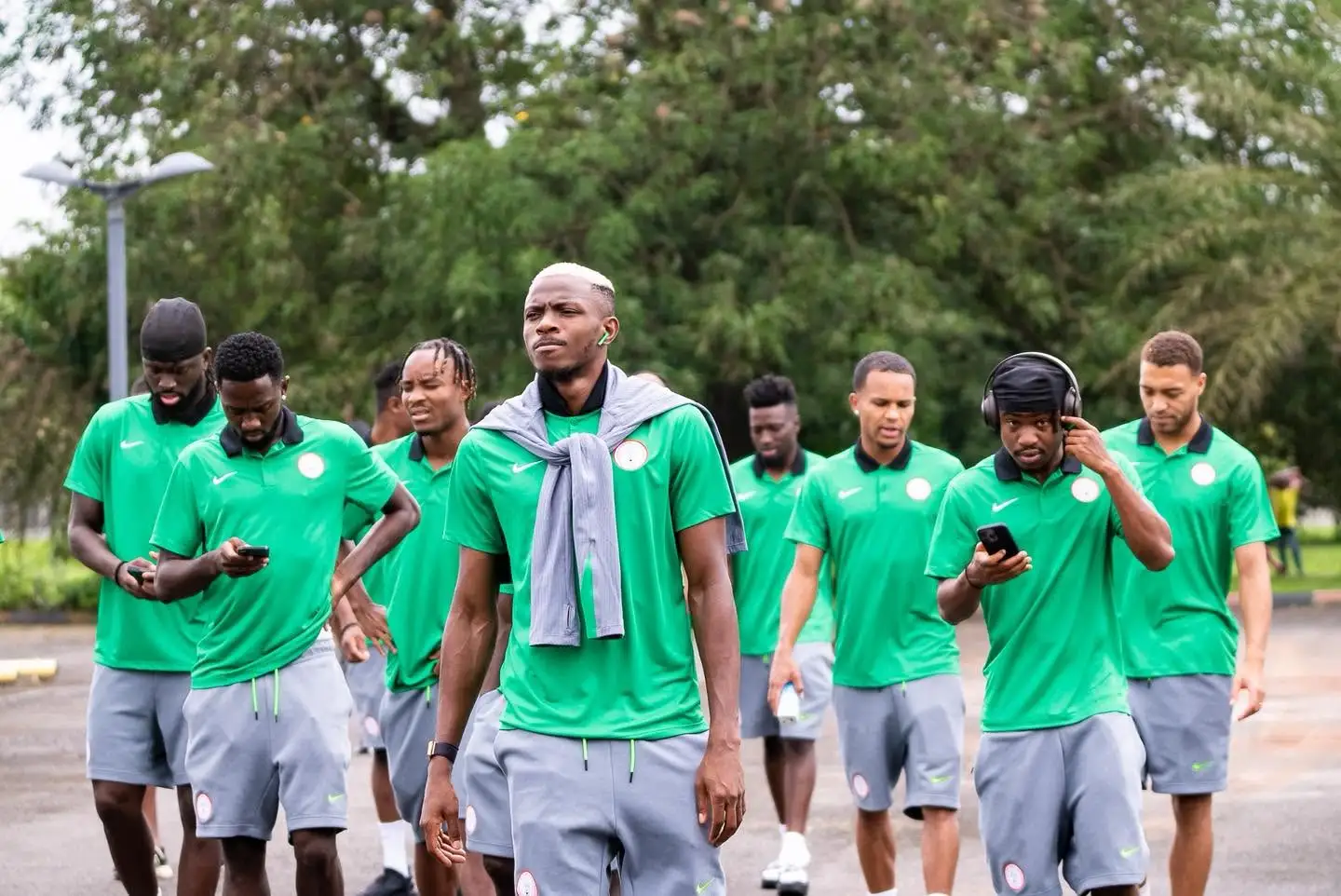


As the 2026 FIFA World Cup kicks off Thursday in North America, the ache of Nigeria’s absence is the kind that sits in the chest and refuses to leave.
The questions come in waves; why aren’t we there? Who do we blame? But I have learned by now that blame is a dead end. It changes nothing and builds nothing. So instead, I let my mind wander to a more hopeful place: why can’t the Super Eagles make it all the way to the final of the next FIFA World Cup, to be held across Morocco, Spain, and Portugal in 2030? The thought made me smile. Then it made me think seriously. What would a genuine, workable plan actually look like?
I looked at the current crop of players, the veterans, the rising stars, and the ones still finding their feet, and something struck me. Almost all the pieces are there. The talent is not the problem. It never was. What is missing is intention, structure, and the kind of administrative courage that turns potential into trophies.
What does it actually take to win a World Cup?
The easy answer is great players. The true answer is something harder to manufacture. Go back four tournaments to South Africa 2010, and you find Spain winning with seven goals in eight games. They were not the most spectacular team in the tournament. They were the most coherent. Vicente del Bosque’s side had spent years building a shared language, short passes, positional discipline, and relentless control until the system ran on instinct. Xavi, Andres Iniesta, and Sergio Busquets: three midfielders who had played together so long they barely needed to look at each other. Twenty of their 23 players were from La Liga. The tactical vocabulary was already fluent before they landed in Johannesburg.
In 2014, Germany told a similar story, only louder. Their 7-1 demolition of Brazil in the semi-final is remembered as a freak result, but it was nothing of the sort. It was the product of a decade-long structural revolution that began after the humiliation of Euro 2000, built on pressing, compactness, and the quiet understanding that no single player was bigger than the machine.

In 2018, France blended youth and tactical pragmatism. In 2022, Argentina added the ingredient of collective belief. Messi was the symbol, but Rodrigo De Paul, Alexis Mac Allister, Enzo Fernandez, and Julian Alvarez were the spine. The common thread across all four champions is unmistakable: they were not collections of great individuals. They were teams with an identity.
The talent is already there
Nigeria’s 2026 absence stings precisely because the talent was never the issue. At the 2025 Africa Cup of Nations, Ademola Lookman topped WhoScored’s player ratings with an almost implausible score of 8.81, ahead of Mohamed Salah, Sadio Mane, and Riyad Mahrez. Victor Osimhen, one of the most coveted strikers on the planet, sat fourth overall. Wilfred Ndidi and Akor Adams were both in the top six. Nigeria had more players in the tournament’s MVP conversation than any other nation. And yet they missed the World Cup.
The qualifying campaign is where the story unravels. Three different coaches, Jose Peseiro, Finidi George, and Eric Chelle, across a single qualifying series. Three different philosophies, three different demands on the same group of players. Home draws against Lesotho, Zimbabwe, and South Africa. And then, two days before a playoff semi-final against Gabon, the players boycotted training over unpaid allowances. Not a tactical failure. An administrative catastrophe.
The bones of a formidable 2030 side
The good news is that the building blocks are already visible. In 2030, Stanley Nwabali will be 27, in the prime of his career, with Maduka Okoye providing experienced cover and the immensely promising Arthur Okonkwo, a 6’6″ Arsenal product, potentially announcing himself as the future of the position.

At the back, Calvin Bassey remains the fulcrum, composed, commanding, effective in European football, and just 30 by the time 2030 arrives. The emergence of Benjamin Fredrick and Abdullahi Bewene is encouraging, as the current defensive unit has too often shown it lacks the elite concentration required at the highest level. The DR Congo equaliser in the playoff final stemmed from a defensive lapse in the 31st minute, and it was not a one-off. It was a symptom of something deeper.
The midfield is where the real excitement lies. Wilfred Ndidi remains the heartbeat: disciplined, physically dominant, tactically intelligent, Nigeria’s Sergio Busquets. But at 33 in 2030, the burden cannot rest entirely on his shoulders. That is where Raphael Onyedika steps in, a dynamic, aggressive, technically accomplished, and just 26 at tournament time. Alongside him, Fisayo Dele-Bashiru, the former Manchester City academy product now thriving at Lazio, is perhaps the most intriguing figure in the squad. Box-to-box, technically alive, at home in Europe’s big leagues, he will be 29 in 2030, right in his prime.
And then there is Ebenezer Akinsanmiro. The 21-year-old Remo Stars product, currently on loan at Pisa, is the name that makes you lean forward. By 2030, he will be 25, the age at which great midfielders begin to truly control games. If his development continues on its current arc, Nigeria may finally have the Xavi-like conductor they have craved for decades.
Up front, the picture is almost embarrassingly rich. Victor Osimhen, at 31, will be at the stage where great strikers distil everything they know into their most complete football. Ademola Lookman at 32 will be in what you might call the Muda Lawal years, every touch purposeful, every movement deliberate, every finish decisive.

His Europa League hat-trick for Atalanta was not luck; it was a statement of what he is. Around them: Samuel Chukwueze’s directness; Akor Adams terrorising La Liga defenders; the exciting 19-year-old Zadok Yohanna, who could yet become one of the tournament’s breakout stars; and a re-centred Victor Boniface, if he can recapture the form that made Bayer Leverkusen’s Bundesliga triumph so compelling.
Four pillars NFF must build
All of this means nothing without the right structure around it. The talent is assembled. The question is whether the administrators have the will to honour it.
The first pillar is simple in theory and difficult in practice: one coach, one vision, four years. Nigeria has done this before. Between 1989 and 1996, Clemens Westerhof and Bonfrere Jo led the Eagles through their most productive era, the first World Cup, a famous run to the Round of 16 against Italy, and ultimately Olympic gold in Atlanta. Stability was not coincidental to that success. It was the foundation of it. Lionel Scaloni’s Argentina kept faith with him after the 2022 group-stage loss to Saudi Arabia. Vicente Del Bosque’s Spain was booed after losing their opening game in 2010 to Switzerland. Both coaches and their respective federations held their nerve. Both lifted the trophy.

The second pillar is player welfare and administrative integrity. Nigeria will never fulfil its potential at a World Cup while players boycott training over unpaid allowances in the days leading up to a playoff. This is not a football problem. It is a structural failure that corrodes everything else. Players must arrive at tournaments feeling respected and prepared, not aggrieved and distracted.
The third pillar is collective identity. The Eagles must spend the next four years becoming a genuine team, with players who know each other’s movements instinctively, who have been through qualifying battles and big friendlies together, and who trust the system and each other. That requires not just better camps, but a long-term coaching philosophy and a domestic league, the NPFL, that genuinely feeds the senior squad rather than being treated as an afterthought.
The fourth pillar is perhaps the most nuanced. Once the NFF has made meaningful progress on the first three, something quietly significant becomes possible: players begin to see the federation not as a bureaucratic obstacle but as a trusted father figure, one they actually turn to when career decisions arise. At that point, the NFF earns the right to sit at the table, helping young footballers chart paths built on legacy and long-term recognition rather than the seductive pull of an immediate paycheck.
This is harder than it sounds in a country where football is often the most visible ladder out of grinding poverty. The pressure to take the money, any money, from anywhere is immense and deeply human. The consequences can be devastating. There are too many stories of promising careers derailed by poor decisions, of young players stranded and forgotten in obscure leagues in remote corners of the world.

Consider Yohanna’s move to Brighton. He had serious interest from Newcastle and Chelsea — names that would dazzle any teenager. Yet someone, whether at AIK or within his inner circle, had the wisdom and the data to identify Brighton as the right environment for his development at this stage of his career. That decision may well define the next decade of his life. But how many players have no one like that in their corner? How many have made the glamorous choice over the smart one and faded quietly from the game? The NFF should be that voice of reason, not just for the fortunate few, but for every Nigerian player standing at those crossroads. Career guidance rooted in genuine analysis and mentorship is not a luxury. It is a responsibility.
READ ALSO: FIFA Ranking: Super Eagles emerge second-highest-ranked team missing the 2026 World Cup
The dream is overdue
The 2030 World Cup is a deadline for a revolution. The players are here. The veterans can still lead; the young ones are arriving. What has been missing is not talent; it has never been talent. It is the administrative will to build something lasting, to stay the course when it gets uncomfortable, and to treat the Super Eagles not as an event to be managed but as a project to be believed in.
Spain did not win in 2010 because they suddenly found better players. They won because between 2004 and 2010, an entire generation committed to one idea and refused to abandon it, game after game, tournament after tournament.
The Super Eagles have the talent to reach the semi-finals of the 2030 World Cup. Perhaps further. All that is required now is that the people running Nigerian football find the courage to build the stage on which these players can finally perform.
The dream is not delusional. It is, in fact, long overdue. I hope my dream comes to pass.