
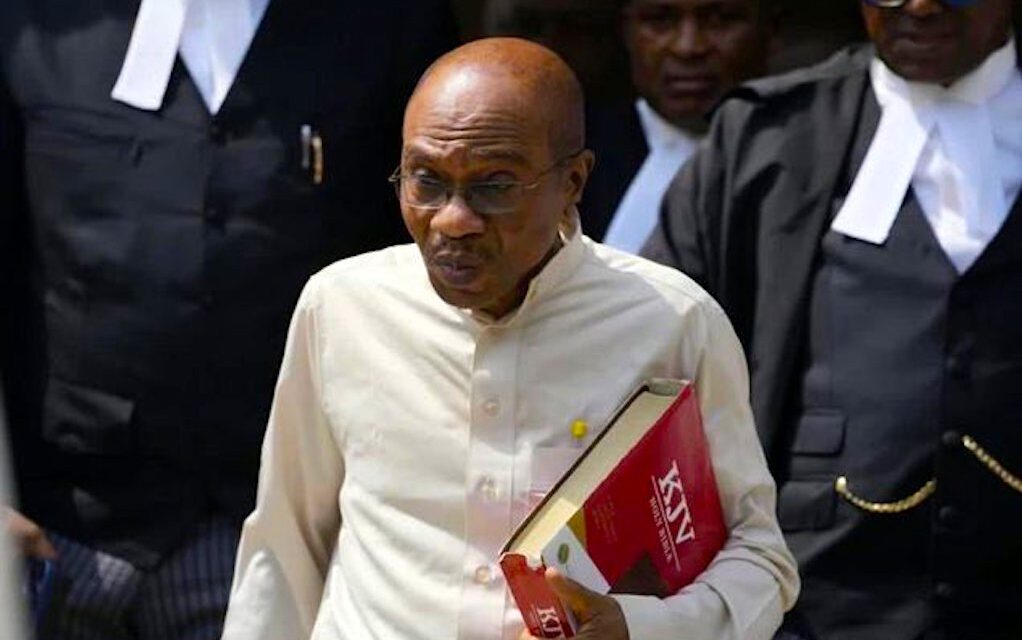

A prosecution witness told the Federal Capital Territory (FCT) High Court in Abuja on Thursday how the Central Bank of Nigeria (CBN) debited N124.86 billion from the Consolidated Revenue Account (CRA) without the National Assembly’s approval during Godwin Emefiele’s time as the CBN governor.
Hamisu Abdullahi, a deputy director working at CBN’s domestic settlement division handling interbank transactions, said the money was used to settle the CBN’s “internal debts”.
Mr Hamisu testified as the ninth prosecution witness in the trial of Mr Emefiele on various charges of illegal activities, including alleged unlawful redesign of the naira notes.
The case is one in a series Mr Emefile has been facing since his removal from office in June 2023 over corruption allegations and sundry malfeasances.
Led in evidence by prosecution lawyer A.O Mohammed on Thursday, the witness said the CBN incurred the N124.86 billion internal debts from various directives it received from the federal government to pay certain agencies without providing funds for the payments.

According to Mr Hamisu, this created a huge debt on CBN’s internal books. He said the accumulated unpaid bills added up to N124.86 billion.
To meet the demands, he said, Mr Emefiele turned to the consolidated revenue account – which is the primary treasury where all public income is gathered and from which almost all government expenditure is paid.
The CRA is governed by a golden rule: no money can be withdrawn from the account except in a manner prescribed by the National Assembly, usually through an Appropriation Act or budget.
But without such a parliamentary approval, Mr Emefiele, according to the witness, directed that the sum of N124. 86 billion (N124,860,227,865.16) debited from the CRA.
He also said there was also no presidential approval for the debit from the CRA, although he did not count that against Mr Emefiele as a wrongdoing.
The witness said Mr Emefiele, in a minute, directed the Deputy Governor in charge of operations to debit the CRA and credit the proceeds into the accounts housing the long outstanding debts.
Giving a breakdown of its distribution, the witness said the pilgrimage subsidy account was credited with N43 billion.
He said the federal government receivable account was credited twice with N43 billion and N38.6 billion.
Explaining further, Mr Hamisu said the CBN usually receives requests for concessionary rates in the sale of foreign exchange for Muslims and Christian pilgrims.
He said, when external auditors raised concern about the debit, they were told that the funds were used to address long outstanding debts.
He also said the same explanation was offered to the Economic and Financial Crimes Commission (EFCC) during its investigations into Mr Emefiele’s activities.
Mr Emefiele is standing trial on four counts, including illegal redesign of naira notes, disobedience to the direction of law, and illegal act causing injury to the public.
The former CBN governor, who was removed by President Bola Tinubu in June 2023 after over eight years in office, denied the charges.
Details of approving memo
Mr Hamisu gave details of Mr Emefiele’s approving memo in his testimony on Thursday.
The witness said Jim Obazee, a special investigator, requested an explanation on the memo that authorised the debit of 124.86 billion naira from the CRA.
The EFCC tendered the said memo, and the court admitted it as an exhibit.
The witness said during Mr Obazee’s investigation, his department was contacted over CBN’s internal memo that dealt with the N124.86 billion.
The witness said he knew Mr Emefiele as a former CBN governor, and he (Mr Hamisu) certified the internal memo in question.
He explained to the court that there were four minutes on the memo. He said the then director of banking services, Okojere Christoper, wrote the first and the last minutes.
According to the witness, Mr Emefiele wrote the second minute, and the then-Deputy Governor of the CBN, Adebisi Sonobi, wrote the third.
Mr Hamisu said Mr Emefiele, as the CBN governor, was the highest-ranking officer among those who minuted on the memo.
“The first minute on the memo was by the then director of banking services, Okojere Christoper. The second one was by Godwin Emefiele, the then CBN governor.
“The third minute was by the former Deputy Governor of the CBN, Adebisi Sonobi, and the fourth minute was by Okojere.
“The above names were the high-ranking officers in the bank, and Emefiele is the highest in hierarchy.”
Details of approval
There was no approval from the National Assembly, the witness said, adding that his own role was carrying out Mr Emefiele’s instructions.
During cross-examination by Mr Emefiele’s lawyer, Olalekan Ojo, a Senior Advocate of Nigeria (SAN), the witness said Mr Emefiele did not benefit from the fund, and he did not come across any letter “complaining that anyone was prejudiced or suffered because of the debt.”
The witness explained that the decision to recover the N124.8 billion was officially approved by CBN’s Directors and the Committee of Governors. He clarified that such regular banking operations, the CBN does not always need the president’s permission to settle debts within the government’s main account.
“Approval was initiated by the banking services department based on the instructions of the governor through the director of finance, who sent the message via email,” the witness said.
Mr Ojo then shifted the witness’ focus to his extrajudicial statement.
He asked the witness if his statement to the investigator, Mr Obazee, had a police logo. He answered, “No.”
The witness said he could identify his statement, “It was my handwriting and signature. I’ve never gone to the police. The logo looks like the Nigerian police logo.”
Mr Ojo then proceeded to show the witness the statement, but the EFCC’s lawyer, Mr Mohammed, objected on the grounds that the statement was not exhibited before the court.
Clash over witness’s statement
Mr Ojo requested that the EFCC provide him with the witness’ statement.
But the prosecution insisted that the defence was served the document on 2 April 2024.
“It is not the statutory responsibility of the prosecution. Now the defence is trying to use the document; the onus is on them to provide the CTC,” prosecution lawyer Rotimi Oyedepo, a SAN, said.
He argued that the defence could not send a notice in the middle of a cross-examination without an application and insisted that the document has been with the defence since 2024.
“Therefore, my lord, he should go ahead and continue his cross-examination,” the lawyer said.
But Mr Ojo requested an adjournment, which Mr Oyedepo opposed.
“An adjournment cannot be in the interest of justice because the document has been with them for more than two years, since 2024,” he said.
Mr Ojo then continued with his cross-examination.
The witness said there was no presidential approval for the N124.86 billion, but an approval request for CBN to sell foreign exchange.
During re-examination by Mr Oyedepo, the witness tried to tender another document, which Mr Ojo objected to.
But Mr Oyedepo, relying on Section 279 (2) of the Administration of Criminal Justice Act (ACJA), said the prosecution reserves the right to present documents for as long as its case has not been closed.
“We urge your lordship to grant the application, and we’ll make a copy and serve it to the defence,” Mr Oyedepo, who is also the Director of Public Prosecutions of the Federation (DPPF), said.
Thereafter, the trial judge, Maryanne Anenih, adjourned until 9 June for the continuation of the trial.