
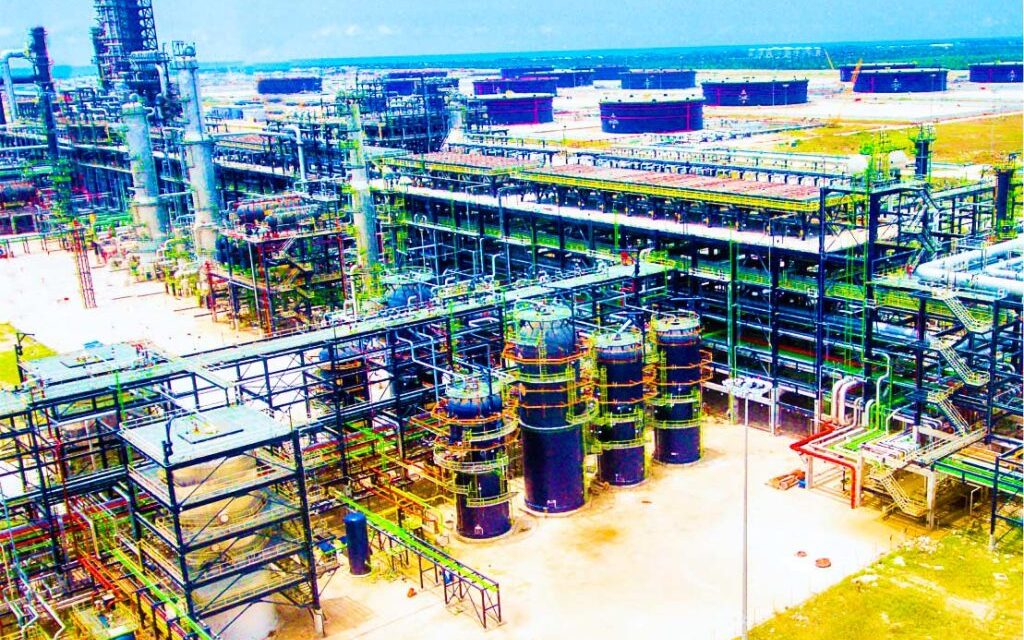


Dangote Petroleum Refinery has rejected allegations that its petroleum products are exported to Lomé, Togo, and later re-imported into Nigeria, describing the claims as “baseless,” “unsubstantiated”, and contrary to commercial logic.
The refinery’s management’s response comes amid growing public debate over fuel prices in Nigeria, even as tensions in the global oil market ease following a ceasefire agreement between the United States and Iran.
Since the outbreak of hostilities involving the United States, Israel, and Iran earlier this year, petrol prices in Nigeria have risen sharply. The escalation of the conflict, which heightened concerns about potential disruptions to global crude supplies through the Strait of Hormuz, pushed up international oil prices and prompted adjustments to domestic fuel prices.
As one of the country’s major suppliers of refined petroleum products, Dangote Refinery increased its ex-depot prices several times during the period.
Petrol, which sold for about ₦870 per litre before the crisis, climbed to nearly ₦1,500 per litre in some parts of the country. It currently sells for around ₦1,340 per litre at many filling stations in Abuja and other major cities.

Many Nigerians expected fuel prices to decline following the ceasefire announcement and the subsequent drop in crude oil prices. Brent crude, which surged to over $100/barrel during the conflict, has retreated significantly since the ceasefire was announced.
Over the past 24 hours, Brent crude has traded between $74.95 and $75.07 per barrel. The development has fuelled debates on social media, with some Nigerians questioning why domestic petrol prices have yet to reflect the decline in global oil prices.
In a statement issued on Tuesday and titled “Response to Unsubstantiated Claims and Tissue of Lies,” the refinery said it typically refrains from responding to unfounded allegations but decided to address the claims in the interest of setting the record straight.
According to the company, suggestions that its products are shipped to Lomé and subsequently re-imported into Nigeria are unsupported by available trade data and lack commercial justification.
The refinery said facilitating imports that would compete directly with its own products would be inconsistent with its objective of maintaining and strengthening its position as a leading supplier of petroleum products in Nigeria.
“Accordingly, Dangote Refinery’s sales contracts and tender terms expressly prohibit the resale or re-importation of products into Nigeria,” the statement said.
The company also argued that the economics of such a trade arrangement do not support the allegation.
It is estimated that transporting products from its facility to Lomé and back into Nigeria would cost between $82 and $90 per metric tonne, significantly increasing costs and reducing profit margins.
The refinery noted that it does not offer export discounts large enough to offset the logistics, storage, financing and handling expenses associated with such transactions.
“Simply put, there is no evident commercial incentive for a producer to incur additional shipping, storage, financing and handling costs only for the product to return and compete in its largest and closest market,” it stated.
Dangote Refinery said it maintains comprehensive records of all product sales, including loading locations, nominated vessels, counterparties and destination declarations where applicable.
It added that allegations suggesting it knowingly facilitates the re-importation of products into Nigeria are inconsistent with the contractual restrictions imposed on buyers and the refinery’s compliance procedures.
The company further stressed that the claims contradict its longstanding position on reducing Nigeria’s dependence on imported petroleum products.
According to the refinery, increased fuel imports undermine local refining capacity, put pressure on foreign exchange reserves and weaken domestic industrial development.
READ ALSO: Dangote refinery cuts jet fuel price to N1,450 per litre
“It would therefore be inconsistent with both the refinery’s commercial interests and its publicly stated position to support or encourage practices that increase imports into Nigeria,” the statement said.
The refinery concluded that there is neither a strategic nor commercial incentive for it to export products to neighbouring countries for subsequent re-importation into Nigeria.
It maintained that the allegations are unsupported by trade economics, contractual arrangements, product traceability mechanisms and its broader commitment to strengthening domestic refining and enhancing Nigeria’s energy security.