
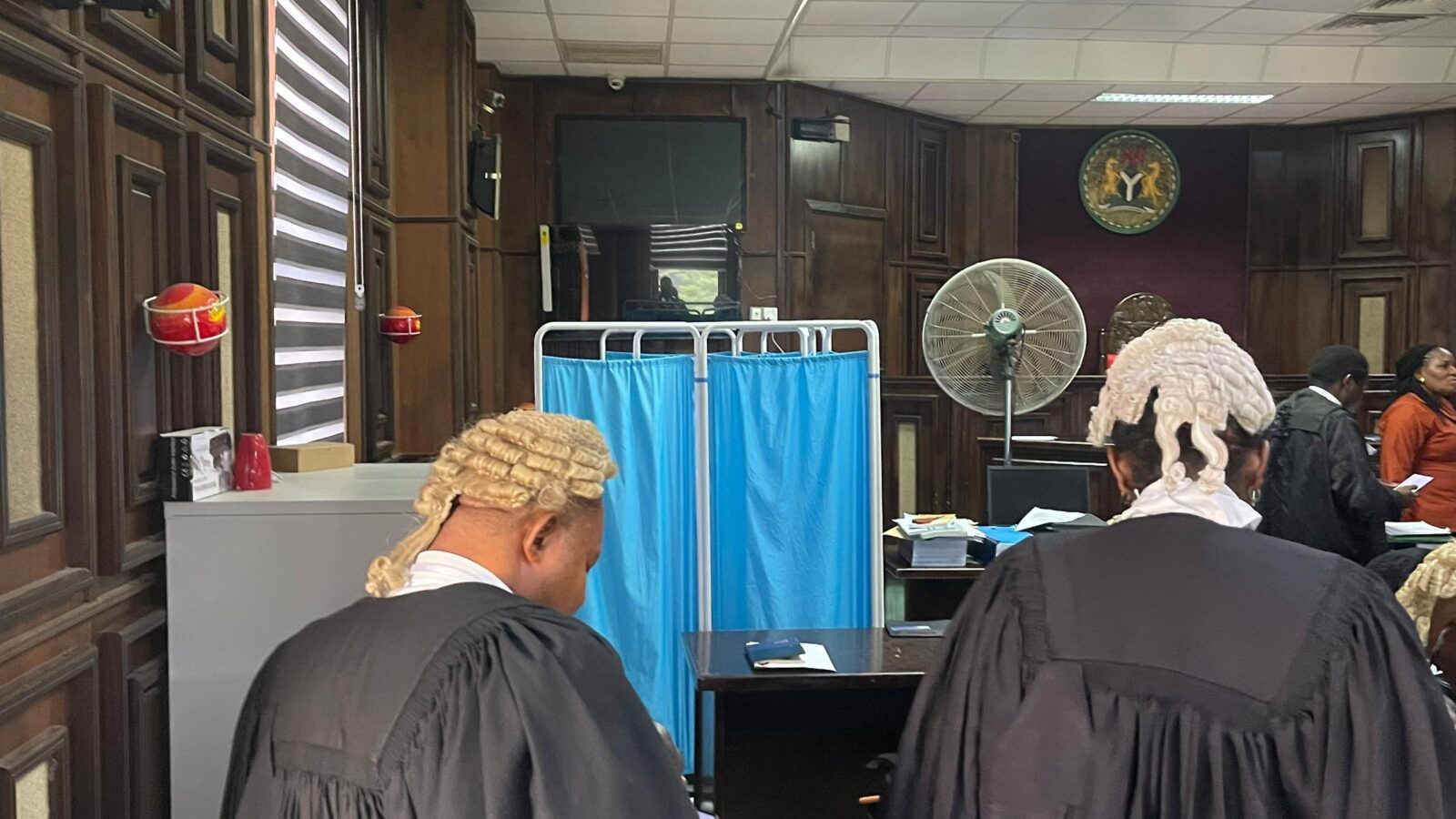

The Federal High Court in Abuja, on Monday, ordered a trial-within-trial to determine the voluntariness of extra-judicial statements the prosecution tendered in the alleged coup plot trial of a retired army major-general and five others.
Judge Joyce Abdulmalik made the order after the prosecution sought to tender the extra-judicial statements attributed to the defendants, along with video recordings, as evidence.
The defence lawyers took turns objecting to the admissibility of the statements and video recordings the prosecution sought to tender, arguing that the statements were not made voluntarily.
They also maintained that the circumstances of the collection of the exhibits breached safeguards under the Administration of Criminal Justice Act (ACJA).
They cited the Anti-Torture Act, 2017, as well as Sections 15 and 17 of the ACJA, alleging oppression and possible coercion during interrogation.

They further challenged the video evidence, claiming it did not properly capture the making of the statements or reflect full compliance with procedure.
The lawyers urged the court to conduct a trial-within-trial to determine their voluntariness before the statements could be admitted in evidence.
Specifically, Olalekan Ojo, a Senior Advocate of Nigeria (SAN) who is the defence lawyer for the fifth defendant, told the court that since all the defendants were objecting, it was in the interest of justice for the court to order separate trials within trial instead of a joint one.
Responding, the prosecution lawyer, Rotimi Oyedepo, also a SAN, said his team was “not afraid of a trial-within-trial.”
But he urged the court to conduct a joint trial-within-trial rather than separate proceedings for each defendant.
After listening to their arguments, Judge Abdulmalik ordered “a joint trial-within-trial to determine the voluntariness of the statements.”
She adjourned proceedings until Tuesday (12 May).
The five co-defendants include Erasmus Ochegobia Victor, a retired navy captain; Ahmed Ibrahim, a police inspector; and Zekeri Umoru, an electrician at the Presidential Villa.
The rest are Bukar Kashim Goni and Abdulkadir Sani, a Zaria-based Islamic cleric.
They were accused of being part of a conspiracy to topple the President Bola Tinubu-led government. Information about the alleged secret plot was leaked to the authorities last September, leading to the arrest of serving and retired military officers alongside their alleged civilian conspirators.
Some serving military officers are undergoing trial before the military’s General Court Martial over the alleged failed coup.
The six men charged before the Federal High Court in Abuja face 13 counts of treason, terrorism, failure to disclose information, and money laundering over the alleged failed coup.
Since the trial began, the prosecution has called four witnesses.
At Monday’s proceedings the last video recording was played before arguments ensued over the admissibility of the clips alongside the hand-written extra-judicial statements attributed to the defendants.
What last video clip shows
In the recording, the last in a series of video clips capturing the interrogation sessions played in court on Monday, Mr Sani, the sixth defendant who described himself as an Islamic cleric, confirmed that nobody assaulted or tortured him and that his “statements were made voluntarily.”
He said he knew the alleged coup ringleader, Mohammed Ma’aji, a serving army colonel, for less than a year. He said Mr Ma’aji approached him through a man identified as Sanda, requesting prayers concerning the alleged coup plot.
According to him, Sanda informed him that his “Oga” intended to stage a coup and needed spiritual prayers and divination regarding its success.
Mr Sani told investigators that after conducting prayers, he informed them the operation would fail and that two persons would eventually betray those involved.
He said a message was later relayed back to him through Sanda “requesting further prayers so that the two individuals would not betray the group.”
The defendant further stated that money was subsequently sent to him for “prayers and charity”, while names of individuals allegedly involved in the plot were also forwarded to him for inclusion in the prayers.
He said shortly after the prayers commenced, Sanda informed him that Colonel Ma’aji had not been seen for four days, adding that he later learnt through media reports that arrests had been made over an alleged coup plot.
However, Mr Sani maintained in the video that the funds transferred to him were not payments for supporting a coup but were meant for prayers.
He also told investigators that he never reported the alleged plot because he did not know who to report to.
The defendant narrated that he was eventually arrested after visiting the Economic and Financial Crimes Commission (EFCC) over restrictions placed on his bank account.
According to him, he had gone to withdraw from the money transferred to him when he discovered that “the account had been flagged.”
He said after contacting an EFCC deputy director, he was invited to the commission’s office where he explained that the money was meant for prayers.
Mr Sani insisted in the recording that he did not make any statement relating to a coup while in EFCC custody.
Objection
After the playback, the prosecution lawyer, Mr Oyedepo, sought to tender the extra-judicial statements allegedly made by the first to fifth defendants before a Special Investigation Panel and military police authorities, as well as the sixth defendant’s statement made before military police investigators.
READ ALSO: ‘I was misled,’ alleged coup defendant says in video recording played in court
But defence lawyers for the six defendants objected to the admissibility of written statements and video recordings, alleging inconsistencies, lack of voluntariness, absence of legal representation.
Muhammed Ndayako, a SAN, appeared for the first defendant, Paul Erokoro, a SAN, for the second defendant, A.H. Shehu for the third defendant, and C.D. Okafor for the fourth defendant.
M. A. Ibrahim and Mr Ojo, also a SAN, appeared for the fifth defendant, while Sanusi Musa, another SAN, represented the sixth defendant.
They claimed their clients were coerced during interrogation. Following their objections, the judge ordered a joint trial-within-trial.
Bail matter
Earlier, one of the defence lawyers raised the issue of bail applications, but the judge told him that she adjourned for continuation of trial before bail hearing.
Mr Oyedepo told the court that the prosecution witness was still in the dock. He then applied that the content of the flash drive of the statement of the sixth defendant, Mr Sani, be played in court.
The alleged coup
Earlier reports noted that the suspects allegedly planned to attack the Presidential Villa, take control of the seat of government, and detain President Tinubu alongside other top officials.
The group was also accused of plotting the assassination of the President, Vice President Kashim Shettima, Senate President Godswill Akpabio, and House Speaker Tajudeen Abbas.
Investigators further alleged that the suspects acquired at least 32 vehicles, including SUVs and Volkswagen Golf cars, for covert operations. The vehicles were said to have been meant for discreet movement, intelligence gathering, and access to strategic locations such as airports and other sensitive facilities.
Sources said documentary materials, including receipts and transaction records linked to the vehicles, have been recovered and will be relied on by the prosecution.
Colonel Mohammed Ma’aji was named in the charges and believed to be among key actors in the alleged plot.
At least 16 senior officers were arrested in connection with the case, including Ma’aji. Fourteen of them are from the Nigerian Army, while the rest are drawn from the Navy and Air Force.