
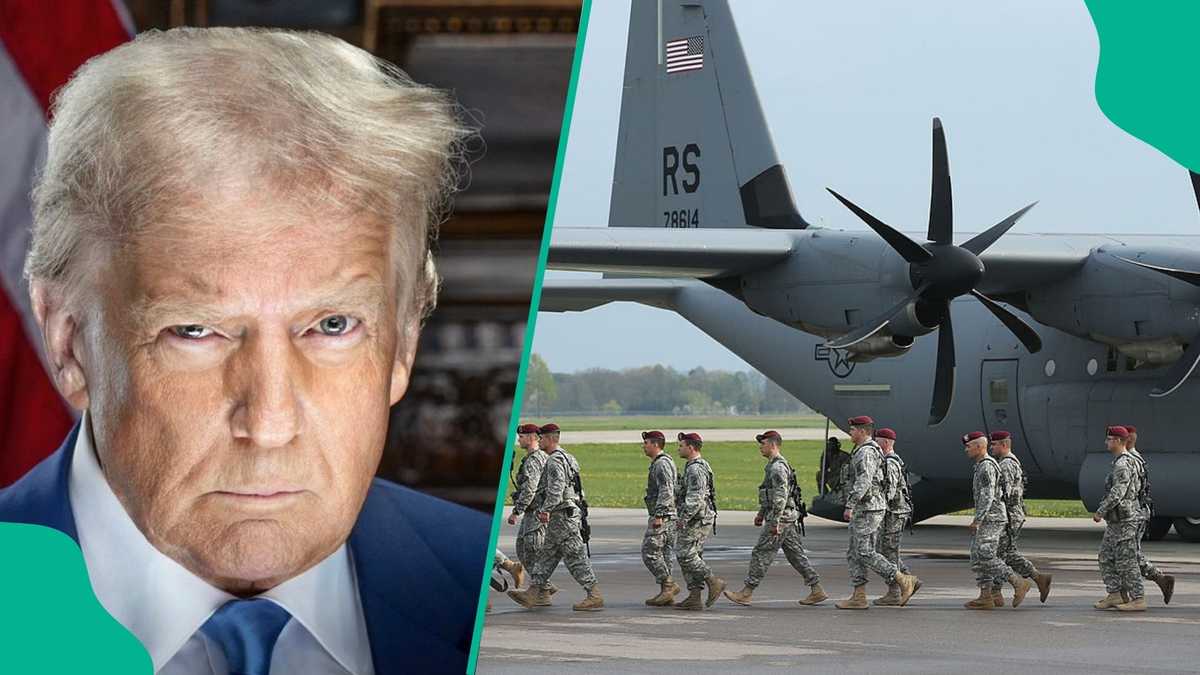

- The Pentagon is preparing to pull about 200 troops from Nigeria who were sent earlier this year to help combat Islamist militants
- US and Nigerian officials said the deployment produced results far beyond what its size suggested, with a major ISIS operation completed in May
- A smaller team of trainers and intelligence analysts is expected to stay behind after the main contingent departs
The United States Pentagon is set to withdraw roughly 200 troops from Nigeria by late September 2026, following a deployment that American and Nigerian officials described as having delivered results well above what its scale would suggest.
The New York Times reported on Thursday, August 27, citing US military officials, that while the main contingent will leave, small teams of trainers and intelligence analysts are expected to remain in the country on a continuing basis.

Source: UGC
American officials went further, describing the Nigerian deployment as a potential blueprint for how the US military could operate across Africa going forward.

AFRICOM cites May operation as turning point
Last month, Dagvin Anderson, commander of US Africa Command (AFRICOM), said many US troops had already been pulled back from Nigeria following a May 2026 operation that killed Abu-Bilal al-Minuki, the second-in-command of ISIS, in the Lake Chad Basin. Anderson said the strike dealt a significant blow to ISIS leadership both in Nigeria and globally.
He added that Nigeria had been “very active” since the May operation, working to cut off terrorists’ ability to sustain themselves, and confirmed that the US would maintain its intelligence partnership with Nigeria regardless of the troop drawdown, The Cable reported.
Broader security picture remains complex
The withdrawal comes weeks after the US and Nigeria held their second round of talks in Washington under a joint working group focused on protecting Christian communities in Nigeria’s Middle Belt.
That group was set up following President Donald Trump‘s designation of Nigeria as a country of particular concern over allegations of Christian genocide, a designation that contributed to the initial US military involvement.

Nigeria has pushed back on the framing that a single cause drives the country’s violence. Officials have consistently described the security situation as layered and multidimensional, Vanguard reported.

Source: Twitter
Ladd Serwat, Africa senior analyst at ACLED, told TheCable that activities by Islamist militant groups “constitute only a small proportion of the overall violence” in Nigeria.
He described the full picture as “a very complicated security situation,” encompassing terrorism spilling over from neighbouring Sahelian states, banditry in the north-west, groups such as ISWAP, ISIS, and Boko Haram, farmer-pastoralist clashes, and violence from cult groups and militias.
Despite the gains cited by US officials, insecurity across Nigeria has continued to rise.
US, Nigerian forces begin joint military training
Previously, Legit.ng reported that US and Nigerian military personnel conducted joint training exercises at Operating Location Bauchi in northern Nigeria, with sessions covering a wide range of skills from emergency medical care to unmanned aircraft systems (UAS).
The programme falls under a broader US-Nigeria security cooperation mission that includes combined training, advising, intelligence sharing, and professional exchanges.
Source: Legit.ng