
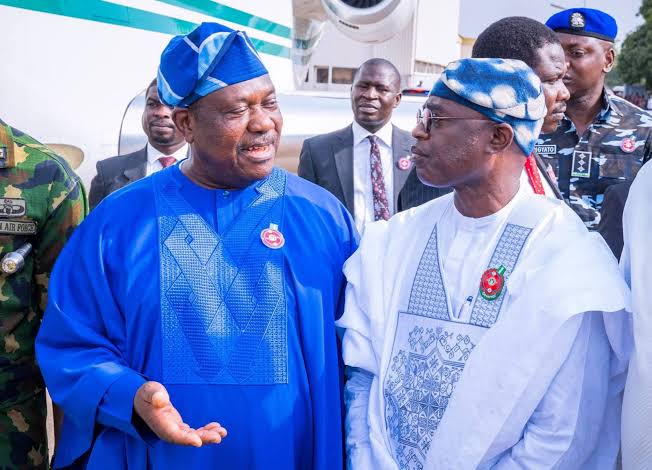

The leadership crisis within the Benue State chapter of the All Progressives Congress (APC) showed signs of easing on Sunday after a high-level reconciliation meeting between Governor Hyacinth Alia and the Secretary to the Government of the Federation (SGF), George Akume, though disagreements persist over key issues ahead of the 2027 elections.
The meeting, held at the Government House in Makurdi, followed an earlier intervention initiated by Mr Akume, who had convened stakeholders after securing the backing of President Bola Tinubu to address deepening divisions within the party.
Those in attendance included federal and state lawmakers, party leaders, and other stakeholders drawn from the rival blocs loyal to the governor and the SGF.
Speaking after the meeting, Mr Akume said the party had resolved to close ranks after months of internal disputes that had fractured its structure across the state.
“We have acknowledged where we went wrong and we want to get back. We want everybody to have a place. We want inclusiveness in this party,” he said.

He added that part of the understanding reached was that elected officials under the APC platform, from the state assembly to the National Assembly, should retain their positions going into the next election cycle.
“Those elected on the platform of the APC must come back. It is automatic,” he said, suggesting support for return tickets for serving officeholders.
However, Governor Alia offered a different interpretation, distancing himself from any suggestion that automatic tickets had been adopted as part of the resolution.
“The president and the national chairman have said clearly that there is no automatic ticket for any candidate,” the governor said.
“What was said was a prayer, not a resolution. It is an appeal to support those who are serving, not a directive.”
Mr Alia confirmed that he apologised during the meeting, describing the move as necessary to stabilise the party and rebuild trust among members.
“For those who were aggrieved, I have to apologise on behalf of every member of APC. It was deliberate as a responsible leader,” he said.
He added that stakeholders agreed to “come under one roof” and work towards unity ahead of the elections.
The reconciliation effort marks the most direct engagement yet between the two camps since the crisis escalated earlier this year.
In March, both factions conducted parallel state congresses, producing separate executive committees and deepening uncertainty over the party’s leadership structure. The governor’s camp returned Benjamin Omale as state chairman, while the Akume-aligned faction reaffirmed Austin Agada as chairman.
The rivalry has since shaped disagreements over zoning arrangements and the push for consensus candidates, with several stakeholders warning that the approach lacked transparency and could alienate party members.
The tensions prompted Mr Akume to convene an emergency meeting earlier, citing concerns at the national level.
“The crises affecting the Benue State chapter of the APC have attracted the attention of the President,” he wrote in a letter dated 22 April, announcing the intervention.
Sunday’s meeting appears to have reduced immediate tensions, but key questions remain unresolved, including which factional structure will oversee party primaries and how candidates will emerge.
A senator, Emmanuel Udende, who attended the meeting, said the immediate priority was restoring unity.
“We were a divided house, and you know the consequences. Today we are united, and we will move on,” he said.
ALSO READ: Benue APC crisis deepens as Alia, Akume factions hold parallel congresses
He declined to comment on which executive committee would conduct the primaries, noting that the issue was not discussed.
Former Governor Gabriel Suswam also described the meeting as a step forward, though he indicated that further negotiations would be required to settle outstanding matters.
“A small committee will handle the details of what has been agreed,” he said.
The Benue crisis reflects broader tensions within the APC across several states, where disagreements over zoning and consensus candidacies have led to internal disputes ahead of the 2027 elections.
Political analysts warn that unless clearly resolved, such disputes could lead to parallel primaries or legal challenges, with potential implications for the party’s electoral position.
For now, the Makurdi meeting signals a pause in hostilities, though the durability of the truce may depend on how unresolved issues are handled in the coming months.