
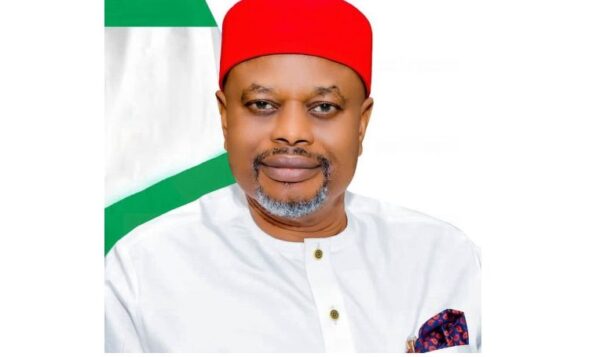


A former Minister of Innovation, Science and Technology, Uche Nnaji, has finally filed an appeal against a court ruling which ordered his arrest over certificate forgery.
PREMIUM TIMES earlier exclusively reported in mid-June that a federal high court in Abuja ordered the Independent Corrupt Practices and Other Related Offences Commission (ICPC) to arrest Mr Nnaji for investigation into his certificate forgery scandal.
The court ruling followed an ex parte motion filed by the ICPC in a suit marked FHC/ABJ/CS/1160/2026.
Apart from the arrest order, the court, in its ruling, also granted an order allowing the ICPC to declare Mr Nnaji wanted in any national newspaper, social media platforms or other medium.
The anti-graft agency had told the court that the ex parte motion was in response to Mr Nnaji’s failure to honour invitations which it extended to him for “investigative activities” over certificate forgery.

The ICPC’s invitation of Mr Nnaji followed a painstaking two-year investigation published by PREMIUM TIMES in October last year, which revealed that the then-minister forged his UNN degree and NYSC certificates, which he submitted to President Bola Tinubu and the Nigerian Senate during his ministerial confirmation in 2023.
Appeal after denials
Mr Nnaji filed the appeal against his arrest order before the Court of Appeal Abuja on 18 June, according to a notice of appeal exclusively obtained by PREMIUM TIMES.
The former minister’s appeal came exactly five days after he denied the existence of such court order against him. He described this newspaper’s report as a media “media trial.”
“We wish to state unequivocally that Chief Nnaji is not in hiding and has never evaded any law enforcement agency.
“We further wish to make it abundantly clear that neither Chief Uche Geoffrey Nnaji nor his legal team, led by Chief Wole Olanipekun, SAN, has received any invitation, summons, warrant, or correspondence whatsoever from the ICPC,” Mr Nnaji said in a statement on 13 June by his spokesperson, Robert Ngwu.
“No such (court) process has been served at his Abuja or Enugu residences, both of which have been publicly known for decades.”
Also, Mr Nnaji had earlier claimed that he was neither invited nor under investigation by the ICPC.
However, PREMIUM TIMES exclusively reported on Wednesday that a document and communications between him and the ICPC showed that the politician repeatedly rebuffed ICPC invitations and failed to show up for scheduled interview sessions with the anti-graft agency regarding his forgery scandal.
Nnaji’s ground of appeal against the court order
Mr Nnaji filed the appeal through Adoga Moses, a litigation clerk in the law firm of the former minister’s lead counsel, Wole Olanipekun, a Senior Advocate of Nigeria.
According to the notice of appeal, Mr Nnaji expressed his dissatisfaction with the “entire orders” granted by the federal high court.
The former minister highlighted four grounds for the appeal against the court order.
In his first ground, he argued that the federal high court “erred in law” by issuing the orders without having the jurisdiction to do so.
Under the second ground, the politician contended that the lower court failed to comply with provision of Section 84 of the Evidence Act (2011) by admitting a computer generated evidence against him upon which it issued the orders.
Section 84 (2) of the Act provides that a statement contained in a document produced by a computer is admissible as evidence in court if, among other conditions, the computer was operating properly when the record was produced or any malfunction did not affect the accuracy of the record.
Section 84(4) of the Act further requires a certificate of compliance, signed by a responsible person, identifying the electronic record and explaining how it was produced.
According to the provision, the certificate of compliance is usually tendered in court alongside any electronic evidence presented.
PREMIUM TIMES understands that Mr Nnaji was referring to the invitation letter which the ICPC forwarded to him via his WhatsApp numbers, email address and text messages.
The ICPC had presented as evidence to the court screenshots of WhatsApp chats and email showing that the anti-graft agency forwarded the invitation letter to the former minister which he reportedly ignored.
In his fourth ground, Mr Nnaji argued that the lower court “erred in law and came to a wrong decision when it relied on unsubstantiated facts” before it in making the ex parte orders.
“There was nothing before the lower court, establishing that the telephone numbers and email addresses to which the referenced messages/texts were purportedly directed, belonged to the appellant.
“There was nothing before the lower court, showing a reply to any of the messages/texts purportedly sent to the numbers and email address contained therein,” he argued.
Under the fourth ground, Mr Nnaji further contended that “the lower court erred in law and came to a wrong decision” when it acted on the ICPC’s alleged misrepresentation of facts by issuing the orders against him.
The former minister further argued that the court relied on the ICPC’s deposition that he received the invitation letter from the anti-graft agency on the basis of his reply to the WhatsApp message.
“Misrepresentation of facts is one of the grounds upon which an ex-parte order could be set aside,” he stated.
Prayers
Mr Nnaji then asked the Court of Appeal to grant an order vacating the order of the federal high court and then strike out the ICPC’s suit filed before the lower court.
In his motion on notice filed at the Federal High Court in Abuja, the politician prayed the court to grant an order staying the execution of the order of arrest against him.
He further appealed to the court to grant an injunction, restraining the federal government or the ICPC or their agents from executing its order of arrest against him.
The politician further pleaded with the court to immediately grant an order, suspending the execution of the arrest order pending the hearing and final determination of his appeal against the said orders at the court of appeal.
Mr Nnaji, who is the governorship candidate of the Nyesom Wike-backed Peoples Democratic Party (PDP) in Enugu State, told the appeal court in his filing that execution of the order of arrest against him “will operate to keep the applicant (Mr Nnaji) out of circulation, thus, depriving him of the opportunity to continue with his campaign activities, towards the elections.”
The former minister further contended that the refusal of the court to grant his application “would negatively affect not just the person of the applicant (Mr Nnaji), but the Nigerian democratic process which is built of freedom of participation and choice of the electorate.”
Background
In October 2023, PREMIUM TIMES began investigating Mr Nnaji’s academic records.
The then-minister had submitted a degree and NYSC certificates to President Tinubu and the Nigerian Senate during his ministerial confirmation in 2023.
He claimed he obtained a degree certificate from UNN, where he purportedly graduated in 1985.
Apparently disturbed that he was under scrutiny, Mr Nnaji filed a suit at the Federal High Court in Abuja to block both UNN and its vice-chancellor, Simon Ortuanya, a professor, from releasing his academic records.
Apart from the UNN and its vice-chancellor, the minister of education, the National Universities Commission, the university’s registrar, its former Acting Vice-Chancellor, Oguejiofo Ujam, a professor, and the Senate of the university were listed as defendants in the suit.
However, the politician, through his legal team, recently applied for an out-of-court settlement.
Before the then-minister could obtain an injunction from the court, Mr Ortuanya had responded to PREMIUM TIMES’ Freedom of Information (FOI) letter, confirming that Mr Nnaji had forged his UNN degree certificate.
The UNN registrar would shortly thereafter corroborate Mr Ortuanya’s position, indicating that although Mr Nnaji was admitted to the university in 1981, he neither graduated nor was issued any certificate.
NYSC authorities, in response to a separate FOI letter from PREMIUM TIMES, had disowned the discharge certificate in possession of the then-minister.
Mr Nnaji resigned from his position as minister three days after this newspaper published the investigation exposing how he forged his degree and NYSC certificates.
READ ALSO: EXCLUSIVE: Despite denial, document confirms Uche Nnaji ignored multiple ICPC invitations over forgery
Many Nigerians had called for Mr Nnaji’s prosecution, maintaining that his resignation was inadequate in light of his violations of various Nigerian laws, including the Criminal Code Act.
Earlier this year, a legal practitioner, Liborous Oshoma, criticised the Nigerian government for failing to prosecute Mr Nnaji over the certificate forgery scandal, maintaining that people like the former minister “should be prosecuted and banned from holding public office to serve as a deterrent to others.”
Meanwhile, in March, this newspaper also exclusively reported that an investigative panel set up by Nigeria’s Minister of Education, Tunji Alausa, found that Mr Nnaji indeed forged his degree and NYSC certificates.
PREMIUM TIMES earlier reported that the former minister “quietly” moved to the Peoples Democratic Party (PDP) from the ruling All Progressives Congress (APC), under which he unsuccessfully contested the 2023 governorship election in Enugu State.
In late May, Mr Nnaji emerged as the governorship candidate of the Mr Wike-backed PDP faction ahead of the 2027 general election.
Within the same period, this newspaper exclusively reported that Mr Nnaji was desperate to become governor in order to, among other reasons, enjoy immunity from prosecution if he wins the governorship poll.