
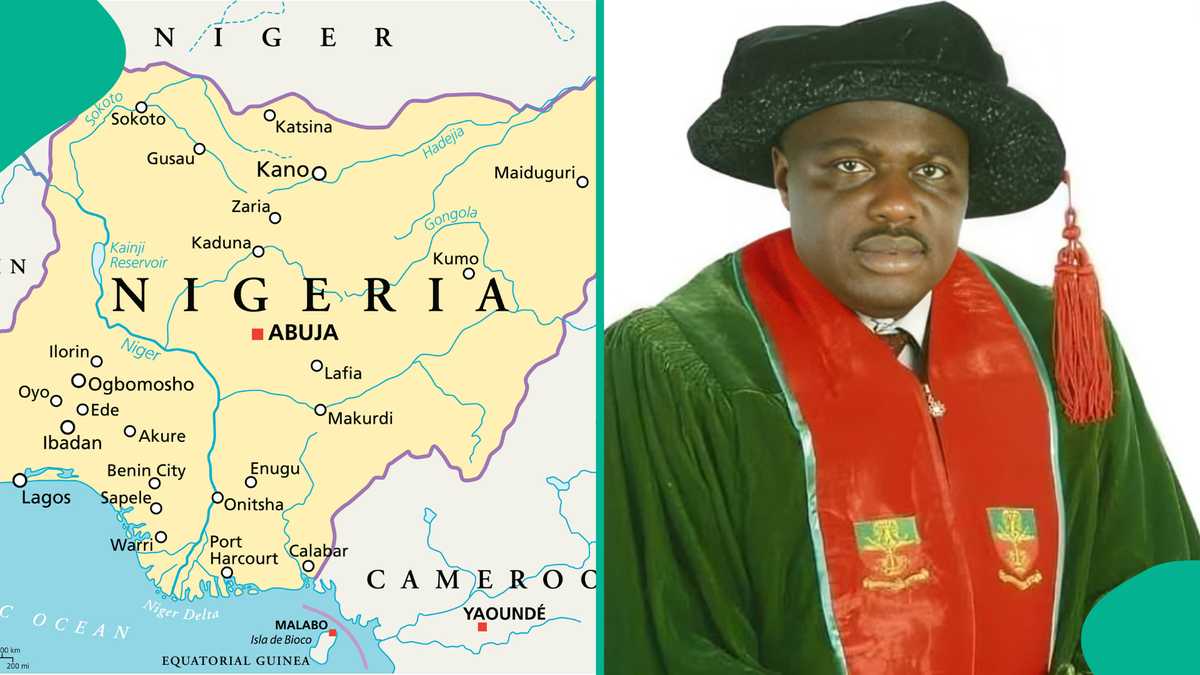

Amid growing concerns over economic challenges in Nigeria, Legit.ng spoke extensively with renowned scholar Professor Suleiman Aruwa of Nasarawa State University, who marks his 55th birthday today, August 24, 2026.
In this exclusive interview, the internationally recognized scholar addressed key issues and shared insights into the root causes of Nigeria’s economic challenges along with solutions drawn from his extensive expertise.

Source: Original
As a distinguished scholar of accounting and finance, Prof. Aruwa has led in many capacities. He was Dean of Postgraduate Studies at Nasarawa State University and now sits on the Governing Councils and Boards of several notable institutions. These include the Association of National Accountants of Nigeria (ANAN), the Financial Reporting Council of Nigeria, ANAN University, Kwall (ANUK), the Association of Forensic Accounting Researchers (AFAR), the Chartered Institute of Forensics and Certified Fraud Examiners of Nigeria (CIFCFEN), and the Nigerian Accounting Association (NAA).
Across his career, he has produced at least 18 textbooks and 156 scholarly works published nationally and internationally, earning more than 887 Google Scholar citations. He has also guided 156 Ph.D. candidates and 139 M.Sc. students to successful completion, while serving as an external examiner for 245 doctoral theses and master’s dissertations in universities across Nigeria and Africa.

Root causes of Nigeria’s persistent economic downturn
To explore the underlying causes of Nigeria’s economic downturn and currency instability, Legit.ng opened its interview with that question. Professor Aruwa explained that the nation’s economic difficulties stem from multiple factors rather than a single source:
“Nigeria’s economic challenges are not caused by a single factor. They are the result of structural weaknesses that have accumulated over many years. First is our excessive dependence on crude oil for foreign exchange and government revenue. Whenever oil prices fall or production declines, government revenues and foreign-exchange earnings come under pressure. Second is weak fiscal discipline. Nigeria has historically struggled with large deficits, inefficient public expenditure, rising debt-service obligations and inadequate revenue mobilisation. We therefore need to distinguish between spending more and spending better. The quality and productivity of public expenditure matter as much as its volume.
“Third is the country’s production deficit. We import too much of what we consume and export too little beyond crude oil. This creates persistent demand for foreign exchange and exposes the naira to external shocks. Fourth is the weakness of institutions and public financial management. Where leakages, corruption, poor procurement practices, abandoned projects and weak accountability exist, public resources do not generate the expected economic returns.

“Finally, monetary and foreign-exchange policy uncertainty can weaken confidence. Currency stability ultimately depends not only on central-bank interventions but also on fiscal credibility, productive capacity, investor confidence and the ability of the economy to generate foreign exchange. So, the fundamental issue is that Nigeria has a revenue problem, a productivity problem, a governance problem and a confidence problem—and these reinforce one another.”
Steps to improve the economy
In response to a question about immediate measures to strengthen the economy in Nigeria, Prof. Aruwa emphasised that the top priority is restoring confidence while safeguarding productive activity and protecting vulnerable households.
“First, government must strengthen fiscal discipline and ensure that every naira borrowed or spent can be linked to a measurable economic or social outcome. Second, we need to accelerate domestic revenue mobilisation without simply increasing the tax burden on already compliant businesses and citizens. The focus should be on broadening the tax base, reducing leakages, improving administration and bringing more economic activity into the formal sector. Third, government should prioritise sectors capable of generating employment and foreign exchange—particularly agriculture, manufacturing, solid minerals, technology and services. Fourth, public expenditure should be restructured towards infrastructure, human capital and productive investment rather than low-impact recurrent spending. Most importantly, economic reform must be accompanied by social protection and targeted interventions. Stabilisation should not mean asking the poorest Nigerians to carry the entire cost of adjustment.”

Role of accountability and transparency in financial institutions
Research shows that the economic struggles in Nigeria often stem less from a shortage of capital than from a deficit of public trust. When confidence in financial management erodes, participation declines and compliance weakens. Prof. Aruwa told Legit.ng that:
“People are more willing to pay taxes, invest, save and comply with regulations when they believe that institutions are acting fairly and that public resources are being properly managed. For financial institutions and government, transparency means providing credible, timely and understandable information about revenues, expenditures, borrowing, investments and financial risks. Accountability means that decision-makers must be able to explain their decisions and face consequences where there is misconduct.
“Nigeria should therefore strengthen independent audit, legislative oversight, procurement transparency, beneficial-ownership disclosure, whistleblower protection and public access to fiscal information. We also need to move from input-based accountability to outcome-based accountability. It is not enough to say how much government spent; citizens should be able to ask: What was achieved with the money? Who benefited? What is the measurable impact? Ultimately, transparency converts information into trust, while accountability converts trust into institutional credibility.”


Source: Getty Images
Practical strategies young professionals can adopt to build financial resilience
Joining today’s workforce presents vast opportunities but also exposes young professionals to an unpredictable economic climate. Inflation, market disruptions, and rising living costs challenge traditional career stability. Prof. Aruwa told Legit.ng that lasting security depends less on salary milestones and more on building a resilient financial foundation:
“Young professionals should understand that financial resilience is built through discipline, diversification and continuous learning. First, they should develop a realistic personal budget and maintain an emergency fund. One should not allow lifestyle expenditure to grow automatically with income.
“Second, young professionals should avoid excessive consumer debt, particularly debt used to finance depreciating assets or lifestyles. Third, they should diversify their sources of income. In an uncertain economy, depending entirely on one salary can create significant vulnerability. Professional consulting, entrepreneurship, digital skills, teaching, research and other legitimate income-generating activities can provide additional resilience.

“Fourth, they should invest in skills that remain valuable in a changing economy—especially digital technology, artificial intelligence, data analytics, financial management, communication and problem-solving. My advice to young professionals would be simple: build skills, control expenditure, avoid unnecessary debt, create multiple income streams and invest for the long term.”
Improving financial literacy nationwide to empower citizens
On improving financial literacy nationwide, Prof. Aruwa told Legit.ng that the nation must rethink how it teaches financial skills:
“Financial literacy should become part of Nigeria’s development strategy, not something reserved for students of economics or accounting. We need to introduce practical financial education from secondary school and strengthen it in tertiary institutions. People should understand budgeting, savings, credit, interest rates, insurance, pensions, taxation, investment risk, digital finance and consumer protection.
“But formal education alone is not enough. Financial literacy should also be delivered through workplaces, banks, professional bodies, community organisations, religious institutions, cooperatives, media and digital platforms. The approach must also be localised. Financial education for a farmer, market trader, civil servant, student and small-business owner should not necessarily be identical.
“Technology provides an enormous opportunity. Nigeria can develop simple digital financial-literacy platforms using local languages, short videos, interactive tools and practical examples. We should move from financial literacy to financial capability—that is, not merely knowing what compound interest means, but being able to use financial knowledge to make better decisions.”

Urgent reforms for economic recovery
Professor Aruwa also outlined three urgent reforms that are essential for economic recovery in Nigeria.
“First: Reform public financial management and accountability. Nigeria needs a stronger expenditure-control framework covering budgeting, procurement, project implementation, auditing and reporting. Every major public project should have clear objectives, cost, timeline, responsible institution and measurable outcomes. Budgeting reform urgently needed.
“We should establish a stronger “value-for-money” culture in government: public spending must demonstrate economy, efficiency, effectiveness and equity. Second: Accelerate economic diversification and productive capacity. Nigeria must move decisively from an oil-dependent, consumption-driven economy to a productive economy that creates jobs and earns foreign exchange.
“This requires coordinated investment in agriculture, manufacturing, infrastructure, energy, technology, skills and export-oriented industries. The objective should be to make Nigeria produce more of what it currently imports and export more of what the world wants to buy.
“Third: Build a transparent and credible fiscal-social contract. Government must rebuild citizens’ confidence by demonstrating a clear connection between taxes, borrowing, public expenditure and public services. Citizens need to see where public money comes from, where it goes and what it achieves. At the same time, government must protect vulnerable households during economic reforms. If Nigerians can see that sacrifice is being shared fairly, resources are being used responsibly and institutions are accountable, public confidence will improve.

“Nigeria does not lack economic potential. What we have lacked is sufficient consistency in converting our resources into productive capacity, strong institutions and improved living standards. The solution therefore is not simply to stabilise the naira or raise more revenue. We must build an economy in which public money is efficiently managed, private investment is encouraged, citizens are financially empowered, institutions are accountable and economic growth translates into better lives. That is the foundation of sustainable economic transformation.”
Gazelle 2 funds and the imperative of transparency
Legit.ng earlier reported that Prof. Suleiman Aruwa released a detailed analysis of fiscal strategy in Nigeria, focusing on refinancing of the Project Gazelle facility.
Source: Legit.ng