
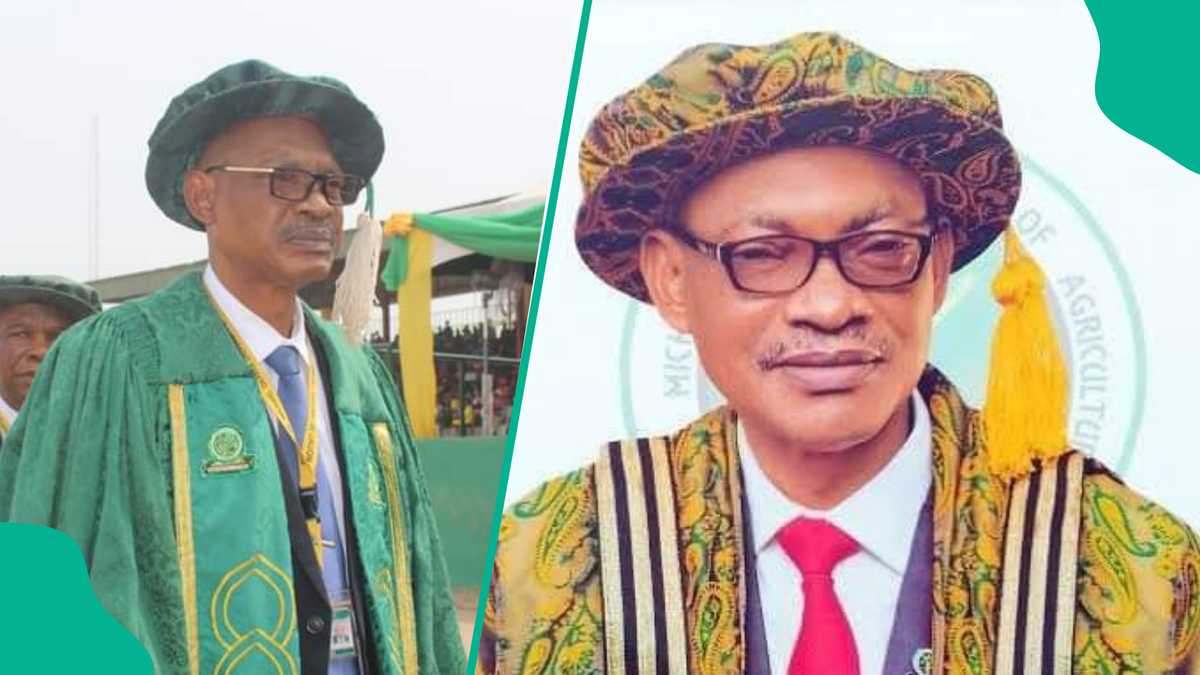

Editor’s note: Kalu Okoronkwo, a communications strategist, leadership and good governance advocate dedicated to impactful societal development, reacted to the ongoing mass staff disengagement scandal at Michael Okpara University of Agriculture, Umudike (MOUAU) in Abia State.
Umudike, Abia State – University administration in Nigeria has over the years produced so many great academic leaders and transformers. From Prof. Eni Njoku, the first Vice-Chancellor of the University of Lagos, to Prof. Kenneth Onwuka D1ke, the first indigenous Vice-Chancellor of the University of Ibadan, to Prof. Ango Abdullahi, the youngest Vice-Chancellor of any Nigerian university then, when he was appointed to lead Ahmadu Bello University, Zaria in 1979 at the age of 40.
And then the very inimitable Prof. Grace Alele-Williams, who shattered the glass ceiling by becoming the first female to head a university in Nigeria when she was appointed the Vice-Chancellor of the University of Benin in 1985.


Source: Twitter
These university administrators and many others not mentioned here left great historical legacies in their different universities at the expiration of their tenures or before they were removed from office. Going by historical antecedents, university administration in Nigeria produces two kinds of university leaders: those who were celebrated while in office and those whose finest vindication came only with the passage of time. Most transformation minded administrators are enemies of the status quo.
Some inherit troubled institutions, make difficult and often unpopular decisions, challenge entrenched interests, and leave behind transformed universities. Drastic transformative actions don’t usually enjoy popular support, but their impacts remain indelible long after the exit of their proponents.
In academia, as in other spheres of public life, the most consequential reforms rarely come without resistance.
That paradox defines the closing chapter of Professor Maduebibisi Ofo Iwe’s tenure as Vice-Chancellor of Michael Okpara University of Agriculture, Umudike (MOUAU), Abia State.

His five-year administration ended on February 28, 2026, amid intense institutional disagreements that, in the eyes of both supporters and critics, have come to dominate public discourse. Whether those controversies accurately define his stewardship or merely reflect the turbulence that often accompanies institutional reform remains a question only history can answer.
The unfolding developments at MOUAU raise a broader question that transcends personalities and governing council politics: How should transformational leadership be judged? By the passions and perceptions of the moment, or by the enduring impact it leaves on an institution?
As competing narratives continue to shape public opinion, the more important inquiry is whether these controversies provide a complete assessment of Professor Iwe’s administration or simply capture one difficult chapter in the university’s evolution.
One of the issues that has fueled public debate since Prof. Iwe left office is the termination of 127 members of staff recruited during the university’s last employment exercise.
According to a report by ThisDay newspaper, while the Federal Government approved the recruitment of 426 personnel, appointment letters were reportedly issued to 618 applicants, with 553 eventually captured on the Government Integrated Financial Management Information System (GIFMIS). This discrepancy generated public scrutiny and differing interpretations of the recruitment process.

Responding to the controversy, Prof. Iwe argued that university administration differs fundamentally from corporate management because it requires balancing the interests of government regulators, governing councils, academic unions, students, alumni, host communities, development partners and political stakeholders, whose expectations often intersect and sometimes in conflict.
According to the former Vice Chancellor, questions surrounding the recruitment exercise arose during the transition period between administrations. He alleged that some applicants later discovered that names different from those originally shortlisted had appeared in their place.
“Many applicants saw their names during the process but later discovered that their names had been substituted,” he said. “As my administration was winding down, it became difficult to determine how those changes occurred. I expected the incoming administration to investigate and correct any anomalies because university administration is a continuum”
He also responded to questions regarding the utilisation of the 2026 intervention funds from the Tertiary Education Trust Fund (TETFund). Iwe explained that the university had long struggled with obsolete printing and copying equipment used for producing sensitive documents, including examination materials. According to him, the university had entered into an agreement with Zinox Technologies to replace outdated equipment with modern, high-capacity digital machines.

He stated that the institution had obtained TETFund approval for a virement to finance the project once the intervention funds were released.
“We secured TETFund approval for the virement, and when the intervention funds amounting to over ₦2 billion were received, they were applied to that purpose in accordance with the approval.”
“I have since been informed that the project has been discontinued by the new administration.” But the question that tugs the minds of keen observers of the unfolding issues in the university is: why was such a project with huge potential to transform the university administration abandoned even when funding had been made available?
Prof. Iwe’s academic and administrative credentials are not in doubt. A distinguished academic, author and Professor of Food Science and Extrusion Technology, Iwe is an Internationally Certified Food Scientist (CFS). He is the current National President of the Nigerian Institute of Food Science and Technology (NIFST).
He served as the sixth substantive Vice Chancellor of Michael Okpara University of Agriculture, Umudike, from March 1, 2021, to February 28, 2026. His tenure was remarkable for the transformative projects he embarked upon. Some of such projects include: moving the institution from the temporary site to the permanent site, initiating construction of a new Senate Building, an ICT Centre, a Physical Planning Building, a 500-seat lecture theatre, all in the permanent site.

Others include the expansion of the guest house to a 25-room facility and the construction of another 51-room facility; provision of 24-hour electricity to the campus, building of bread and water factories to enhance internally generated revenue, among others.
Universities are built over decades as monuments of teaching, learning and research, not administrations. Vice-Chancellors come and go. Governing councils change. Governments rise and fall. Institutions, however, endure. They preserve totems of physical infrastructure, academic culture and intellectual foundations established for future generations.
That is why the legacy of a university leader should never be judged solely by the turbulence surrounding the end of a tenure. It should also be measured by the condition of the institution inherited, the vision pursued, the reforms implemented and the platform created for successors.
Viewed through that broader lens, Prof. Iwe’s administration marked a period of ambitious institutional expansion. Objective and dispassionate observers describe him as a reformer who broadened the university’s national profile and accelerated its physical and academic development.
Critics, however, have questioned aspects of his administration and governance. Whatever position one adopts, few would dispute that the university which emerged at the end of his tenure differed substantially from the one he inherited.

When Prof. Iwe assumed office, MOUAU was approaching three decades of existence. Though respected for its robust agricultural education, MOUAU was still widely regarded as a largely regional institution whose enormous potential remained underutilised. International visibility was modest, town and gown engagement was limited, and one of its greatest assets, the vast 6,503-acre permanent site, had yet to be fully developed. For almost 30 years, the university concentrated its academic, administrative and research activities within a relatively small portion of its land, leaving much of its permanent site fallow.
Perhaps no other achievement better captured Prof. Iwe’s administration than the relocation of the university to its permanent site. Although previous administrations secured the Federal Ministry of Education’s approval for the move, Iwe oversaw its implementation. He had successfully acquired its Certificate of Occupancy, which is a major step forward in the quest to transform the permanent site of the university to a world-class teaching, learning and research environment.
More importantly, the relocation laid the foundation for a purpose-built agricultural university, with modern lecture theatres, specialised laboratories, research facilities, libraries, administrative complexes and expansive farmland capable of supporting innovation in food security, agribusiness and agricultural research.
The relocation also ushered in an unprecedented phase of infrastructure development. Across the permanent site, projects at various stages of completion, including a new Senate Building, an ICT Centre, a Physical Planning Building, a 500-seat lecture theatre and other strategic facilities, reflect a long-term vision for institutional growth. These were not merely construction projects; they represented investments designed to serve generations of students, researchers and faculty members.

It is also worthy of mention that in over 33 years of existence, it was during Prof. Emebisi Iwe’s tenure that Michael Okpara University of Agriculture, for the first time, was accessed and entered the global academic map with its first appearance in the Times Higher Education (THE) Impact Rankings for Sustainability in 2026.
The school was placed in the 1001–1500 band out of 1,646 universities from 116 countries that participated in the 2026 assessment. The certificate was received at the 2026 Global Sustainable Development Congress in Jakarta, Indonesia. Among Nigeria’s five Federal Universities of Agriculture in Abeokuta, Makurdi, Umudike, Zuru, and Jalingo, MOUAU showed up and earned a place on the list.
It would be intellectually dishonest to suggest that Iwe’s tenure was without controversy. As his administration drew to a close, disagreements between the Vice-Chancellor and sections of the Governing Council became increasingly public, giving rise to competing narratives about his stewardship.
Such disputes are not uncommon in university governance, where the delicate balance between institutional autonomy, administrative authority and council oversight often produces friction. The challenge, however, is ensuring that such disagreements do not eclipse a fair assessment of an administration’s overall record.
Perspective observers of the happenings in the university point to what they regard as an unusually strained transition. They note that, unlike the longstanding tradition in many Nigerian universities, the outgoing Vice-Chancellor had yet to receive the customary institutional send-off and farewell accorded to departing chief executives.

They also observe that the Pro-Chancellor and Chairman of Council, Comrade Fidelis Ede, was absent during Iwe’s valedictory lecture, a development that fueled speculation about the state of relations between the outgoing Vice-Chancellor and the Governing Council. The university has not publicly offered an official explanation for the Pro-Chancellor’s absence.
The recruitment exercise conducted during the closing months of Iwe’s administration has also remained at the centre of public debate. Following the disengagement of some employees after they had resumed work, questions arose regarding the recruitment process and the approvals granted.
Pro-Chancellor had maintained that internal stakeholders were not involved in aspects of the exercise, noting that the former Vice-Chancellor acted alone. Prof. Iwe, on the other hand, has consistently maintained that any irregularities alleged to have emerged during the transition period should be investigated objectively and resolved through established administrative procedures.
When questions arose regarding the utilisation of the university’s 2026 TETFund intervention, Iwe stated as a matter of fact that the funds were applied to procure modern digital printing and copying equipment under an approved virement in line with an existing agreement between the university and Zinox Technologies. He has maintained that the expenditure received the necessary approvals before implementation.

It is equally important to consider Professor Iwe’s broader record of engagement with the university community. Throughout much of his tenure, Iwe’s administration was widely regarded by objective observers within the university community as one that prioritised dialogue and constructive engagement with internal stakeholders. One frequently cited example was the resolution of a long-running labour dispute that predated his administration.
The dispute, which arose during the tenure of Professor Hillary Edoga, involved the alleged wrongful placement and promotion of about 100 staff members and resulted in multiple court cases. Rather than allowing the litigation to continue, Professor Iwe’s administration pursued negotiations that reportedly led to the withdrawal of the suits and an amicable settlement acceptable to the affected parties.
The transition to a new administration has generated additional public discussion. Professor Ursula Ngozi Akanwa, the current Vice-Chancellor and former Deputy Vice-Chancellor during Iwe’s tenure, publicly distanced herself from the recruitment exercise undertaken by the previous administration.
That position has itself generated debate within sections of the university community, particularly among observers who expected greater institutional continuity between successive administrations. Similarly, some administrative decisions taken at the commencement of the new administration, including personnel changes, were against the standard civil service procedure. A retired civil servant was engaged to take over from a level 14 officer without advertising the position as stipulated by the civil service rule.

More troubling is the fact that the affected officer was a retired civil servant, which is contrary to the service rule. Also, the manner in which the current VC approved compulsory leave for the Bursar and Registrar and the constitution of investigative panels have attracted different interpretations. Critics view them as evidence of deeper institutional divisions. Whatever the interpretation, the developments underscore the importance of transparent governance and due process in managing leadership transitions within public universities.
There have also been public discussions surrounding the process that produced the current Vice-Chancellor. Some commentators have questioned aspects of the Governing Council’s selection process, including reports that the exercise was conducted in Abuja, with Council members numbering about 30 flown to Abuja and accommodated in luxury hotels for the exercise, far away from the university’s campus in Umudike, Abia State.
Beyond the personalities involved lies a broader concern for the future of higher education in Abia State. The recurring controversies at MOUAU have prompted wider conversations about academic leadership, institutional stability and the need to protect universities from excessive politicisation.
Many stakeholders argue that the focus should remain on preserving institutional memory, strengthening governance and ensuring that successive administrations build upon and not diminish the achievements of their predecessors.
This conversation also extends beyond MOUAU. Indigenes of the state have expressed concern about the underrepresentation of Abia State in the leadership of federal universities, noting that comparatively few academics from the state have occupied vice-chancellorship positions in recent decades. For instance, of all the federal universities in Nigeria, none has an Abia state indigene as Vice Chancellor. Also, of the eight federal universities in the South East, four Vice Chancellors are from Imo State, two from Ebonyi and the other two from Enugu states respectively.

It is also on record that MOUAU has produced seven Vice Chancellors, with Professor O.C Onwudike, the second Vice Chancellor and Prof. Emebesi Iwe, the sixth Vice Chancellor, as the only VCs from Abia state. The broader implication is that while other states in the South East are taking the lead in admission and employment in federal universities, Abia State, without definite leadership in such varsities, trails behind.
Whether or not one accepts this argument, it reinforces the importance of creating an environment in which merit, institutional excellence and leadership development remain the primary considerations in the governance of higher education rather than mere politics.
Every Vice-Chancellor leaves office with two reports: the first is written immediately by supporters and critics, often shaped by emotion, politics and the immediacy of events. The second is written quietly by history, informed by evidence, institutional outcomes and the enduring value of reforms.
Years from now, when future administrators inherit stronger infrastructure, expanded academic programmes, improved research capacity, broader international partnerships and a more competitive Michael Okpara University of Agriculture, Umudike, it will become obvious to discerning minds that many of the foundations for that progress were laid during Professor Maduebibisi Ofo Iwe’s administration. Leadership should ultimately be judged not by the intensity of the controversies it attracts, but by the lasting value it creates.

As MOUAU enters a new chapter, the responsibility now rests with its Governing Council, management, staff, students, alumni and other stakeholders to preserve what has been achieved, improve what remains unfinished and ensure that institutional progress is never sacrificed to transient divisions or primordial interests.
Great universities flourish when successive administrations view leadership as a continuum rather than a contest for historical supremacy. Whatever history’s final verdict on Iwe may be, it should be grounded in evidence, measured against outcomes and guided by a principle that transcends personalities. Institutions are strongest when every generation builds upon the legacy of those who came before it.
Disclaimer: The views expressed in this opinion are solely those of the author, Kalu Okoronkwo. They do not necessarily reflect the editorial position of Legit.ng, which publishes diverse perspectives to encourage informed public discourse.
Okoronkwo can be reached via kalu.okoronkwo@gmail.com
Source: Legit.ng