
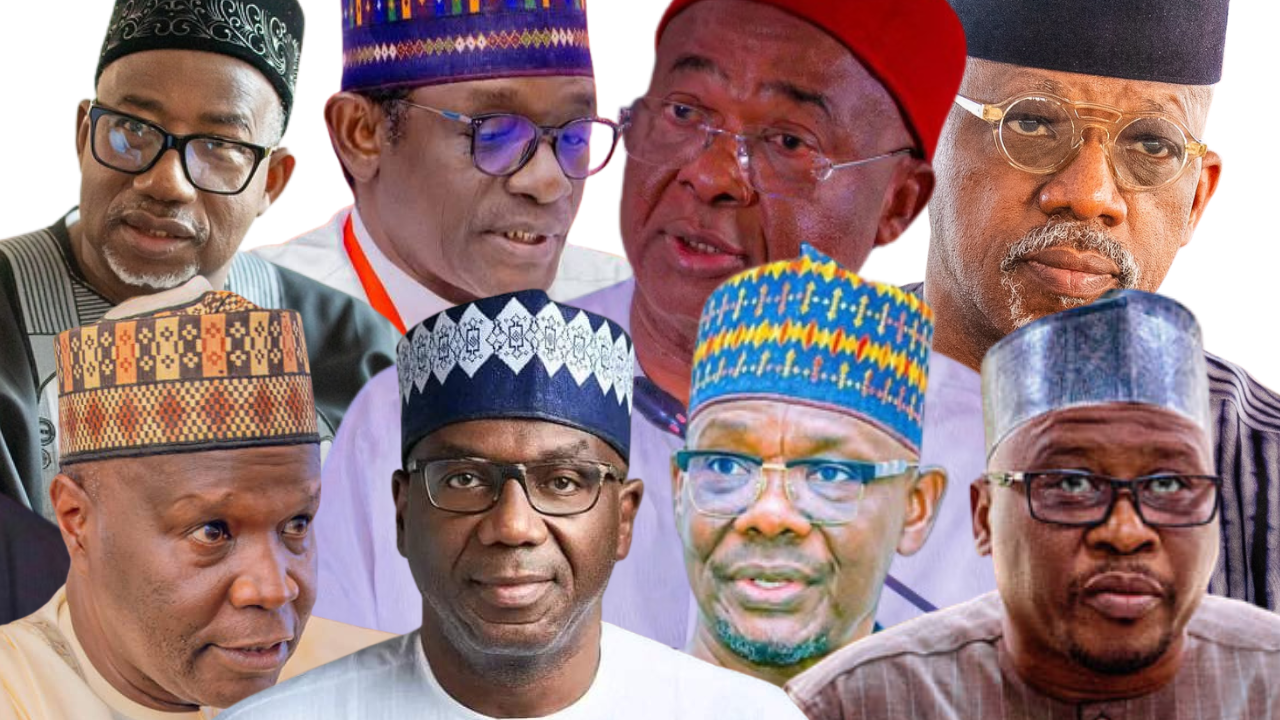

With a few months to the 2027 general elections, Nigeria’s political class is already witnessing a familiar migration pattern: outgoing governors preparing soft landings in the Senate, the country’s highest legislative body.
At least 12 of Nigeria’s 36 governors are serving their second and final terms in office. Ten of them will complete their constitutionally permitted eight years on 29 May 2027, while two – Bayelsa State Governor Douye Diri and Imo State Governor Hope Uzodimma – will leave office in early 2028 due to off-cycle elections.
For many of these governors, the question is no longer whether they will remain politically relevant after leaving office, but where they intend to relocate within Nigeria’s power structure. Increasingly, the preferred destination is the Senate, the upper chamber of the National Assembly.
The growing migration has become so pronounced that in the current 10th National Assembly, 14 former governors occupy seats in the Senate, reinforcing a long-standing pattern in which state executives move almost seamlessly from Government House to the Red Chamber.
This trend has transformed the composition and power dynamics of the upper chamber, where former governors now rank among the most influential blocs because of their extensive political networks, financial resources and executive experience.

The jostling has intensified following the conclusion of the APC senatorial primaries held on Monday, 18 May, where several outgoing governors either secured the party’s tickets directly or consolidated their grip on party structures ahead of the 2027 elections.
Governors in the race
Among the governors nearing the end of their tenure are AbdulRahman AbdulRazaq (Kwara), Abdullahi Sule (Nasarawa), Ahmadu Fintiri (Adamawa), Babajide Sanwo-Olu (Lagos), Babagana Zulum (Borno), Bala Mohammed (Bauchi), Dapo Abiodun (Ogun), Mai Buni (Yobe), Inuwa Yahaya (Gombe), and Seyi Makinde (Oyo), who recently declared his intention to run for president.
Messrs Douye Diri and Hope Uzodimma will also conclude their second terms in January and February 2028, respectively.
Although not all have publicly declared senatorial ambitions, no fewer than eight governors have already entered the race either directly or through endorsements by political stakeholders, while at least seven APC governors have already secured senatorial tickets following the ruling party’s primary elections.

Ahmadu Fintiri (APC, Adamawa State)
Among those with perhaps the clearest route to the Senate is Governor Fintiri of Adamawa State.
The governor’s ambition for the Adamawa North Senatorial seat received a major boost after the incumbent senator, Amos Yohanna, stepped aside in his favour.
Mr Yohanna announced his withdrawal during a stakeholders’ gathering in Mubi, where Mr Fintiri received his N20 million nomination forms.
“My resolve to support Governor Fintiri is guided by personal conviction and loyalty to our people,” the senator said.
The endorsement of Mr Fintiri, who recently moved from the PDP to the APC, demonstrated the immense influence sitting governors still wield within party structures and electoral calculations in their states.
It also highlighted a recurring political reality in Nigeria: lawmakers often struggle to withstand the political machinery of outgoing governors.
Mr Fintiri eventually emerged as the winner of the APC senatorial primary for Adamawa North, further consolidating his transition from Government House to the Red Chamber ahead of the 2027 general election.

Mai Buni (APC, Yobe State)
A similar scenario is unfolding in Yobe State, where Governor Buni appears to be enjoying institutional backing for his Senate ambition.
The senator representing Yobe East District, Musa Mustapha, did not only withdraw from seeking a second term but also openly endorsed Mr Buni for the seat.
According to him, the decision followed a stakeholders’ meeting of the Yobe APC Critical Stakeholders’ Forum held at the Government House in Damaturu and convened by Mr Buni alongside the Minister of Police Affairs, Ibrahim Geidam, a former governor of the state.
“To exercise the spirit of integrity and responsibility, I hereby formally withdraw from the contest for the APC governorship ticket,” Mr Mustapha said.
“Additionally, to make it explicitly clear, I am not contesting the senatorial ticket; rather, I will fully support our leader, His Excellency, Governor Mai Mala Buni, to contest the senatorial seat.”
Following the APC primary, Mr Buni secured the party’s senatorial ticket for Yobe East after emerging unopposed.

Abdullahi Sule (APC, Nasarawa State)
Abdullahi Sule is also among the outgoing governors positioning strongly for a Senate return.
The Nasarawa governor is seeking the Nasarawa North Senatorial seat which is currently vacant as a result of the passing of Godiya Akwashiki who occupied the seat until his death on 31 December, 2025.
He eventually clinched the APC senatorial ticket for Nasarawa North following the party’s primary election.

Hope Uzodimma (APC, Imo State)
The development in Imo State is uniquely interesting. Governor Hope Uzodimma purchased nomination forms under the APC to contest for the Imo West Senatorial seat, even though his tenure comes to an end in February 2028.
Mr Uzodimma previously represented Imo West in the Senate from 6 June 2011 to 9 June 2019 before becoming governor in 2020, making a possible return to the National Assembly both politically strategic and symbolically significant.
His contenders, a former governor and a former senator of Imo State, Rochas Okorocha and Osita Izunaso, also sought the APC ticket to represent the district in the upper chamber.
While Mr Okorocha represented the district from 2019 to 2023, Mr Izunaso is the incumbent senator. The trio are members of the APC.
Speculations have intensified that Mr Uzodimma had perfected plans to resign his position as governor to pursue his senatorial ambition, saying that he had struck a deal with his deputy, Chinyere Ekomaru, to resign her position, which will pave the way for the appointment of a new deputy governor.
Mr Uzodimma eventually emerged as the winner of the APC senatorial primary for Imo West, defeating other high-profile contenders and tightening his grip on the political structure of the state despite still having months left in office as governor.
![Kwara State Governor AbdulRahman AbdulRazaq [Photo Credit: Abdulrahman Abdulrazaq]](https://i0.wp.com/media.premiumtimesng.com/wp-content/files/2025/11/480549799_1173330487491205_1224809731778849767_n-e1763630634481.jpg?resize=729%2C463&ssl=1)
AbdulRahman AbdulRazaq (APC, Kwara State)
In Kwara State, AbdulRahman AbdulRazaq secured endorsements from sections of APC stakeholders for the Kwara Central Senatorial ticket.
If successful, the governor would replace the incumbent first-term senator, Saliu Mustapha, whose bid for the APC governorship ticket ended in defeat after the party’s governorship primaries.
Following the APC primaries, the governor won the ticket for Kwara Central Senatorial District, giving him a pathway to the Senate.
![Ogun State Governor, Dapo Abiodun [PHOTO CREDIT: Prince Dr. Dapo Abiodun - MFR]](https://i0.wp.com/media.premiumtimesng.com/wp-content/files/2026/04/475107770_1171258727695327_8223520622942216060_n.jpg?resize=2048%2C1364&ssl=1)
Dapo Abiodun (APC, Ogun State)
Perhaps one of the most politically symbolic contests is unfolding in Ogun East.
Governor Dapo Abiodun has emerged victorious in the APC primary, defeating the incumbent senator, Gbenga Daniel, himself a former governor.
The outcome marks a decisive shift in the internal power dynamics of the Ogun APC, where both men command significant political structures and loyal followings across the state.
It also signals the consolidation of the governor’s influence over the party’s senatorial architecture ahead of the 2027 general elections.

Muhammadu Yahaya (APC, Gombe State)
An equally fascinating battle is taking shape in Gombe State.
Muhammadu Yahaya joined the race for the Gombe North Senatorial seat currently occupied by Ibrahim Dankwambo, a member of the Peoples Democratic Party (PDP), who himself governed the state from 2011 to 2019.
He reportedly received his nomination forms during an expanded APC stakeholders’ meeting attended by governorship aspirants, National Assembly hopefuls, party executives and elders.
The governor eventually secured the APC senatorial ticket for Gombe North after the party primary.
If Mr Yahaya succeeds in the 2027 election, one former governor would effectively replace another in the Senate.

Bala Mohammed (APM, Bauchi State)
Governor Bala Mohammed is the only non-APC governor in the race. He has also picked the nomination form to contest the Bauchi South Senatorial District under the platform of the Allied Peoples Movement (APM).
Mr Mohammed was in the Senate from 2007 to 2010 on the ticket of the defunct All Nigeria Peoples Party (ANPP) until he was appointed FCT minister by President Goodluck Jonathan. He became Bauchi governor in 2015.
His bid to pick the APM ticket is not under any contention after leaving the PDP, where he was the chairman of the party’s governors’ forum.
Unlike the APC, which has already concluded its senatorial primaries, the APM is yet to conduct its primary election.
A familiar political tradition
The Nigerian constitution limits governors to two terms of four years each. After serving eight years, many governors historically seek seats in the Senate.
Over the years, the Senate has gradually evolved into what critics often describe as a “retirement home” for former governors. The pattern cuts across party lines and regions.
The movement became especially visible and institutionalised after the 2007 elections, widely regarded as the defining moment when outgoing governors began transitioning to the Senate in large numbers during Nigeria’s Fourth Republic.
The 2007 transition marked the first major turnover of governors elected at the beginning of democratic rule in 1999 who had completed two consecutive terms under the 1999 Constitution. Many sought to preserve political relevance by moving directly into the Senate.
Among the prominent former governors who moved to the Senate after leaving office in 2007 were George Akume, who represented Benue North-west after serving as governor between 1999 and 2007; Ahmed Makarfi, who moved from Kaduna Government House to the Senate; Joshua Dariye (Plateau); Adamu Aliero (Kebbi); Saminu Turaki (Jigawa); and Ahmed Yerima (Zamfara), who remained influential in the upper chamber for years.
That 2007 cycle effectively established a template that later evolved into a recurring political culture. The pattern expanded significantly after the 2011, 2015, 2019 and 2023 elections as former governors such as Bukola Saraki (Kwara), Aliyu Wamakko (Sokoto), Ibikunle Amosun (Ogun), Tanko Al-Makura (Nasarawa), Orji Kalu (Abia), Godswill Akpabio (Akwa Ibom), Adams Oshiomhole (Edo), Ibrahim Gaidam, (Yobe) Theodore Orji (Abia), Rochas Okorocha (Imo), Seriake Dickson (Bayelsa), and many others reinforced the tradition.
The movement from state executive offices to the Senate has not been limited to governors alone. Several former deputy governors have also transitioned into the National Assembly after leaving office.
Among them are Enyinnaya Abaribe, former deputy governor of Abia State; Ibrahim Hadejia, former deputy governor of Jigawa State, and Biodun Olujimi, who served as deputy governor of Ekiti State and later became the senator for Ekiti South Senatorial District.

Why the Senate remains attractive
Several factors explain this attraction. First is political survival.
After controlling state structures for eight years, many governors are reluctant to disappear from national politics. A Senate seat offers continued visibility, influence and relevance.
President of the Campaign for Democracy (CD), Ifeanyi Odili, said the trend reflects how political power in Nigeria circulates within a small elite class rather than opening opportunities for new entrants.
“When second-term governors buy senatorial forms before leaving office, it means the Senate is used as the next rung on a career ladder, not as a distinct arm of government with its own talent pipeline.” Mr Odili told PREMIUM TIMES.
According to him, the growing movement of governors into the nation’s highest lawmaking body weakens internal party democracy because governors already control party structures, delegate lists and campaign financing within their states.
Mr Odili also linked the Senate ambitions of outgoing governors to fears of political vulnerability after losing constitutional immunity from prosecution.
According to him, while not all governors facing Senate races are under investigation, many perceive continued political office as a layer of protection against possible anti-corruption scrutiny after leaving Government House.
He said, “Many governors also see the Senate as an escape route from pending EFCC cases. Once immunity ends, prosecution becomes a real risk and probably inevitable. Apart from defecting to the ruling party to seek vote, securing a Senate seat is one of the few sure ways to gain political cover and avoid immediate arrest, prosecution, or detention.”
He further warned that the trend risks weakening legislative independence because former governors often arrive in the Senate with entrenched executive influence and strong political structures behind them.
According to him, the pattern also limits opportunities for younger and grassroots politicians who cannot compete with outgoing governors in terms of resources, political structures and name recognition.
“The Senate starts to look less like a deliberative body and more like a holding space for former executives,” he said.
Second is the protection of political structures. Governors often seek legislative offices to maintain influence over their successors and preserve their political networks within their states.
Third is access to federal power. The Senate remains one of the most influential institutions in Nigeria’s political architecture, particularly in appointments, budget approvals and oversight functions.
Significantly, unlike governors who are constitutionally limited to two terms in office, senators face no tenure restriction, allowing them to seek re-election indefinitely.
There is also the prestige attached to the office. For many governors, moving from a government house to political retirement is seen as a decline in status, while transitioning to the Senate provides continuity.
The trend has often been defended as a continuation of public service and a way to deploy executive experience in lawmaking. Supporters argue that former governors bring administrative knowledge, political networks and national visibility that can strengthen legislative oversight and policymaking.
Critics, however, see it differently.
One of the major criticisms surrounding the movement of former governors to the Senate is the issue of double compensation.
Several ex-governors who later became senators have faced public backlash for earning salaries and allowances as federal lawmakers while also benefiting from generous pension packages approved by their state governments for former governors and deputy governors.
Across Nigeria, roughly 25 states enacted pension-for-life laws granting former governors extensive retirement benefits after office. Depending on the state, such packages included houses in Abuja and their home states, vehicles replaced periodically, domestic staff, medical allowances, security personnel and annual cash payments.
Analysts estimate the cumulative cost of these pension arrangements at over ₦100 billion.
The debate intensified after the inauguration of the 10th Senate in 2023, which included a large number of former governors.
The civic organisation, Socio-Economic Rights and Accountability Project (SERAP), publicly demanded that former governors serving in the Senate disclose whether they were still receiving pensions and retirement benefits from their states while also earning federal legislative salaries and allowances.
According to SERAP, drawing benefits from multiple public offices at the same time amounted to “double pay” funded by taxpayers.
The controversy had earlier forced some states to review their pension laws. In November 2020, Governor Babajide Sanwo-Olu announced plans to repeal the Lagos State Public Office Holder (Payment of Pension Law) 2007, which granted generous retirement benefits to former governors and their deputies.
However, when the Lagos State House of Assembly passed the amendment in August 2021, lawmakers stopped short of completely abolishing the law. Instead, the legislature reduced financial benefits by 50 per cent, removed provisions for houses in Lagos and Abuja, and reduced the number of official vehicles while extending replacement periods from three to four years.
Lawmakers argued that fully withdrawing security and domestic staff attached to former governors could expose former top officials to security risks.
Critics argue that the Senate has become an elite protection platform where former governors seek political relevance, immunity from obscurity, and continued access to state structures after leaving office.
Others believe the trend weakens internal party democracy because sitting governors often deploy incumbency powers to displace lawmakers already occupying those seats.
READ ALSO: Senate amends Electoral Act on court jurisdiction on pre-election disputes
The unfolding contests ahead of 2027 appear set to reinforce both arguments.
A former Senate Chief Whip, Victor Oyofo, had previously criticised the growing migration of governors to the National Assembly, arguing that many former governors pursue Senate seats more for comfort and continued privilege than legislative service.
“It has become obvious that politics is the quickest way to unearned wealth,” he once said.
“Most of the governors, after they have given a heavy retirement pension for themselves, work their way to the National Assembly as senators, where they enjoy their retirement in opulence.
“This trend is not unnoticed by the populace, even if they appear hopeless and speechless.”
Failed bids
Despite the trend, not all governors successfully transition to the Senate.
For instance, in 2023, former governors who lost senatorial bids even before leaving office include ex-Abia governor Okezie Ikpeazu, former Benue governor Samuel Ortom, former Enugu governor Ifeanyi Ugwuanyi, Ben Ayade of Cross River, Atiku Bagudu of Kebbi State, among others.