
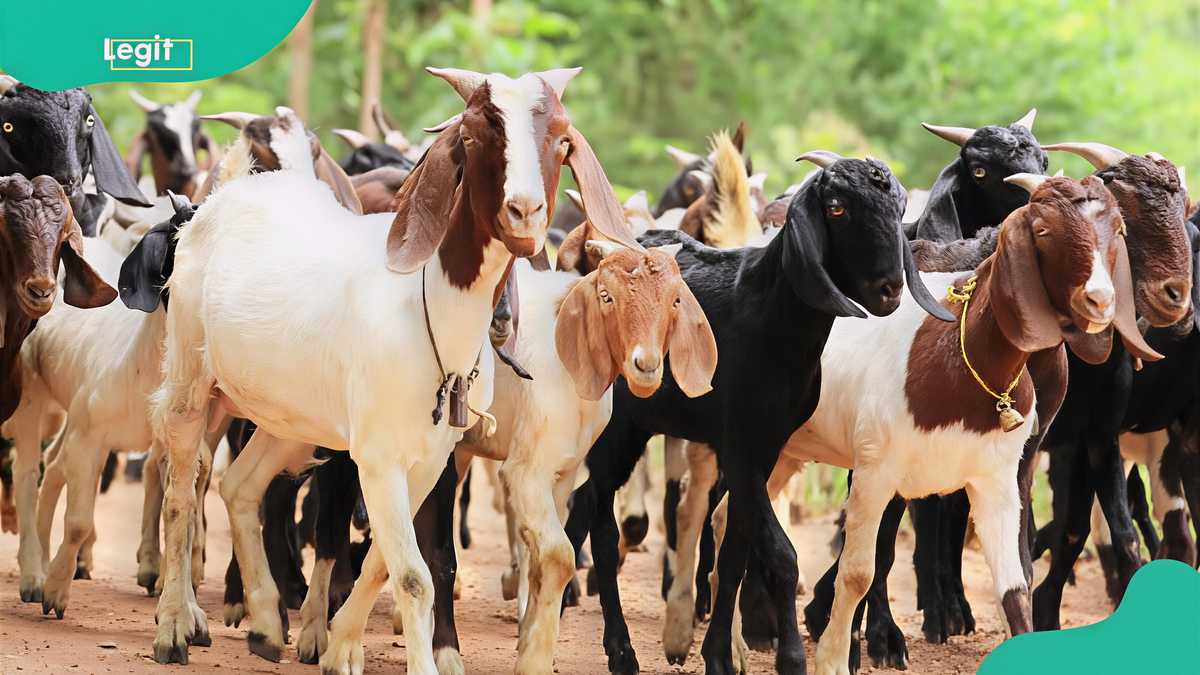

How much does it cost to start goat farming in Nigeria? The budget for goat farming in Nigeria can begin from as low as ₦300,000 for stock acquisition, housing, fencing, healthcare, and nutrition. Profitability from goat farming is contingent upon the farm’s size, location, breed, and nutrition.

Source: Facebook
TABLE OF CONTENTS
Key takeaways
- Starting a small-scale goat farm in Nigeria with 10 goats requires between ₦300,000 and ₦700,000, covering animals, housing, fencing, and initial feeding.
- A mature goat sells for ₦35,000 to over ₦100,000, with prices rising sharply during cultural and religious ceremonies such as Eid al-Adha and Christmas.
- Profit in goat farming in Nigeria generally starts from the second year, once the herd has grown and operational costs are better controlled.
- As it is one of Nigeria’s most sought-after meat sources, net profit from a small herd can range from ₦250,000 to over ₦400,000 annually.

How much does it cost to start goat farming in Nigeria?
A flock of 5 to 10 goats is sufficient to start a goat farm. This initial cost can be anywhere from ₦300,000 to ₦700,000, depending on the breed.
A mid-scale operation of 30 to 50 goats requires roughly ₦1.5 million to ₦3 million, while a commercial farm running 100 or more goats requires an investment of more than ₦5 million.
Turning goat farming into a workable business opportunity in Nigeria? Here is a full breakdown of every major cost category.
The cost of buying goats in Nigeria

Source: Facebook
At the start, building your initial stock can seem like a daunting expense. Prices vary widely by breed, size, age, purpose, pedigree, and location of purchase. Have a look at the average cost estimates of goats in Nigeria by breed as of 2026.
|
Breed |
Cost in Naira (per goat) |
|
West African goats |
₦10,000–₦20,000 |
|
Sokoto Red goats |
₦20,000–₦40,000 |
|
Boer goats |
₦50,000–₦100,000 |
|
Sahelian goats |
₦50,000–₦120,000 |
|
Kalahari goats |
₦25,000–₦3 million |
|
Savannah goats |
₦2.5 million–₦3.5 million |

As a beginner, you can opt to start with local breeds, which are cheaper compared to imported breeds. Buying younger goats also significantly slashes the cost for beginners.
Buying goats directly from relatively cheaper northern markets in Sokoto, Kano, Kaduna, and Bauchi is a common cost-reduction strategy used by experienced farmers.
Land costs
One to two hectares are sufficient for grazing and housing a small- to mid-sized flock. Larger farms of 50 to 100 goats may need five or more hectares.
Land lease costs in peri-urban and rural areas vary by state, from ₦30,000 to over ₦200,000 per hectare annually.
Housing and fencing costs

Source: Facebook
Goats need clean, dry, well-ventilated, and secure shelter from predators. According to Farming In Africa, a basic goat shed for 40 animals costs about ₦1,718,500 for a 10-foot by 17-foot shelter.
While a 10-foot by 17-foot space provides 170 square feet in total, the recommended indoor space for an adult goat is a minimum of 15 feet by 20 feet of shelter. For 40 goats, you would ideally need between 600 and 800 square feet of indoor shelter space. Larger structures for 50 to 100 goats can cost more than ₦5 million.

Fencing is equally essential, as goats are natural wanderers. Farmers often use barbed wire or welded mesh fencing, which adds ₦20,000 to ₦50,000 to a small farm’s budget. A larger perimeter for a commercial farm could cost between ₦100,000 and ₦300,000.
|
Scale |
Goats |
Estimated start-up cost |
|
Small-scale |
1–5 goats |
₦50,000–₦150,000 |
|
Middle scale |
5–10 goats |
₦300,000–₦700,000 |
|
Large-scale |
30–50 goats |
₦1.5 million–₦3 million |
|
Commercial scale |
More than 100 goats |
₦5 million |
How much does a goat cost per month?
Once you are operational, the main recurring costs are feeding, healthcare, and labour. For a 10-goat farm, expect total monthly running costs of roughly ₦25,000 to ₦60,000. Here is a breakdown of the recurring goat farming expenses.
|
Expense |
Average cost |
Key elements |
|
Feeding |
₦2,000–₦5,000 per month |
Fodder crops, pasture grazing, and supplementary feed |
|
Healthcare |
₦1,000–₦3,000 per year |
Routine vaccination, deworming, and veterinary visits |
|
Labour |
₦30,000–₦80,000 per month |
Full-time farmhand |
|
Miscellaneous |
₦10,000–₦30,000 per month |
Water supply, equipment maintenance, transportation, and record-keeping |
How many times will a goat give birth in a year?

Source: Twitter
Goats have a gestation period of 145 to 150 days, approximately five months. Under optimal conditions and with strategic breeding management, some farmers achieve a 3-in-2-year cycle, meaning three pregnancies over two years.

The typical litter size is one to two kids per pregnancy. This means a doe in good health can add two new animals to your herd per year. The reproductive cycle is a key driver of profitability.
Is the goat business profitable in Nigeria?

Source: Facebook
When managed properly, goat farming is among the more profitable livestock businesses available to Nigerian entrepreneurs. This profitability is driven by the year-round national demand for goat meat (chevon).
Goat meat is a key component in Nigerian cuisine, such as pepper soup, suya, and stews. Additionally, demand spikes sharply during festive ceremonies.
Nigeria imported approximately $1.28 million worth of animal products in 2022, according to World Bank data. Local production currently meets only about 30% of national demand, a gap that represents a direct commercial opportunity.
A well-fed mature goat can sell for ₦35,000 to over ₦100,000, depending on size and season. Farmers who time sales to coincide with festive seasons consistently report higher margins.
Goat farming risks to factor in
The main threats to goat farming in Nigeria include disease, theft, feed cost, and weak market access. Here is a summary of the risks a local farmer can encounter and how to handle them.

|
Risks and their effects |
Remedies |
|
Herd loss caused by pests, parasites, and disease |
Routine vaccination, deworming, and veterinary visits |
|
Herd loss caused by theft |
Secure fencing |
|
Lower livestock margins caused by a spike in feed prices |
Waste management, feed conservation using silage and hay, and drought-tolerant fodder |
|
Low profitability due to weak market access |
Establishing a direct-to-market supply chain |
Is the goat business profitable in Nigeria?
Goat farming is one of the most profitable businesses in Nigeria due to strong year-round demand for chevon, low mortality rates compared to poultry, and the animals’ reproduction ability. Profitability becomes clear from the second year of operation, once the herd has grown and costs are stabilised.
What is the profit from 100 goats in Nigeria?
A well-managed commercial farm of 100 goats can generate an estimated net profit of ₦2 million to ₦7 million annually, depending on sale prices, feed costs, and market access. Selling during festive seasons and directly to end buyers significantly improves margins.
How many times will a goat give birth in a year?
Goats typically give birth once a year. Under a structured 3-in-2-year breeding programme, a doe can produce three litters over two years. However, this requires close veterinary and nutritional management.

How much does a goat cost per month?
The monthly cost of keeping one goat in Nigeria ranges from ₦2,000 to ₦5,000 for feeding alone. Healthcare, housing maintenance, and labour costs bring up the monthly cost per goat to about ₦3,000 to ₦8,000, depending on farming system and location.
What does small-scale goat farming in Nigeria entail?
Small-scale goat farming in Nigeria typically entails keeping about 5 to 30 goats, usually managed by an individual or family. It requires startup capital of between ₦300,000 and ₦1.5 million and is commonly used as a supplementary income source alongside formal employment, freelance work, or other farming activities.
Determining how much to start goat farming in Nigeria requires balancing available capital with long-term production goals. Initial costs vary by scale and breed choice. With strategic management and sales, farmers can expect stabilised profits after two years.
DISCLAIMER: This article is not sponsored by any third party. It is intended for general informational purposes only and does not address individual circumstances. It is not a substitute for professional advice or help and should not be relied on to make decisions of any kind. Any action you take upon the information presented in this article is strictly at your own risk and responsibility!

Legit.ng recently published an informative post about the OPay USSD codes for balance, transfer, data, and how to activate. The mobile money platform allows customers to complete most transactions without the Internet through their USSD service.
Since 2018, OPay has been enhancing its customer service. The OPay USSD code enables a range of banking transactions, including money transfers, airtime and data purchases, withdrawals, and more. Read on to discover all OPay USSD codes for convenient transactions.
Proofreading by Kola Muhammed, copy editor at Legit.ng.
Source: Legit.ng