
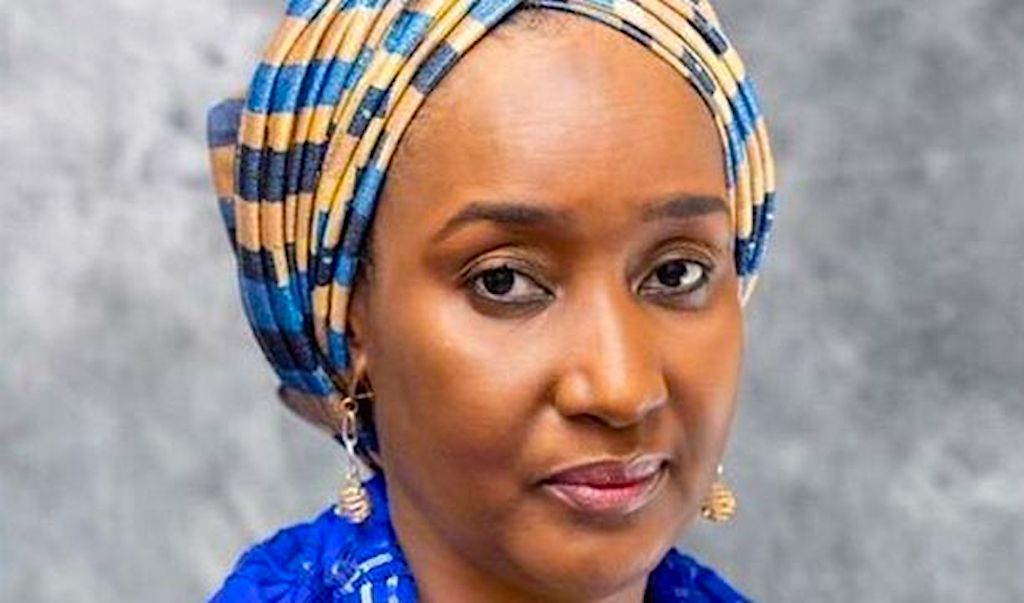

Former Minister of Humanitarian Affairs, Disaster Management and Social Development, Sadiya Umar-Farouq, on Monday, failed to appear before the Federal Capital Territory (FCT) High Court in Abuja for her scheduled arraignment on fraud charges involving $1.3 million and N746.6 million.
This is coming a month and two days after trial judge Jude Onwuegbuzie ordered her and one of her co-defendants to be arrested and brought to court.
The judge, after issuing the arrest warrant against the two individuals on 16 April, set today (Monday) for the Economic and Financial Crimes Commission (EFCC) to arraign the defendants.
However, Ms Umar-Farouq’s legal team, again on Monday, blamed her absence on ill health, the same excuse offered for her failure to attend the 16 April proceedings.
At the 16 April hearing, the court ordered the arrest of Ms Umar-Farouq and her permanent secretary at her then-ministry, Bashir Nura Alkali, for their failure to appear for arraignment.

The judge said their lawyers had not been able to produce them for arraignment since the charges were filed in December.
Their co-defendant, Sani Nafiu Mohammed, who is the third defendant, was present in court.
Mr Mohammed and Mr was present in court on Monday.
Mr Alkali, who was ordered to be arrested alongside Ms Umar-Farouq, was also present in court on Monday.
Defence gives reason for ex-minster’s absence
EFCC’s lawyer Rotimi Jacobs, a Senior Advocate of Nigeria (SAN), asked the court to vacate Mr Alkali’s warrant of arrest following his earlier surrender at the commission’s office.
Mr Jacobs also told the court that the anti-graft agency was trying to collaborate with international partners to arrest Ms Umar-Farouq and sought for time for it to be done.
However, the former minister, through her lawyer, filed an application to discharge the bench warrant that the court issued against her. An additional affidavit was filed on 15 May and served on the EFCC.
Mr Jacobs reminded the judge that Ms Umar-Farouq’s lawyer had explicitly undertaken to produce her at Monday’s (today’s) hearing.
He urged the court to enforce the undertaking. However, in his defence, the former minister’s lawyer, Oladipo Okpeseyi, also a SAN, two events overshadowed the undertaking. First, the application to vacate the arrest warrant and the publication of the EFCC “To the whole world, the notice that the first defendant should be arrested anywhere.”
Exasperated, the trial judge, Mr Onwuegbuzie, asked Ms Umar-Farouq’s lawyer to inform the court of her whereabouts.
Mr Opeseyi said she was medically challenged and “the EFCC granted her leave to go for medical attention when the anti-graft agency took her in as a suspect.”
“She is still in the hospital in Egypt and cannot leave against the doctor’s advice. The doctor said she needed to stay another two months in the hospital, and this is contained in her medical report.
“She is not medically fit to come; we humbly ask for an adjournment so that we can also take the motion.”
Mr Jacobs did not oppose this. Thereafter, the judge vacated the order of arrest against Mr Alkali and warned that if Ms Umar-Farouq does not appear at the next adjourned date, “the court will be forced to wield the stick.”
The judge rescheduled the arraignment for 8 June.
Charges
In December, EFCC filed 21 counts of breach of trust and diversion of public funds against the three defendants.
The prosecution accused Ms Umar-Farouq and her co-defendants with abuse of office, breach of trust, fraudulent award of contracts, and criminal conversion of public funds. The financial infractions allegedly involved $1.3 million and N746,574,303
EFCC alleged that the sum of $1.3 million was excess funds paid by the National Social Safety Net Coordinating Office (NASSCO), supervised by the ministry, for the validation of Rapid Response Register beneficiaries.
It said the money was meant to be refunded by the contractor, Social Development by Visual ICT Limited, to the ministry. But instead of refunding it, the prosecution alleged, Ms Umar-Farouq and Mr Alkali, then-permanent secretary of the ministry, converted it to their “personal benefit”.
EFCC also alleged that the defendants committed the offences, charged under section 315 of the Penal Code, between 8 May 2021 and 22 September 2022, while Ms Umar Farouq was serving as the minister overseeing the ministry.
Long road to trial
As minister, Ms Umar-Farouq led a scandal-scarred Ministry of Humanitarian Affairs, Disaster Management and Social Development, which championed the federal government’s social security intervention funds, including the direct cash transfers and school feeding.
In September 2020, the Independent Corrupt Practices and Other Related Offences Commission (ICPC) said its investigations revealed a diversion of N2.67 billion meant for school feeding during the COVID-19-induced lockdown
The funds were reportedly intended for feeding boarding students in Federal Government Colleges who were all at home during the COVID-19 lockdown.
Calls for her probe and possible prosecution intensified after she left office, upon the completion of the second and final term of President Muhammadu Buhari in May 2023.
She served as the minister between August 2019 and May 2023.
On 8 January 2024, the EFCC detained Ms Umar-Farouq for questioning over allegations of corruption in the handling of N37.1 billion social intervention funds during her tenure.
EFCC’s investigation follows reports of the diversion of funds from her ministry.
In July 2024, while the EFCC investigation was going on, the Federal High Court in Lagos ordered the former minister to account for payments of N729 billion to 24.3 million poor Nigerians for six months and also provide the list and details of the beneficiaries who received the payments, the number of states covered and the payments per state. The judgment followed a Freedom of Information suit brought by the Socio-Economic Rights and Accountability Project (SERAP).
Ms Umar-Farouq has, however, emphasised her willingness to defend her actions in a tweet she posted on X in the wake of EFCC investigations into her.
“I remain proud to have served my country as a minister of the Federal Republic of Nigeria with every sense of responsibility and will defend my actions, stewardship and programmes during my tenure whenever I am called upon to do so,” she wrote.
Her successor, Betta Edu, appointed by President Bola Tinubu in 2023, was also caught in the web of another scandal shortly after she took office.
PREMIUM TIMES reported the scandal, including the approval of payment of hundreds of millions of naira into private accounts of civil servants.
Mrs Edu came under criticism from Nigerians for ordering the transfer of N585.2 million into the private bank account of a civil servant, who is the accountant in charge of grants for Vulnerable Nigerians.
She also faced an EFCC investigation into the scandal, although the outcome or status of the probe is not yet public.
In January 2024, EFCC detained her for a few hours as part of the probe.