

On 16 February 2023, then President Muhammadu Buhari signed a law intended to upgrade one of Nigeria’s most strategic training institutions.
The law—University of Maritime Studies, Oron (Establishment) Act 2022, gazetted on 15 May 2023, created a new university in Akwa Ibom State and repealed the Maritime Academy of Nigeria Act, CAP M3 Laws of the Federation of Nigeria 2004, which had governed the Maritime Academy of Nigeria (MAN), Oron for decades.
In legal terms, the academy ceased to exist on 16 February 2023.
Three years later, that legal stamp has not translated into practice as the university exists only on paper, while the academy, which the law abolished, continues to operate.
Students still apply to the academy for admission. Budgets are still prepared in its name. Federal allocations continue to flow to the academy. Billions of naira move through a structure that no longer has legal backing.

An investigation by PREMIUM TIMES reveals that this delay is not due to routine bureaucracy. It is driven by the convergence of individuals’ financial interests and weak accountability. Insiders say powerful government officials benefit from keeping the institution in its current state: neither fully upgraded nor legally compliant.
University defined by law, absent in reality
The law that created the University of Maritime Studies, Oron, set out a mandate for degree-awarding programmes in marine engineering, nautical science and related fields. It also mandates postgraduate research in shipping, maritime technology and marine environmental protection.
The university is to operate under the National Universities Commission and align with global standards set by the International Maritime Organisation. It is designed to serve as a national hub for maritime research, innovation and international collaboration.
Its location in Oron, close to Nigeria’s maritime boundary with Cameroon, positions it as a strategic asset for the country’s blue economy. However, none of these provisions has been implemented.
Promises without progress
Faced with growing concerns, government officials have repeatedly said the transition is underway.
In a 29 November 2024 letter to the Senate Committee on Legislative Compliance, the Federal Ministry of Marine and Blue Economy said it had directed the academy to begin transitioning. It also said it initiated a joint process involving the Ministry of Education and the National Universities Commission.
A follow-up meeting was scheduled for December 2024.
On 7 April 2025, the Joint Admissions and Matriculation Board (JAMB) invited the institution to an orientation for newly approved universities, a step meant to integrate it into the national admission system.
At first glance, these steps suggested movement.
However, the reality on the ground told a different story. The academy continued to admit students under its old structure.
Even at the 2025 graduation ceremony in Oron, the Minister of Marine and Blue Economy, Adegboyega Oyetola, stated the government’s commitment to transition.
“We hope that this upgrade will unlock new opportunities for advanced learning, cutting-edge research and innovation,” he said.
Despite the assurances, “hope” has yet to materialise.
Community demands, political hesitation
As the delay continued, frustration grew within the host communities.
In December 2025, leaders from the Oron ethnic nationality travelled to Abuja to press for the implementation of the law.
They met with the President of the Senate, Godswill Akpabio, and asked him to facilitate the appointment of a governing council, a vice-chancellor, and other principal officers for the university.
Their meeting with Mr Akpabio revealed a deeper layer of the problem.
According to Mr Akpabio, there is a split within the government over the institution’s future. Some officials favour retaining the academy structure while granting it degree-awarding powers, similar to the Nigerian Defence Academy. He explained that the reason is funding.
According to Mr Akpabio, as an academy, the institution receives funds from agencies such as the Nigerian Maritime Administration and Safety Agency (NIMASA) and international bodies. He argued that a full transition to a university would place it under the Federal Ministry of Education, where funding and oversight differ.
“You have spoken tonight about your preference for a Maritime University. I will convey your decision,” Mr Akpabio told the delegation after deliberations.
The exchange exposed a central tension in the institution’s transition: the choice between legal compliance and financial convenience.
In January 2026, a group within the host communities, the Oro Youth Movement, reinforced pressure by writing to the minister of Marine and Blue Economy, describing the delay as “undue” and calling for immediate implementation of the law.
Following the root of the institution’s problem: money
Financial records reviewed by PREMIUM TIMES show why the status quo has remained attractive.
Under Section 16 (2) of the NIMASA Act, the agency must remit at least five per cent of its annual revenue to the Maritime Academy of Nigeria. This provision has generated billions of naira for the academy.
Between 2021 and 2024, NIMASA remitted N12.21 billion to the institution. Records from NIMASA financial statements show that in three years alone, the agency remitted N12.21 billion to the academy:
In 2021, N6.19 billion was remitted. 2022, N3.93 billion; and 2024, N2.09 billion.
Figures for 2023 and 2025 are not publicly available. NIMASA acknowledged a media enquiry from PREMIUM TIMES on 9 March 2026 regarding the 2023 and 2025 figures, but had yet to provide the data at the time of filing this report.
However, a closer look at the academy’s spending records tells a revealing story.
Data from Nigeria’s Open Treasury Portal, which tracks spending across federal institutions, shows that the academy consistently spends far less than it receives from NIMASA. Consequently, the whereabouts of the remaining balances remain unknown.
In 2021, the academy spent N1.37 billion out of the N6.19 billion it received. In 2022, it spent N361.85 million out of the N3.93 billion NIMASA remitted. In 2024, it spent N602.28 million out of N2.09 billion.
Curiously, a comparison of the revenue remitted by MIMASA with the federal government’s budget for the academy shows that each year the government continues to approve a relatively lower budget for the academy, leaving unaccounted funds.
For instance, in 2021, when the N6.19 billion revenue was remitted, the federal government approved a budget of N2.1 billion, which was 33.9 per cent of the revenue.
The pattern continued the following year. In 2022, when the academy received N3.93 billion, the federal government’s approved budget for the academy was N2.06 billion. It was no different in 2024 when N2.09 billion was remitted as revenue to the academy. That year, the federal government budget for the academy stood at N1.63 billion.
Each of those years, the billions of naira that remained unspent from the analysis of the academy’s expenditures, as reported on the Open Treasury Portal, and from the academy’s budget approvals, remain unexplained in publicly available records.
When contacted on 8 March, the Acting Rector of the Academy, Okonna Kevin, did not respond to questions about whether the unspent funds had been returned or carried forward, or what accountability measures were in place to manage them.
After listening to the questions, he hung up the phone. He also did not respond to messages seeking clarification at the time the report was filed.
Sources in the Ministry of Marine and Blue Economy and the Ministry of Education told PREMIUM TIMES that the academy’s funding and budgeting model gives it unusual financial flexibility, leaving room for the diversion of funds with little or no alarm raised.
One source described the academy as “a cash cow for powerful interests in Abuja.”
They said converting the academy into a university would introduce tighter controls and reduce discretionary spending.
History of questioning financial accountability
Concerns about financial management at the academy are not new.
Over the years, the institution has faced repeated allegations and investigations linked to financial mismanagement.
In 2015, a former rector, Joshua Okpo, was investigated over an N18 billion fraud case.
In 2021, another former rector, Joshua Effedua, alleged that as much as 80 per cent of funds allocated to the academy had been misappropriated over time.
That same year, the Senate Committee on Public Accounts investigated the institution over the alleged diversion of N1.05 billion.
In 2023, the Independent Corrupt Practices and Other Related Offences Commission listed it among 52 federal agencies with high corruption risk.
Taken together, these events reinforce concerns about how funds linked to the institution are managed.
Legal contradiction
While financial questions linger, the legal contradiction is even more direct.
The Act that created the University of Maritime Studies repealed the Maritime Academy Act. Yet the federal government continues to allocateee funds to the academy in its annual budgets.
In 2024, N1.63 billion was allocated in its name. In 2025, the figure rose to N3.11 billion. For 2026, N2.73 billion has been proposed.
During 2026 budget deliberations, Senate Minority Leader Abba Moro warned that the practice could expose the National Assembly to legal action.
He said, “This is a legal matter. I think if we do not comprehensively address it, we may be complicit in illegality. All funds allocated to the Maritime Academy Oron from the date the law establishing the Maritime University becomes law are illegal allocations.
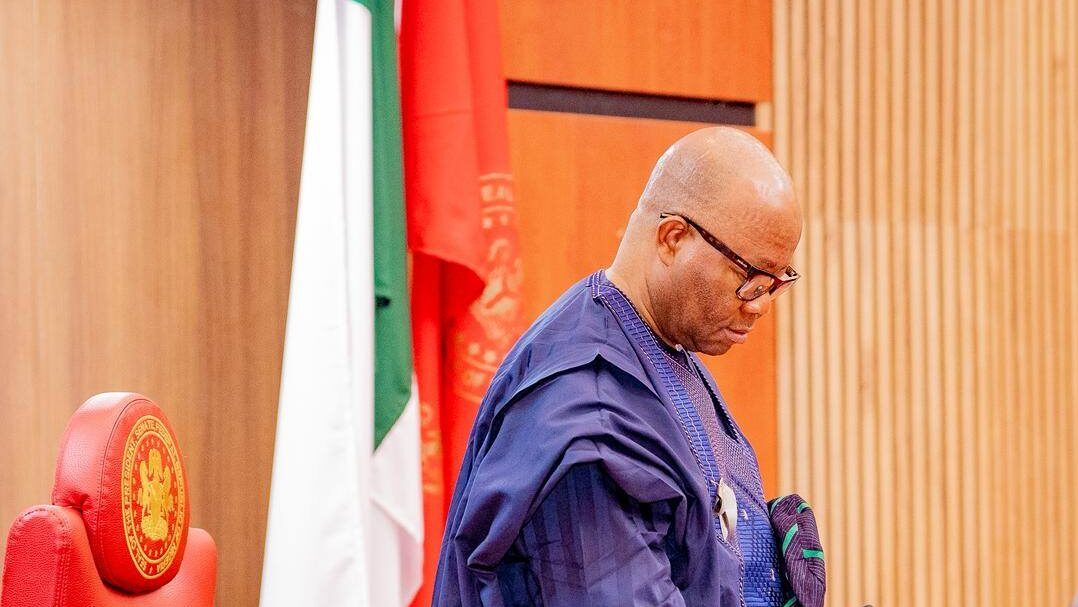
“If they take the National Assembly up for allocating funds to
![The Senate President, Godswill Akpabio [PHOTO CREDIT: Godswill Obot Akpabio]](https://i0.wp.com/media.premiumtimesng.com/wp-content/files/2026/02/626757986_1486187732863083_387420584751448298_n-e1773649409858.jpg?resize=1078%2C607&ssl=1)
which no longer exist in the eye of the law, then certainly we will have questions to answer.”
Mr Moro asked the Chairman of the Appropriation Committee, Solomon Adeola, to work with relevant authorities to ensure the law is adhered to when transitioning the institution before the 2026 appropriation bill is passed into law.
Tale of two institutions
Developments elsewhere make the delay in Oron more questionable and point to what is possible when political will aligns with legal mandate.
On 27 January 2025, President Bola Tinubu signed the law establishing the Nigeria Maritime University, Okerenkoko.
Within months, it had a vice-chancellor and was integrated into the federal university system.
Its 2025 budget stood at N5.08 billion, rising to a proposed N5.26 billion for 2026—almost double the allocation for the Oron institution.
READ ALSO: Buhari declines assent to Maritime University Bill, one other
Silence from officials
PREMIUM TIMES sent detailed enquiries to the Federal Ministry of Marine and Blue Economy and the Senate Committee on Marine Transport and Blue Economy on 27 February 2026, the Federal Ministry of Education on 6 March 2026, and the Acting Rector of the Maritime Academy on 8 March 2026.

The questions submitted to the Ministry of Marine and Blue Economy, directed to the Special Adviser to the Minister, Bolaji Akinnola, sought explanations on several points: What concrete steps has the ministry taken since February 2023 to transition the academy? What factors have contributed to the apparent delay? Why do the Ministry’s budget documents continue to reflect allocations under the repealed academy? What is the timeline for completing the transition and ensuring full compliance with the Act? Has the Ministry issued any formal directives, implementation guidelines, or transition framework to give effect to the institution’s new legal status?
The same questions were asked the Director of Press and Public Relations of Federal Ministry of Education, Folasade Boriowo.
For the Chairman, Senate Committee on Marine Transport and Blue Economy, Wasiu Eshilokun PREMIUM TIMES asked about specific steps the committee has taken to ensure that the institution’s legal status aligns with the Act, the legal or administrative basis that informs the committee’s continued budgetary approvals and seeming inactions over continued expenditures made under the academy’s designation, the explanations, if any that the executive arm has provided to the committee regarding the delay in fully operationalising the University of Maritime Studies, and concrete interventions the committee intend to pursue to ensure compliance with the Act and a seamless transition to the university framework envisaged by law.
None of the officials responded to the questions before this report was filed.
Yet, for students, maritime professionals and the host communities of Oron, the issue is no longer just administrative but about the credibility of Nigeria’s maritime education system and the effectiveness of the law of the land.