
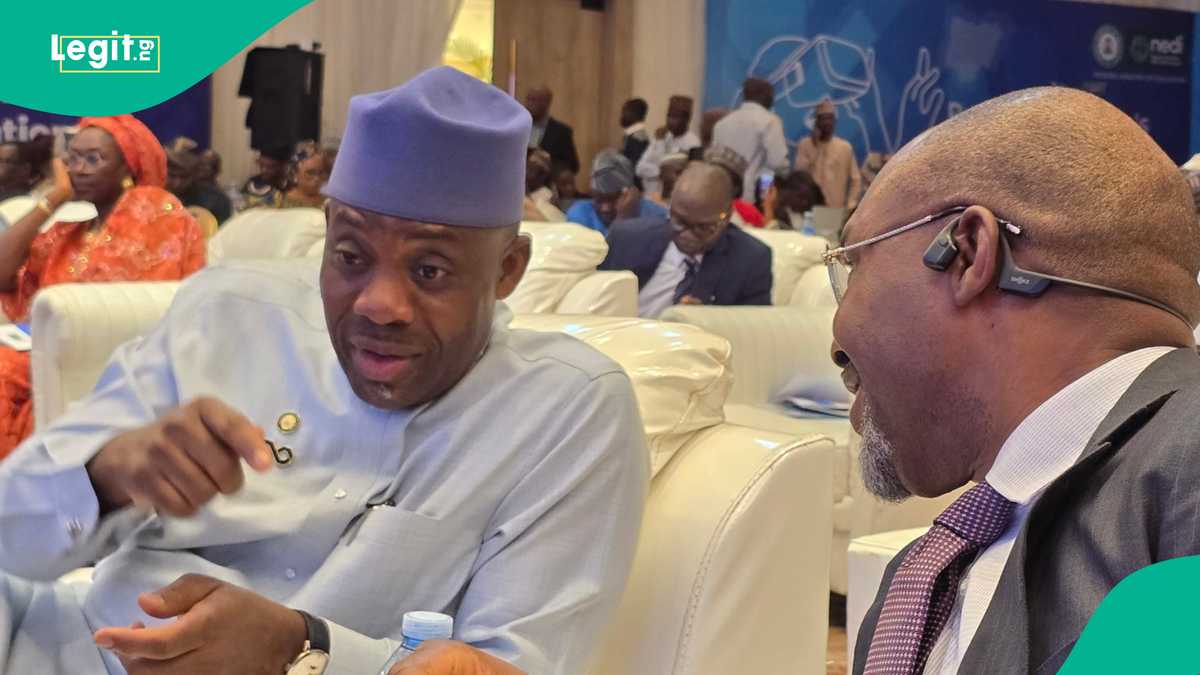

- Former aviation minister Osita Chidoka has endorsed Education Minister Tunji Alausa’s ongoing education reforms
- Chidoka said delays in education reforms permanently affect children, particularly Nigeria’s estimated 15 million out-of-school children
- The ex-minister also praised the growing use of real-time data to shape education policy and called for wider evidence-based governance across government sectors
Abuja, FCT – Former aviation minister Osita Chidoka has endorsed the education reform agenda being driven by education minister Tunji Alausa, describing the National Education Data Infrastructure initiative as one of Nigeria’s most significant national projects in recent years.
Chidoka made the remarks after attending the National Stakeholders Meeting on the National Education Data Infrastructure held on Thursday, May 14, where government officials and education stakeholders reviewed data-driven approaches to tackling challenges in the sector.

Source: Twitter
‘Roads can wait, education cannot’ – Chidoka
In his reflection after the meeting shared on the X page of the education ministry, Chidoka argued that while infrastructure projects such as roads and airports could be postponed and completed later, failures in education often leave permanent consequences for children affected by poor policies.

“Roads can wait. Buildings can wait. Airports can wait. Education cannot,” Chidoka declared.
“The road we fail to build today can still be built tomorrow. The airport that was delayed this year may still serve future generations. But the child pushed out of school by policy failure is often lost forever,” he said.
According to him, each passing year worsens the crisis facing Nigeria’s millions of out-of-school children.
“Every year, one of Nigeria’s roughly 15 million out-of-school children loses a narrow window that may never reopen. When reforms eventually come, they benefit a different cohort, not the child already left behind,” he stated.
Chidoka praises education data system
The former minister said he was particularly impressed by the scope of data now being deployed to shape education policy decisions under Alausa’s leadership.
“That is why yesterday’s National Stakeholders Meeting on the National Education Data Infrastructure, led by the Honourable Minister of Education, Tunji Alausa, struck me as profoundly consequential,” he said.

“In many ways, it may become one of the most important national infrastructure projects Nigeria has undertaken in recent years.”
Chidoka also praised the Nigeria Education Management Information System developed by Ernst & Young, describing it as a critical national asset.
“The Nigeria Education Management Information System, designed by Ernst & Young, the company that developed a similar system in India, is a national treasure, robust yet simple,” he wrote.
He said the platform already contains extensive information from across the country, including enrolment figures, infrastructure conditions and teacher-to-student ratios.
“Data from all states were available on the portal, from school enrollment to the state of physical infrastructure to the student-teacher ratio. A mind-boggling quantum of data, made easy to understand, compare, and drive policy,” he stated.
Concerns over school transition and university admissions
Chidoka said two aspects of the presentation stood out during the meeting, including the sharp drop between primary school and junior secondary school enrolment.
“The first was the gap between primary school enrolment and junior secondary enrolment. The drop is so wide that I found myself asking the obvious question, what happened to those children?” he said.

“Where did they go between Primary Six and JSS One? A generation appears to thin out between those two rungs, and we owe ourselves an honest answer.”
He also highlighted mounting pressure around admissions into Nigerian universities through the Joint Admissions and Matriculation Board (JAMB) system.
“The second was the composition of JAMB candidates, fresh entrants versus repeat candidates. The ratio revealed an admission bottleneck I had not fully grasped,” Chidoka said.
“Too many qualified young Nigerians are queuing behind the same narrow gate, year after year.”
The former aviation minister added that the data presented during the meeting changed his view of some of Alausa’s policy decisions.
“Suddenly, the Minister’s policy direction on easing admission bottlenecks, which I had instinctively questioned, began to make sense to me,” he said.
“That is the power of credible, real-time data. It does not merely inform policy, it humbles assumptions.”
Chidoka speaks on expansion of digital connectivity
Chidoka disclosed that the Nigeria Research and Education Network (NgREN), where he contributes, plans to expand digital connectivity for tertiary institutions this year and extend similar infrastructure to secondary schools by 2027.

“I am grateful to be contributing my own quota through the Nigeria Research and Education Network, NgREN. We have committed to delivering connectivity and digital services to tertiary institutions this year, and to extending similar infrastructure to secondary schools in 2027,” he said.
He maintained that although the reforms may not yet dominate public discourse, important structural changes are already taking shape within the education sector.
“What is happening in education may not yet dominate the headlines, but something important is taking shape quietly beneath the surface. Evidence is beginning to replace assertion. Data is starting to shape decisions,” he stated.
“The question on my mind, if evidence can transform education governance, when will the rest of the government follow?”

Source: Twitter
Analyst highlights Alausa’s education reforms
In a related development, education analyst Seyi Gesinde said Nigeria’s tertiary education reforms under Education Minister Tunji Alausa are expanding access to higher institutions.
The highlighted reforms include UTME exemptions for Colleges of Education and some agricultural courses, as well as changes to ordinary level requirements.
Source: Legit.ng