

In Emere-Oke Kingdom, a cluster of five gazetted villages in Eastern Obolo Local Government Area of Akwa Ibom State, the promise of development sits uneasily beside stark neglect.
The kingdom, comprising the villages of Emereoke I, Emereoke II, Emeremen, Okwaanobolo, and Otunene, hosts critical oil assets operated by major companies. Yet, the daily lives of many residents are not defined by the prosperity expected from the oil wealth flowing in their community, but by the absence of basic education infrastructure, potable water and functional healthcare.
A recent video circulating online captures this reality in unsettling detail.
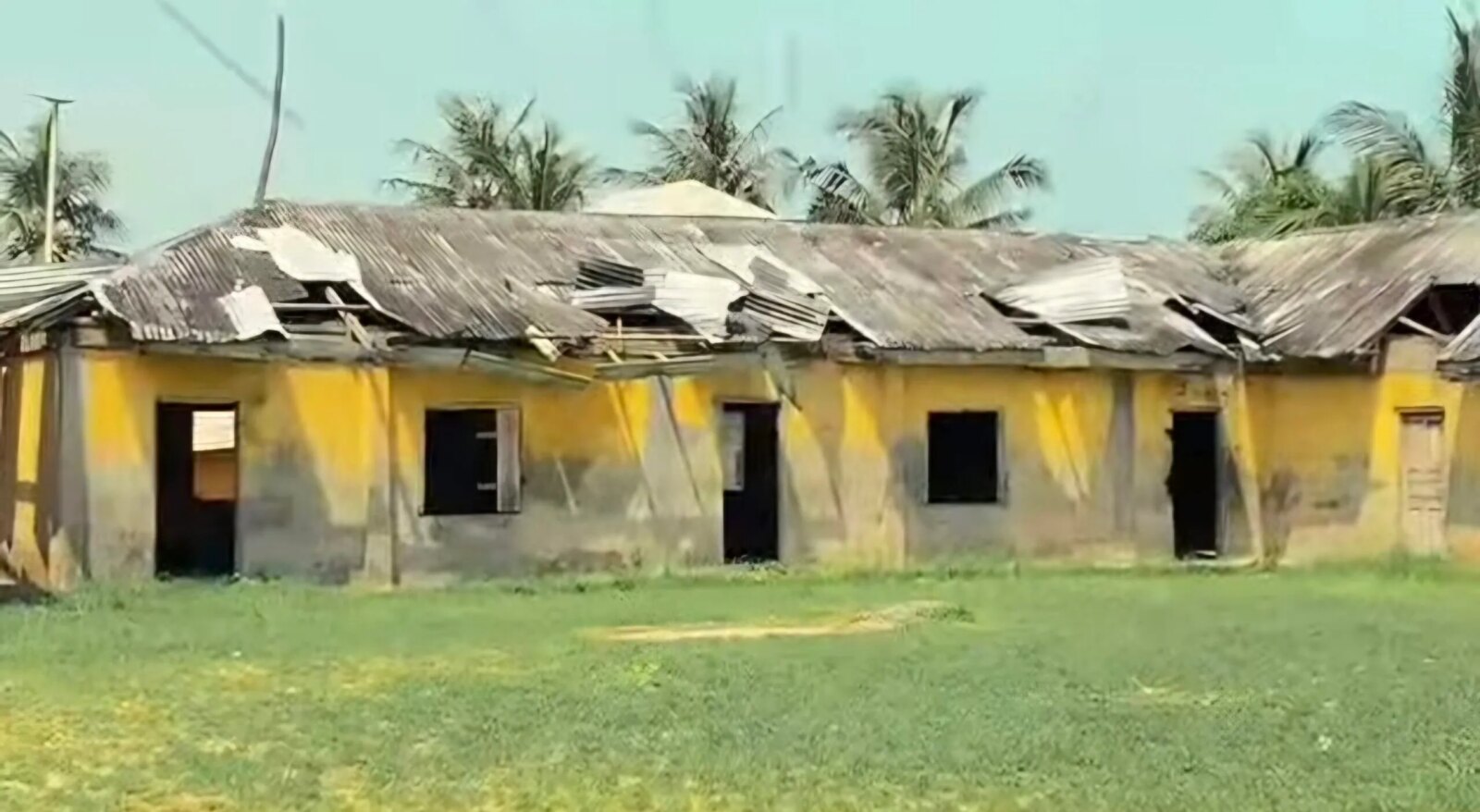
School in ruins
At the Government Primary School in Emere-Oke, the only public primary school serving the five villages, learning takes place in conditions many residents describe as unsafe.

Four classroom blocks stand on the premises. But three are decrepit, with rusted roofs and collapsing ceilings. Windows and doors are missing, leaving classrooms exposed. In one room, only three seats are available, while many classrooms lack seats for pupils.


In a state where members of the ruling party fear speaking out about community needs for fear of retribution, Blessing Timothy, the All Progressives Congress Ward Coordinator of Emere-Oke, could not hide his worry over the deplorable condition of the school. He said the situation in the kingdom has continued for years.

“The primary school lacks windows and desks. The roofs are dilapidated. Ceilings are falling. There is no water, no toilet,” he said.
Pointing to a nearby pool of stagnant water in the video, he asked: “Is this the kind of water a student should drink?”
The absence of basic water, sanitation and hygiene (WASH) facilities compounds the situation. There are no toilets in the school, raising health and safety concerns for children.
Emere-Oke residents say pupils often sit on bare floors or crowd into the few usable seats available, as enrolment outstrips capacity.
For many parents, the condition of the school reflects a deeper neglect of the community.
Nathan Elijah, a resident, said access to clean water for community members remains a daily struggle.

The community is located near the Atlantic Ocean; hence, the water is salty and not good for drinking or cooking. The few streams within the community are frequently polluted by oil spills.
“In this village, we drink from the stream. The water is not good enough. We need treated water from the government,” Mr Elijah said.
When PREMIUM TIMES visited the Emere-Oke health centre in August 2025, the facility was poorly equipped, lacking beds and essential medical equipment. Parts of the building were already dilapidated. Only one healthcare worker, a community health extension worker, serves the facility. There are no staff quarters.
Residents say the situation worsened in early 2026. Grace Clement, a community member, described the community’s health system as barely functioning.

“The health worker who serves the health facility comes and goes. We can stay up to a week without a health worker,” she said. “When there is an emergency, we are taken out (of the community) before we can survive.”
Billions budgeted, little delivered
Between May 2023 and December 2025, the administration of Governor Umo Eno received N2.53 trillion in revenue, with the largest chunk coming from the 13 per cent oil derivation fund.
Eastern Obolo is among the leading oil-producing local government areas in Akwa Ibom.
A review of the 2023 through 2026 Akwa Ibom State budget did not show allocation to any educational, health or WASH project in Emere-Oke.

In the state’s 2026 budget, the only project that features Emere-Oke and surrounding communities is the construction of a 10-kilometre Kampa–Emeroke–Ikonta–Obianga Road, with bridges, valued at N2.5 billion.
While residents acknowledge the importance of road infrastructure, they question the absence of targeted interventions in education, healthcare and water supply.
The federal government, too, seems not to care about the community.
A review of the 2026 federal budget shows no projects directly addressing the highlighted needs of Emere-Oke. Most constituency projects in Eastern Obolo focus on solar street lighting.
The federal government, however, had made some interventions in the community between 2024 and 2025.
Lawmaker defends interventions
The member representing Ikot Abasi/Mkpat Enin/Eastern Obolo Federal Constituency, Uduak Odudoh, said he had intervened in Emere-Oke.
He told PREMIUM TIMES he nominated a six-classroom block, constructed and furnished, at Migrant Secondary School, Emere-Oke, as his constituency project. The project was completed in 2025 after construction began in 2024.

This is the only public secondary school that serves the five villages in the community.
“My 2025 and 2026 budget, which is yet to be funded, focuses on other communities within my constituency,” he said. “I will certainly revisit the community… I can’t do everything at once.”
When contacted by PREMIUM TIMES, the village head of Emereoke II, Joshua Ayagwung, confirmed the lawmaker’s claim of intervention.
He acknowledged the lawmaker’s intervention as the only completed government-built structure at the school, but noted that other ongoing projects were undertaken by the EMOIMEE Host Community Development Trust (HCDT), the World Bank, and the community itself.
EMOIMEE is an acronym for the seven local government areas that make up the HCDT: Eket, Mkpat Enin, Onna, Ikot Abasi, Mbo, Esit Eket and Eastern Obolo.
‘Even God can’t reach out to everyone at the same time’
The member representing Ikot Abasi/Eastern Obolo State Constituency at the Akwa Ibom State House of Assembly, Selinah Ukpatu, argued that development must be seen in phases.
“Out of five villages in Emere-Oke, this administration has touched three,” she told PREMIUM TIMES. “Even God Himself cannot reach out to everyone at the same time.”
She cited the ongoing road project designed to reach Emere-Oke as a major intervention by the Akwa Ibom State Government, but did not provide details of specific projects in Emere-Oke addressing education, health or water.
When pressed on the absence of such projects in the budgets between 2023 and 2026, she said that not all communities can receive projects simultaneously.
“The governor knows the challenges of all the communities, including Emere-Oke. Before the end of his administration, he will address them,” Ms Ukpatu said.
Poverty persists despite oil wealth
The paradox of Emere-Oke is sharpened by the oil wealth flowing from its land and waters.
Eastern Obolo hosts multiple oil assets, including Oil Mining Leases (OMLs) 67, 68, 70, and 104, operated by Seplat Energy; OMLs 99 and 102, operated by Total Energies; and OML 13, operated by Sterling Oil.
Under the Petroleum Industry Act, oil companies are required to set aside three per cent of their operating expenditure for HCDTs.
For the EMOIMEE Trust, remittances have been substantial: N36 billion for 2021 and 2022, and N30.84 billion reported in 2024. Each local government reportedly received N3.95 billion in 2024.
Yet, residents say these funds have not translated into visible improvements in Emere-Oke beyond the ongoing classroom block constructed at the Migrant Secondary school.
Transparency remains a concern, with limited publicly available data on how much was received in 2023 and 2025 and how the funds were utilised.
Documents from another trust funded by TotalEnergies, BOPANE HCDT, Eastern Obolo cluster, show planned interventions in Emere-Oke, including a science laboratory at the secondary school and a solar-powered borehole project in Emereoke I.
BOPANE is an acronym for HCDTs funded by TotalEnergies in Nigeria. This includes Bonny, Opobo, Andoni, Nkoro and Eastern Obolo.
However, these projects remain at the bidding stage.
Sterling Oil, another operator in the area, has yet to commence funding for its host community development plan, with no public details of proposed projects.
READ ALSO: Akwa Ibom’s Paradox: Luxury SUVs for ex-officials while pupils sit on floors
Accountability gaps at the grassroots
Under Nigeria’s constitution, local governments are responsible for basic education and primary healthcare.
Between January and November 2025, Eastern Obolo received N4.34 billion from the Federation Account Allocation Committee (FAAC). This means an average monthly figure of N394.5 million, excluding internally generated revenue.
The condition of the Emere-Oke primary school and primary healthcare facility raises questions about the utilisation of these funds.
The council has also failed to comply with the Akwa Ibom State Fiscal Responsibility Law, which mandates the publication of budgets and financial reports online.
PREMIUM TIMES contacted the Chairman of Eastern Obolo, Samuel Nteogwuijah, with detailed questions on education, healthcare, water provision and financial transparency.
He did not respond to calls or the enquiry as of the time of filing this report.
Yet as multi-million naira continue to flow to the local government area monthly, back in Emere-Oke, the daily reality remains unchanged. Children continue to learn in classrooms with broken roofs. Families rely on unsafe water sources. Emergencies are managed with uncertainty.
As one community member put it, the question is when help will come.