
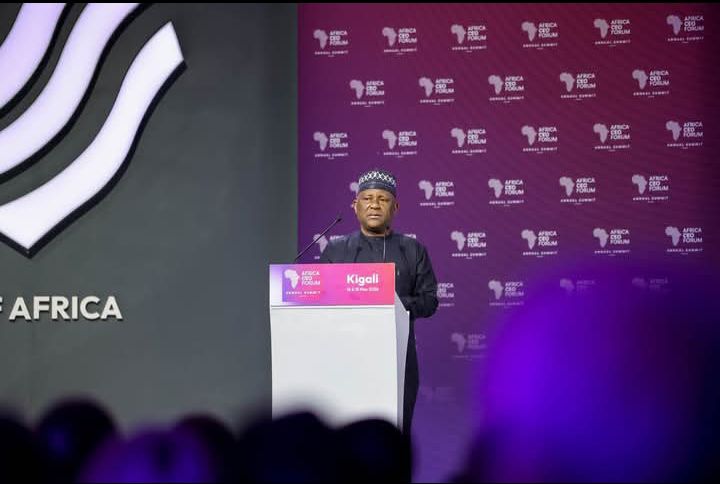

The founder of BUA Group, Abdul Samad Rabiu, said South African authorities denied him entry because his visa expired a day before his arrival in 2025, while Europeans were reportedly allowed into the country without visas.
The business mogul disclosed his travel experience while speaking at the Africa CEO Forum titled “Africa at Scale: Capital, Policy, and the Architecture of Growth” on Thursday in Kigali.
The billionaire said he returned to Lagos after waiting at Cape Town airport for hours, noting the experience as part of the challenges faced by Africans in Africa.
“I had a personal experience. Last February, I was travelling to Cape Town for the Mining Indaba. And as we landed, I left at night from Lagos to Cape Town. We arrived at 6 in the morning.
“As we arrived, we went to immigration. I tendered my passport, and the immigration officer looked at it and asked, ‘Where is your visa?’ and I said, ‘My visa is there.’ Unknown to me, my visa had expired the day before.

“Unfortunately, our crew did not check the visa to ensure the visa was valid. We were there for four hours, but at the end of the day, I had to turn back. I was turned back to Lagos,” he said.
According to the BUA Group chairman, passengers from three international flights, most of whom were Europeans, were allowed into Cape Town without visas.
The businessman said he understood why he was denied entry, but noted that allowing foreigners from other continents into South Africa without visas while restricting Africans from entering did not sit well with him.
“But the issue is, while we were waiting to see whether we would be able to get access to the countries without visas, there were three international flights from Europe. All three flights were mostly Europeans.
“I was standing there by the immigration desk, and every passenger on those three flights went into Cape Town without any visa. I do not have a problem with the fact that I was there without the visa and I was returned. I took full responsibility for that,” he said.
“I had an issue with being an African in Africa, being turned away because I did not have a visa, while foreigners from other continents were coming in and were allowed to enter without a visa. This must change,” he said.
Lack of cooperation
Mr Rabiu said there is a lack of cooperation among African countries, which affects the movement of Africans and also frustrates business expansion from one country to another on the continent.
Giving another instance, he said some countries lack the spirit of agreement on the continent, noting that their practices were not supportive when the BUA Group tried to expand into those countries.
“At BUA Group, as we expanded our regional investment, we actively sought to supply several African markets under the African Continental Free Trade Area framework.
“While some countries embraced the spirit of agreement, others were less supportive in practice, with administrative barriers and legacy import structures limiting our ability to participate fully in regional trade.
“So really, AfCFTA is not working as it should. Because I had a personal experience in one of the countries that we tried to penetrate, we were actually frustrated,” he said.
The BUA Group chairman said the experience underscores a broader challenge facing Africa, noting that although the African Continental Free Trade Area framework was created to integrate African markets, implementation across the continent remains inconsistent.
According to him, true integration is what transforms potential into economic scale, with the AfCFTA serving as a key driver through its market of more than 1.4 billion people across 55 countries.
ALSO READ: South Africa relaxes visa rules for Nigerian tourists, business persons
He described the AfCFTA as one of the world’s most ambitious integration initiatives, stating that “its promise is clear: intra-Africa trade, regional value chains, and industrial scale that no single economy can achieve alone. Its potential does not deliver outcome, execution does.”
Africa’s transformation
Mr Rabiu said Africa’s next phase of transformation largely depends on five areas: capital, policy, infrastructure, value addition, and integration.
According to him, Africa needs capital to finance ambition, policy to enable execution, infrastructure as the foundation of growth, value addition to unlock the full value of its resources, and integration to unlock scale and fully drive its next phase of transformation.
“Let me start with capital. Across the continent, institutional capital is expanding—pension funds, sovereign wealth funds, and increasingly sophisticated private investment vehicles, yet infrastructure financing remains far below potential.
“The reality is clear: Africa is not short of capital; it is short of coordinated, mobile capital deployed at scale. We must unlock cross-border capital flows, harmonise investment frameworks, strengthen project preparation, and expand risk-sharing mechanisms for both domestic and international investments.
“Deepening capital markets is equally critical; cross-border listings, interoperable settlement systems, and expanded local currency trade are not merely technical reforms; they are strategic infrastructure,” he said.
He said segmented legal frameworks, overlapping approvals, and inconsistent enforcement continue to raise the cost of investment across many regions in Africa, describing them as structural constraints on growth.
“What is required is clear and transparent rules, predictable enforcement, and coordinated industrial strategies across borders. Alignment does not compromise independence; rather, it strengthens economic performance,” he added.
He reiterated that infrastructure is important to Africa’s growth, noting that no economy can industrialise without systems that power growth, including reliable energy, efficient ports, modern rail networks, quality roads, and digital connectivity.