
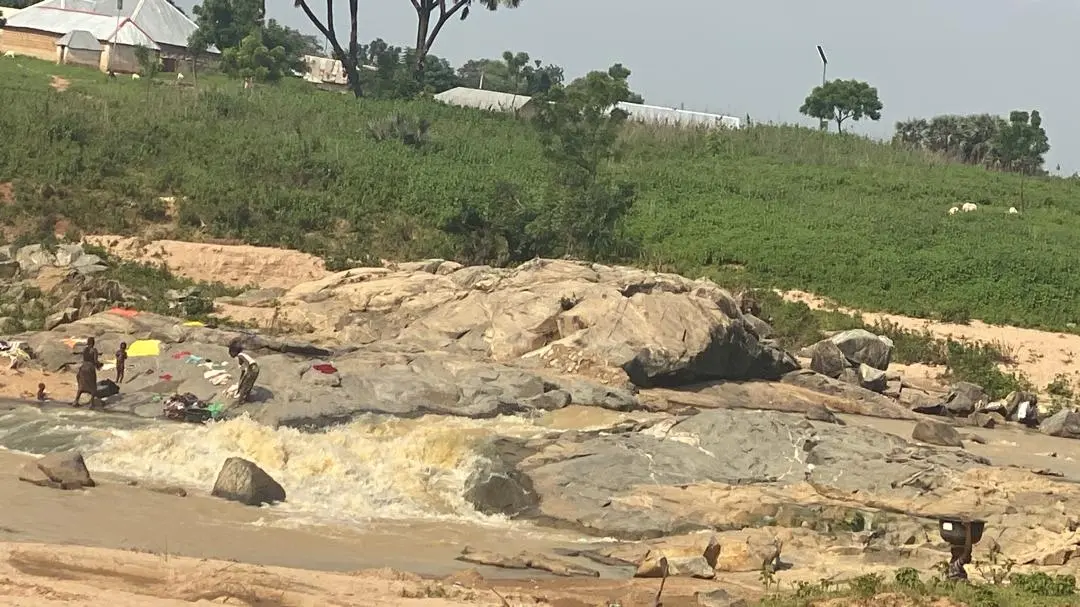

For years, communities in Shiroro have depended on the “Onato” stream for drinking, cooking and other household needs. This was before mining started polluting the water. Residents say they cannot determine who is operating nearby mining sites or whether the operators are licensed, exposing wider concerns about access to Nigeria’s digital mining oversight systems.
The stream, once clear, now runs brown. A few metres away, excavators roar to life as artisanal miners claw deep into the earth. There are four mining sites in Farin Doki and Ajata Aboki, both in the Shiroro area, where residents relied on the Onato stream.
Locals told PREMIUM TIMES that two of the mines are managed by indigenous artisanal miners, while the remaining two are operated by companies they could not identify. Some residents alleged that one of the sites appeared to be linked to Chinese operators, although PREMIUM TIMES could not independently verify the company’s ownership.
“We don’t know the names of those companies,” a youth leader who pleaded anonymity for his safety said.
But he suspects that local authorities might have those details. “People like the district head may know their names since they are benefiting from them,” he said.

The youth leader, however, did not explain how the leaders were allegedly benefiting from the mining activities, and our reporter could not independently verify his claim.

A stream residents no longer trust
Sadace Anguwa, a 46-year-old woman in Ajata Aboki, described the Onato stream as “the backbone of our daily life.”
“It has been 20 years since I married into this village, and we have relied on the stream as our main source of water,” she said. “We drink from it, cook with it and use it for our basic needs.”
But the stream is now threatened by gold mining activities, turning what was once a dependable resource into a source of fear.
“The stream has become contaminated and now poses a serious threat to our health and the well-being of the entire community,” she said, adding that health workers now warn against using the water.

“Whenever our children fall ill, and we take them to hospitals, medical personnel strongly warn us to stop giving them water from the stream,” she added.
Information gaps in mining communities
In Nigeria’s mining communities, this uncertainty is common, an everyday reality shaped not just by excavation on the earth, but by the absence of accessible information about who is mining, under what authority, with what environmental safeguards and at what cost.
While government agencies maintain digital systems intended to support transparency and oversight in the mining sector, many affected communities remain unable to access or use them effectively.
At the centre of this system is the Mining Cadastre Office (MCO), which maintains a public, online register of mining licences. Alongside it is the Mines Environmental Compliance (MEC), tasked with monitoring environmental standards and enforcing compliance.
Together, these departments under the Ministry of Solid Minerals Development are meant to ensure that mining activities are regulated and accountable. But many mining communities are left in the dark.
However, experts say that although parts of Nigeria’s mining oversight system are digitised, they do not yet function as a fully accessible Digital Public Infrastructure (DPI).
A public register that few can use
The MCO’s portal is designed as an open database where anyone can track who holds a mining licence and where operations are taking place. The department represents a key pillar of transparency in Nigeria’s extractive sector.
The portal, otherwise known as the electronic Mining Cadastre system or eMC+, was launched on 01 November, 2022 to transform mineral title administration. It was developed in partnership with GAF AG, Germany.
In principle, this should allow citizens, journalists, investors and host communities to verify whether mining operators are licenced and legally recognised. However, experts say the systems remain difficult to navigate and largely inaccessible to locals in rural areas where mining is most active.
“Many rural communities sit on the wrong side of Nigeria’s digital divide,” said Felicia Dairo, a member of Nigerian Indigenous Women in Mining and Natural Resource Organisation (NIWIMNRO) and a project manager at Centre for Journalism and Innovation Development (CJID). She explained that the communities are located in areas with weak or no network coverage, where even basic connectivity is a challenge.
Ms Dairo said access to government platforms in such places is “almost non-existent,” compounded by low literacy levels, including digital literacy, and limited device ownership.
In some communities, only a handful of residents own smartphones, making engagement with an online system effectively impossible, she added.
Experts say publishing licensing records online is insufficient if affected communities cannot search the databases, interpret licence data, or verify whether operators comply with environmental obligations.
This gap poses unanswered questions at the community level: Who is mining here? Are they licensed? What are they allowed to do? Without clear answers, communities are left guessing whether operators are legal or illegal, and whether any standards are being followed.
Access to clear licensing data, Ms Dairo argues, could significantly change this dynamic.
“Locals do what they do because they don’t even understand the laws and regulations governing the sector,” she said, adding that accessible information paired with proper sensitisation would help communities to better distinguish between legal and illegal mining.
Environmental oversight with little visibility
While the licensing system is hard for locals to access, environmental oversight is even more opaque.
The MEC is responsible for ensuring that mining operators comply with environmental regulations. They are expected to conduct inspections, identify violations, coordinate community development agreements and enforce penalties where necessary. Yet no publicly accessible platform shows this work in action.
There are no easily available records of inspections, no clear database of violations, and no transparent log of enforcement actions.
Even when people living near mining sites report degraded farmland, polluted water sources or abandoned pits, there is little publicly available information on whether those complaints were investigated or whether any enforcement action followed.
Where such a gap exists, the consequences can be far-reaching. Ms Dairo described the situation as one that encourages “anyhowness” in Nigeria’s mining industry, “which will result in illegality as we are currently experiencing.”
A digital infrastructure without DPI components
Many oversight systems in Nigeria are, in many ways, already digital. But by the core standards—openness, interoperability, inclusivity, and security—of Digital Public Infrastructure (DPI), they fall short of being truly public.
On openness, while licensing data exists within the system managed by the MCO, it is neither easily accessible nor presented in ways that ordinary citizens can understand or use. Environmental data is even more restricted. The MEC lacks a user-friendly interface that allows the public to track inspections, violations, or enforcement actions. In both cases, information exists, but not in a form that enables scrutiny.
Experts argue that transparency must go beyond simply publishing reports.
It should mean that people can easily access, understand, verify, and act on information about a mining project’s environmental performance, Ms Dairo advised.
“Beyond these, it also means that the information can influence decisions and drive accountability,” she said. “Also, Environmental Impact Assessments (EIAs) must be done and publicly disclosed to the affected communities with approval conditions.”
In terms of interoperability, DPI experts have said that data held by agencies like the MEC should be easily shared with the MCO—and vice versa—so information is connected, not siloed. The United Nations Development Programme (UNDP) describes interoperability as the ability of different public systems to securely work together and exchange information.
Because licensing, environmental inspection and enforcement records are not integrated across agencies, communities cannot easily determine whether a licensed operator has violated environmental standards or faced sanctions.
Announcing the adoption of DPI in 2025, the Minister of Communications, Innovation, and Digital Economy, Bosun Tijani, had said, the framework will “enable the government to support citizens efficiently from birth to legacy, based on a platform of interoperability across all government services.”
Inclusivity remains the most glaring gap, with experts arguing that digital systems cannot be considered public if the people most affected by them cannot access or use them. Global development institutions such as the UNDP and the Gates Foundation have consistently mentioned that DPI systems should be inclusive by design in a way that ensures that people in low-connectivity, low-income and rural communities are not excluded from public services. In Nigeria, agencies such as the National Information Technology Development Agency (NITDA) echo this principle, but implementation gaps remain stark in sectors like mining.
Beyond weak [internet] connectivity, low digital literacy and limited device ownership in rural mining communities, experts say deliberate design choices such as simplified interfaces, offline access, and local language support should be prioritised.
Ms Dairo referenced how some other countries, such as Jamaica, Ghana, Australia, Tanzania, Canada, Guinea, the Ivory Coast, and Zambia, have designed their digital mining cadastres to be “transparent and accessible to non-technical users, including investors, local communities, and the general public.”
“These systems often use web-based Geographic Information Systems (GIS) to map mining and exploration rights,” she said, citing an example with JAMinCAD, a Jamaican project launched to transition from a paper-based to a digital system.
JAMinCAD, she explained, allows the public to view, locate, and track mining licenses on their phones or computers, providing a user-friendly, transparent interface.
READ ALSO: Why Nigeria must intensify regulation of its booming mining sector, By Mukhtar Ya’u Madobi
Until Nigeria’s digital mining system is redesigned to reflect the realities of the communities they are meant to serve, transparency will continue to be a challenge in villages like Ajata Aboki and Farin Doki, where unregulated mining results in environmental degradation and locals are without the tools to demand accountability.
Obadiah Nkom, the director general of MCO, and Vivian Okono, the director of MEC, could not be reached for comments. Neither responded to calls or messages sent to them.
Speaking at a webinar last year, Mr Nkom stressed that mining operations in Nigeria are only legal when properly licensed, with each licence carrying defined “parameters, obligations, and requirements that must be adhered to by operators.”
This report is produced under the DPI Africa Journalism Fellowship Programme of the Media Foundation for West Africa and Co-Develop.