
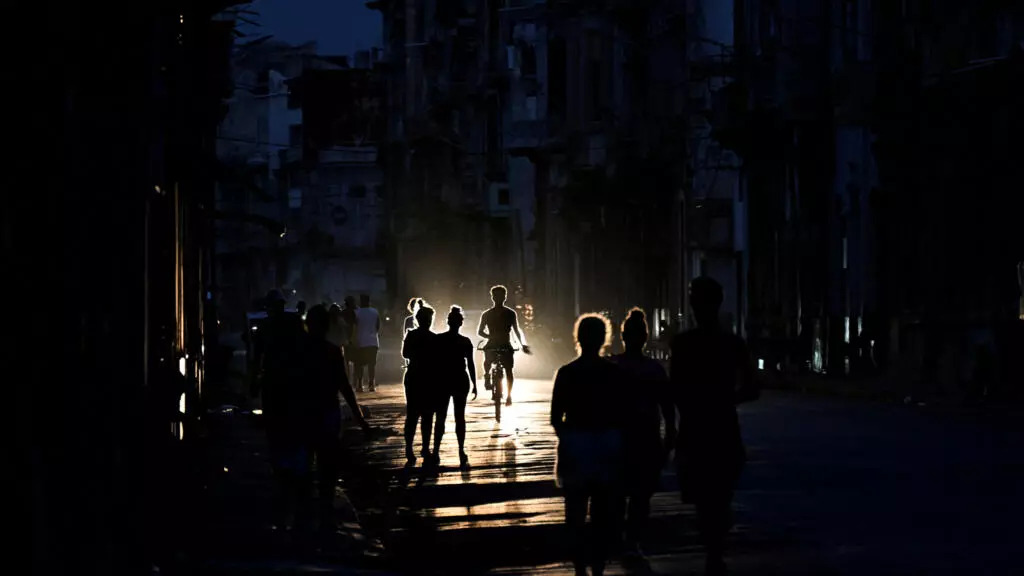

Since the start of the year, the US has cut off oil shipments to Cuba as a strategy to squeeze the island country’s economy into submission and overthrow the communist government.
In January, President Donald Trump signed an executive order imposing tariffs on countries selling oil to the island; a move experts regard as coercive economic pressure or “bully diplomacy” designed to isolate Cuba and deepen its domestic crises.
Three months later, the result is a growing humanitarian crisis and worsening economic instability.
Cubans now face daily blackouts that can last longer than 16 hours; bus stops are empty; families are turning to wood and coal for cooking; and tourism facilities have closed.
The once-vaunted medical system is also teetering on the brink. Hospitals can no longer function at optimum. Dialysis, chemotherapy, and other life-saving services are being disrupted. Around 96,000 patients are waiting in line for suspended surgeries. Water is in short supply.

However, African countries, with whom Cuba shares strong historical ties linked to nationalist, anti-colonial struggles, have opted for a passive and largely muted response to what the Castro communist regime has termed economic genocide.
In March, President Donald Trump said he expects to have “the honour of taking Cuba.” He bragged about his capacity “to do anything” and predicted that after 67 years of communist rule, the “weakened nation” would collapse under US pressure. He has also repeatedly warned that Cuba “is next” on his list and would turn his attention fully to the country after the war with Iran.
Two weeks ago, Mr Trump expanded the sanctions to include target officials, entities “operating in Cuba’s energy, defence, mining and financial sectors”, and also those considered by the US to be “complicit in corruption or human rights violations”, a policy China described as an infringement on Cuba’s right as a state and a violation of international law.
Washington, through the policy, has effectively been paralysing the island, which produces less than 40 per cent of the fuel it needs to power the economy.
Several American presidents have imposed sanctions on Cuba, but none have been as extreme as those of the Trump administration, which aims to force a change of government and impose a pro-American government on the Island country.
Resistance to US action has had little practical effect, and among African countries with which the Cuban state shares strong, historical ties, it is largely non-existent.
Rather, African countries watch from the sidelines as the US asphyxiates Havana, without extending the support needed to keep the island from dropping to its knees.
Cuba’s history with African countries
Usman Ayegba, a university lecturer and expert in international relations, diplomacy, and politics, described the reluctance of African countries to stand by a key ally as both understandable and disturbing.
Cuba’s relations with Africa predate the Cold War era. The Caribbean country played a pivotal role in the continent’s apartheid and liberation struggle.
When Cubans overthrew the Batista government and ran US imperialism out of their Island in 1959, it ushered in a socialist government led by Fidel Castro, who was keen on supporting Africa. So, while the country faced a barrage of US sanctions, it nonetheless extended support to liberation movements in the country.
Cuba’s first major intervention came in Algeria between 1961 and 1963. Shortly after independence from France, the country became vulnerable to external pressure, particularly from neighbouring Morocco, which sought to exert control over a disputed border area.
During the Sand War, Fidel Castro sent military equipment, advisers, and a medical brigade to support Algeria.
Havana also extended support to Congo during its liberation struggle around 1965 after a post-independence civil war backed by the West. The Castro regime supplied arms and troops to the Simba rebel forces. The Cuban mission in Congo was led by Che Guevara, a prominent guerrilla leader and revolutionary, who also gave an impassioned speech on the “tragic case of Congo” at the UN General Assembly. The mission, however, was unsuccessful.

Cuba’s role in Angola changed the course of history on the continent. Its decision to support the Movement for the Liberation of Angola (MPLA) government in 1975 during the Angolan Civil War, most decisively through its military intervention at the Battle of Cuito Cuanavale, helped shift the regional balance of power.
It contributed to Namibia’s independence and accelerated the end of apartheid-era rule in Southern Africa.
Contribution to healthcare
Cuba’s support extended well beyond military intervention. It made significant contributions in healthcare, education, and technical development across multiple countries.
In Angola, Mozambique, Ethiopia, Guinea-Bissau, South Africa, and Namibia, Cuban medical teams and educators helped expand healthcare access and literacy programmes in the post-independence period and through the Cold War era. All while the US and Europe regarded Cuba as a soviet proxy.
Between 2010 and 2019, Cuba’s intervention shifted primarily toward humanitarian and medical service exports to underserved countries, benefiting Africa immensely.
During the Ebola outbreak in 2014, the country deployed about 256 doctors and health professionals to Sierra Leone, Guinea, and Liberia, the epicentre of the epidemic.
As the activist lawyer, Femi Falana, put it at the time, Cuba was the only country that supported Africa in the “war against Ebola without stigmatising or discriminating against them.”

During the Coronavirus pandemic in 2020, Cuba sent around 1,200 health professionals to African and Caribbean countries worst hit by the disease. Around 200 medics were deployed to South Africa, which reported more than 4 million positive cases.
Medical service was also Cuba’s most lucrative export. Although there were concerns about worker exploitation, the country generated substantial revenue by leasing professionals to countries where local healthcare systems struggle to fill posts.
The country was generating around $11 billion each year through its “army of white coats” despite being isolated by US sanctions for years.
Before 2019, when the US, under Mr Trump’s first administration, began targeting countries that accepted Cuba’s medical labour exports, Cuba had deployed around 50,000 Cuban doctors to underserved areas in 67 countries, including Ghana, Angola, Botswana, and Algeria, to fill gaps in health systems.
Many Nigerian students have also studied medicine in Cuba under scholarship programmes.
No oil supply for three months
Cuba also has trade relations with African countries, though on a modest scale compared with its trade with the US, Europe, and China.
Venezuela, whose oil industry is now being controlled by the US, was Cuba’s largest oil source, followed by Mexico and Russia. However, a smaller amount came from Algeria and, to an extent, from Angola and Nigeria, which exported intermittently.
But all oil imports into the country ceased due to Mr Trump’s order, effectively amounting to a blockade. Cuban President Miguel Díaz-Canel said in March that the island had not received oil from foreign suppliers for three months.

Russia recently supplied 700,000 barrels of crude to Cuba, which experts say will ease the hardship in the communist country. However, the new shipment can only provide 7-10 days of supply.
While African countries such as Algeria and Angola have provided oil to offset low supplies from Venezuela in the past, they have yet to aid the Island under the US “marine siege.”
Jorge Piñón, a former oil executive who runs a team at the University of Texas at Austin tracking Cuba’s oil, points out that Cuba’s longtime African friends are not only silent but staying away.
Shehu Sani, a senator under the Peoples Democratic Party, opined that not just Africa, but also non-African countries, “the world” stays quiet and “watches helplessly” the repression of a smaller sovereign nation by a great power.
He said the unjustified attack on Cuba was an affront to international law and international relations, and declared both systems “obsolete.”
“This is a country with no nuclear ambition and no links to terrorism now under siege; its people are denied energy and power” because of the US, he said.
Why are African countries silent?
Africa’s silence is not a reflection of indifference towards Cuba’s plight, but rather a result of complex political, economic and diplomatic realities at this time, according to Mr Ayegba, the don.
He attributed their reluctance to their economic dependence on the US and the fear of incurring the wrath of a country that has regained its unipolar standing in global politics.
“Many of the actions people thought would be unthinkable, that would be unheard of, that America could never do, America is doing it and is getting away with it,” he said.
He noted that African countries rely heavily on the United States for foreign aid, investment, and trade.
He explained that domestic realities are currently unfavourable, and that jeopardising their economic relationship with the US would be very costly.
Owei Lakemfa, president of the Society for International Relations Awareness (SIRA), also affirmed that this silence stemmed from fear of possible repercussions for standing against the US.
“It has nothing to do with principles, ideology, or programmes,” he emphasised.
READ ALSO: Hungarys Viktor Orban swept away despite support from Trump, Putin
What African states can do
Analysts say the neutrality or silence of African countries appears to be a politically pragmatic choice, but insist it is important for the continent to stand up for its long-time friend and ally.
Mr Ayegba opined that, while domestic and global political realities constrain individual African countries, they can channel their positions through regional bodies.
This can be done, in particular, through the African Union, the Economic Community of West African States (ECOWAS), the Southern African Development Community (SADC), the East African Community (EAC), and the Economic Community of Central African States (ECCAS).
He said collective action may be more effective than isolated responses, adding that “if the US wants to punish the entire African continent, so be it.”
He also recommended increased civil society and media engagement that enlightens young citizens about the continent’s strong ties with Cuba and gets them to speak up about US imperialism.
Experts also recommended intensifying the use of the United Nations system to support Cuba, particularly through resolutions against the US embargo.
They also recommend economic collaboration that reduces the impact of US sanctions.
Mr Ayegba noted that, while this would be difficult to achieve at present, African countries, post-US embargo, should consider expanding trade with Cuba and strengthening bilateral ties. Such cooperation, he said, could enable them to invoke the principle of pacta sunt servanda in future treaty-related matters.
“Even if the world pretends all is well, Africa should not be silent. We build friendship over time for support when one party is weak. Now is the time to stand for Cuba, “ he said.