

Legit.ng journalist Ridwan Adeola Yusuf has over four years of experience covering security issues and counterinsurgency in Nigeria and across Africa.
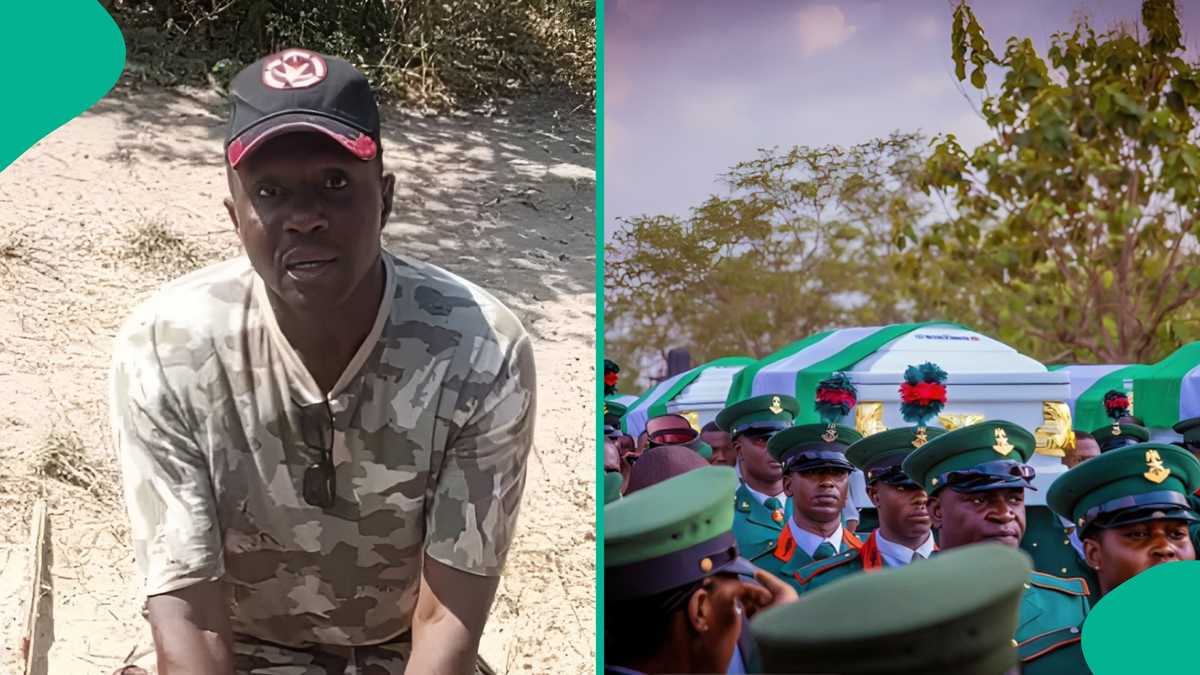
Maiduguri, Borno state – Seated on a bushy path under the blazing sun in mid-November 2025, Nigeria’s Brigadier General Musa Uba looked on haplessly as AK-47-wielding fighters from the ISIL (ISIS) affiliate in West Africa Province (ISWAP) surrounded him. A gunshot wound to his leg was visible, and panic gripped him in his final moments.
The weapons and the exhibition of terror left him with nowhere to turn. His face, dripping with dread and agony, suggested he was trying to reach whatever remained of the men behind the gun. Uba could neither argue nor resist. All he had left was the faint hope that he could reach something human in the beasts eager to pull the trigger.

Source: Twitter
In those last moments, his mind must have splintered, fragments flying everywhere in his body. Some of those fragments must still have been pleading, still calculating and still clinging to hope. Some others must have been withdrawing, already bracing for what was coming. His body would have sensed it before the act itself.

Perhaps there was one final appeal, maybe communicated with the eyes. That must have been a last bid to be recognised, not as a target, but as a human being. It was an appeal that went unanswered by the bloodthirsty terrorists.
General Uba killed like a chicken
On Friday, November 14, 2025, ISWAP terrorists had waylaid a convoy of soldiers and operatives of the Civilian Joint Task Force (CJTF) in northeastern Borno state.
The assailants ambushed troops along Damboa Road near Wajiroko village while they were transporting military equipment, opening sustained fire on the convoy and triggering a shootout with the soldiers.
At least 17 military motorcycles were seized by the ISWAP members, while two CJTF operatives and two soldiers were killed during the gun battle.
Following the ambush, Uba was abducted by the insurgents and later executed after being taken captive.
Certainly, that was not their first killing. Documented information show that they cut short lives with the naturalness of a monster.

Source: Original
According to the 2026 Global Terrorism Index (GTI) report, ISWAP and Boko Haram insurgents accounted for roughly 80% of all terrorism-related deaths in Nigeria during 2025. In 2025 alone, ISWAP was responsible for approximately 384 deaths, overtaking Boko Haram to become Nigeria’s deadliest group.

The rank of brigadier general is one of the highest in the military. A brigadier general typically commands a brigade, which consists of approximately 4,000 troops. Uba was the commander of the 25 Task Force Brigade in Damboa Local Government Area (LGA) of Borno state.
The murder of an officer of this rank is neither unprecedented nor finite. In November 2021, Brigadier General Zirkushu Dzarma was killed with four other officers when ISWAP rammed a bomb-laden car into his official vehicle. Brigadier General Oseni Braimah, the commander of the 29 Task Force Brigade, was killed alongside other soldiers on April 9, during an attack by ISWAP gunmen on a military base in Benisheikh, Borno.
Uba’s case is somewhat different. He initially escaped the ambush and was in contact with military authorities via the popular messaging platform WhatsApp to facilitate his return to base when he was captured by the terrorists.

Source: Original
Communication breaks down when signals are not protected, said Adam Sulaiman Akorede, a Lagos-based security analyst.
“Though digital links run everything, old habits linger, like using everyday networks for secret moves across war zones. Risks pile up when codes fail, or eavesdroppers listen in at weak points. Missions’ edge toward danger if messages travel unshielded. Tougher shields often get skipped, leaving gaps where enemies slip through,” he remarked poetically.

Before and after executing Uba, the terrorists subjected him to scorn. ISIS elements posted his graphic images and shared screenshots of his WhatsApp conversations in Al-Naba, the group’s Arabic language newspaper.
A tweet below shows Nigeria’s President Bola Ahmed Tinubu grieving the loss of Brig. Gen. Uba.
Uba’s tragedy exposes tech gaps
The circumstances around Brig. Gen. Uba’s capture and killing provide insights into a critical aspect of Nigeria’s security challenges, as they highlight a major weakness in Nigeria’s counter-terrorism efforts. While the capture and subsequent killing of the army general indicates insurgents’ increased capability in rapid intelligence, surveillance and reconnaissance, it also points to poor technological adoption despite increased defence spending, as well as underscores unsophisticated coordination between Nigeria’s military authority and counter-terrorism units.
Timothy Avele, a security consultant and managing director of Agent-X Security Limited, pointed out that terrorists are increasingly leveraging dark web tools, open-source intelligence, and locally developed attack drones and other technologies. He warned that unless security agencies take urgent steps to counter these developments, “we may be heading to a point of no return, and Abuja may not be safe for long.”

Currently, Nigerian security agencies and the military appear to be lagging in the use of advanced telecommunications and Information and Communications Technology (ICT) in the fight against insecurity. Avele explained that it is not that the agencies are unwilling to adopt these tools, but that they face significant challenges in doing so.
“Most of these tools are heavily priced and must be renewed yearly,” Avele noted in an interview with Legit.ng. “In some cases that I have personally witnessed, for no just cause, the foreign suppliers don’t want to sell to Nigeria and in some instances refuse to renew expired critical tools used by key agencies. But the most visible reason is the attitude of most agencies that still want to continue doing things in the old and outdated ways; they seem to fear innovation.”
Feasible solutions are not far-fetched though, according to the expert.
“Nigeria is blessed by some of the best tech brains in the world. Use locally built tools, organise a national tech wizard week relating to security and defence solutions, and you will be amazed by what Nigerians can do.”
Among other ‘workable’ solutions, Avele advocated the use of artificial intelligence–powered intelligence and locally developed defence systems to predict attacks well in advance, continuously monitor terrorist movements in real time, and enable pre-emptive strikes before they occur, describing it as “the surest way to fight and defeat all forms of insecurity in Nigeria.”

In his contribution, Olaopa Dare, a security and safety expert, deplored the manner in which Uba was intercepted and eventually murdered by terrorists, saying the incident underscores the technological and strategic weaknesses in Nigeria’s security architecture.
According to Dare, the incident highlights multiple failures, including intelligence lapses, the lack of real-time surveillance, and inadequate tracking systems.
To bridge the gap, the retired military officer urged Nigeria to prioritise the adoption of a multi-layered, ICT-driven security strategy.

Source: Original
“There is an urgent need for novel strategies to curb the menace of disturbing insecurity,” he said. “For instance, the use of real-time communication tracking and surveillance is a central component in modern counter-terrorism strategies, hence, Nigeria must embrace it wholly. Its components, like AI and advanced cellular interception, are increasingly used to detect and prevent terrorist activities.
“You know, communication tracking and surveillance are extensively adopted by serious security and intelligence agencies worldwide nowadays, and they have become central to national security, counter-terrorism, and law enforcement strategies. They are very useful.
“These technologies allow security agencies to identify threats, locate suspects, and provide protection during active incidents. We really need to up our game.”
Now, zero compromise towards safety is the way to go!
Source: Legit.ng