
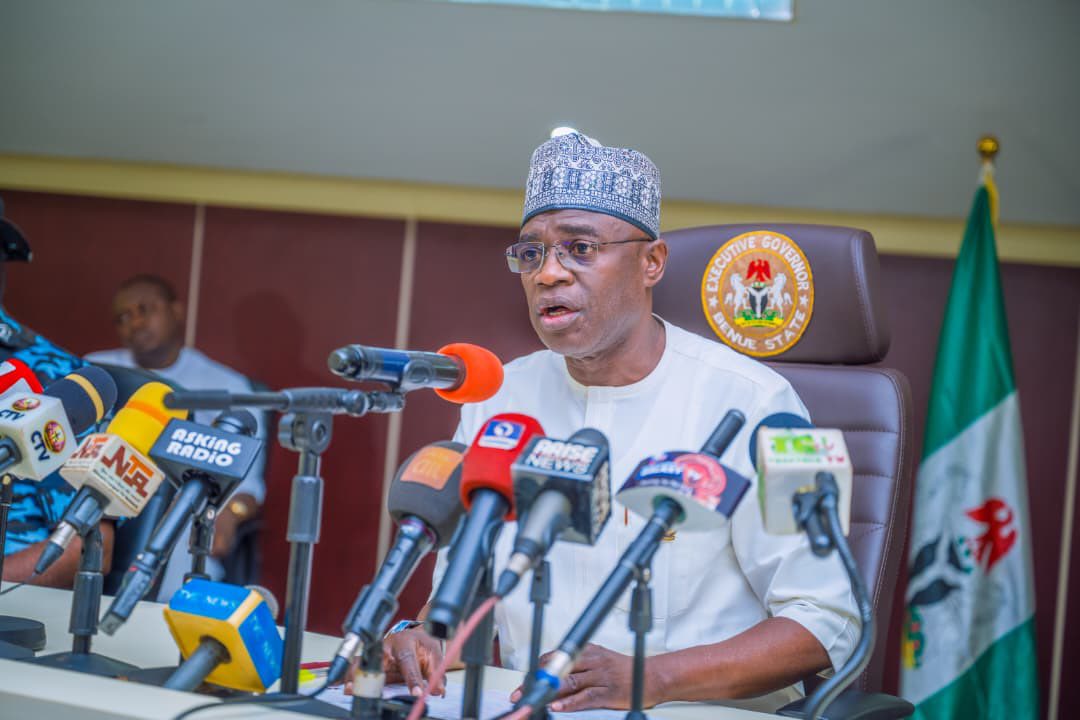

The Benue State Government spent only N111.06 million on security between January and March 2026 despite budgeting N41.85 billion for security-related expenses in the 2026 fiscal year, a review of the state’s first-quarter budget performance report has shown.
The report raises concerns over Governor Hyacinth Alia’s administration security spending priorities at a time of escalating attacks across several local government areas in the state.
The approved 2026 budget allocated N40 billion for security votes and operations, alongside N1.85 billion for security services, bringing the total security allocation to N41.85 8.
However, the first-quarter performance report indicates that only N111.06 million, representing 0.3 per cent of the total allocation, was released and spent within the period.
The amount spent on security was lower than the N3.35 billion released for the running costs of the Benue State Government House and the Benue State House of Assembly during the same period. The security expenditure in the state accounted for only 3.3 per cent of that amount.

Security votes and related security allocations by state governments typically support security agencies through logistics, intelligence gathering, fuel supply, vehicles, emergency operations and stipends for local vigilante groups.
The low expenditure comes amid sustained attacks in parts of the state, where dozens of residents were reportedly killed between January and March.
Benue, often described as Nigeria’s “food basket” because of its agricultural output, has experienced recurring violence linked to armed banditry, farmer-herder clashes and attacks by armed groups. PREMIUM TIMES had reported how the killings have impacted Nigeria’s food security.
Several local government areas, including Kwande, Gwer West, Ohimini and Agatu, recorded deadly attacks during the period under review.
On 14 January, two people were reportedly killed on a rice farm in Kwande Local Government Area of Benue State.
Two days later, five people were killed in Gwer West Local Government Area of the state.
On 22 January, suspected armed militia attacked Tse-Amuneke village in Mbapupuu Ward, killing two residents.
In Ohimini Local Government Area, a young man was reportedly killed on 27 January in Alaglanu community, Oglewu Ward.
Communities in Agatu Local Government Area also came under attack on 23 January when armed men invaded Opatali, Ejima G’Eche and Ejima G’Okpa, killing two residents and injuring five others.
On 24 January, a trader identified as Joseph Okoh was reportedly killed after armed men blocked the Adoka–Odugbo Road at Edikwu-Okpogo village. A woman, Aneh Sunday, sustained severe injuries in the attack.
Another farmer was reportedly killed on 27 January when armed men ambushed villagers along the Agagbe–Abian Road. On 30 January, an engine operator was killed in Ikobi community.
On 3 February, attackers invaded Abande and Anwase communities in Turan District, killing at least 17 people, including a police officer.
Another major attack occurred on 5 March when armed assailants killed 16 people in Mbaav community in Mbadura Council Ward and Mbachoon community in Yaav Council Ward.
Despite the worsening violence, the Benue State Bureau of Homeland Security established by Governor Alia in July 2024 to coordinate security operations and liaise with security agencies recorded no releases for personnel, overhead or capital expenditure during the first quarter.
The agency has a total budgetary allocation of N2.15 billion for 2026.
Security analysts have repeatedly warned that persistent attacks in the state threaten food production, livelihoods and humanitarian conditions, underscoring the need for stronger state-backed security coordination and intervention.
Revenue, expenditure profile
The report also showed that the Benue State Government recorded total revenue of N127.18 billion within the first quarter of 2026.
According to the breakdown, N57.68 billion came from the state’s share of Federation Account Allocation Committee (FAAC) revenue, while internally generated revenue accounted for N11.33 billion.
The state also received N14.42 billion from grants and aid, while N43.75 billion represented opening balances carried over from the 2025 fiscal year.
Total expenditure within the period stood at N82.28 billion.
Of the amount spent, N34.48 billion went to personnel costs, while N22.38 billion was spent on other recurrent expenditures.
Capital projects and programmes received N25.42 billion.