
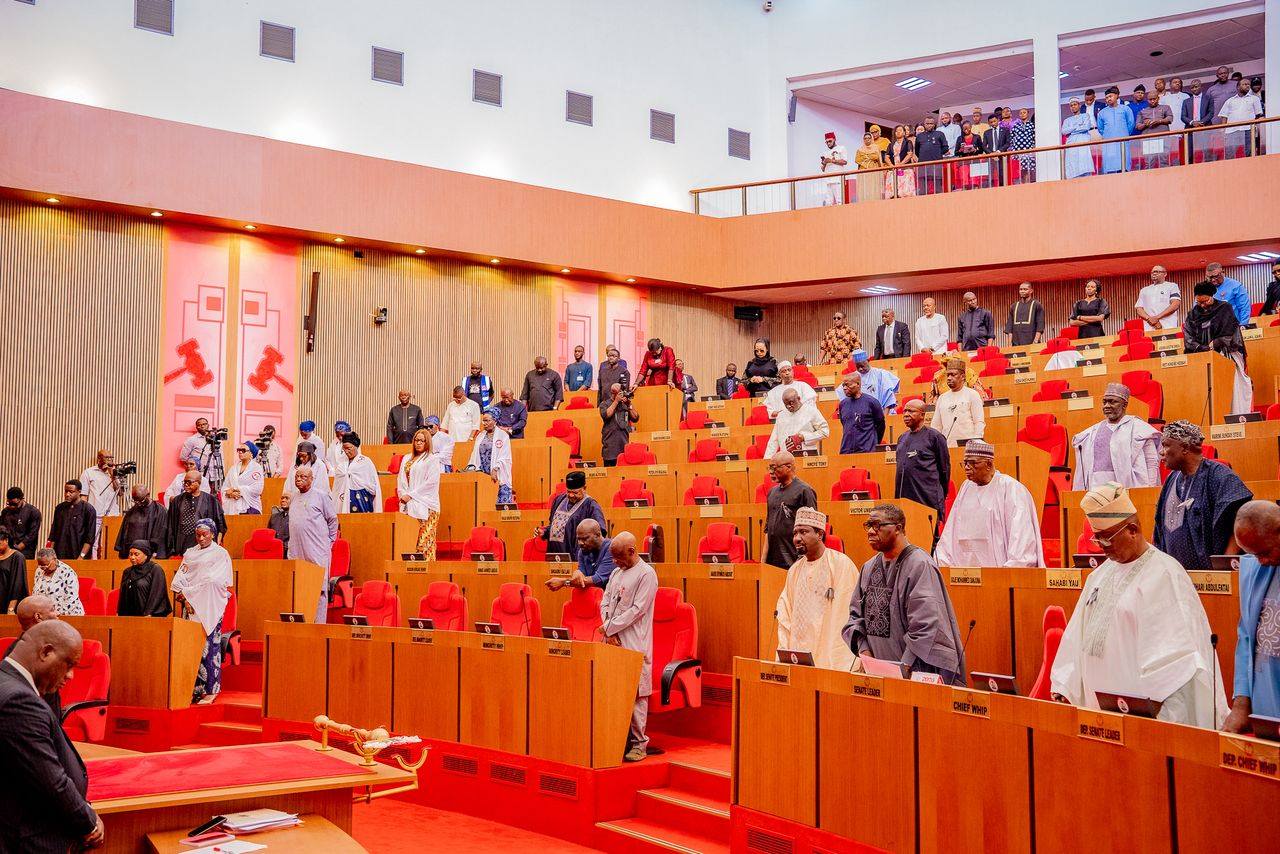

The Senate on Thursday passed a bill seeking to amend provisions on jurisdiction for pre-election matters contained in Nigeria’s Electoral Act 2026.
The upper chamber passed the bill after considering the report of the Committee on Electoral Matters, presented by its Chairman, Simon Lalong (APC, Plateau South).
The bill specifically seeks to amend Section 29(5) of the Electoral Act, which deals with legal disputes arising from party primaries, particularly where an aspirant challenges information submitted by a candidate in an affidavit or other documents relating to constitutional requirements for contesting an election.
Before the amendment, Section 29(5) limited aspirants challenging a candidate’s documents to filing suits only at the Federal High Court in Abuja.
The section stated, “An aspirant who participated in the primaries of his political party who has reasonable grounds to believe that any information given by the political party’s candidate in the affidavit or any document submitted by that candidate in relation to his constitutional requirements to contest the election is false, may file a suit at the Federal High Court in the Federal Capital Territory or in the jurisdiction the cause of action arose against that candidate seeking a declaration that the information contained in the affidavit is false.”

However, the amendment now allows aspirants challenging a candidate’s documents to file such suits at any court in the Federal Capital Territory or in the jurisdiction where the cause of action arose.
It states, “An aspirant who participated in the primaries of his political party who has reasonable grounds to believe that any information given by the political party’s candidate in the affidavit or any document submitted by that candidate in relation to his constitutional requirements to contest the election is false, may file a suit at a court in the Federal Capital Territory or in the jurisdiction the cause of action arose against that candidate seeking a declaration that the information contained in the affidavit is false.”
The clauses of the bill were considered at the Committee of the Whole.
The Senate President, Godswill Akpabio, announced passage of the bill after a majority of the senators supported it through voice vote.
Insertion on new section
The amendment also introduced a new provision tagged Section 29A(1)–(5), which seeks to clearly define how courts should handle pre-election disputes.
Under the new provision, all pre-election matters relating to the nomination of candidates and other electoral activities covered by the Constitution and the Electoral Act must be filed, heard and determined in line with the procedures outlined in the section.
The amendment further provides that pre-election disputes involving elections into the National Assembly, State Houses of Assembly, as well as governorship and deputy governorship positions, must begin at the Federal High Court. Appeals arising from such cases will proceed to the Court of Appeal.
For disputes involving presidential and vice-presidential elections, the Court of Appeal will serve as the court of first instance, meaning such cases will originate there. Any appeal arising from those matters will go directly to the Supreme Court.
The provision also bars any court from entertaining pre-election matters outside the framework established under the new section.
It added that the section will apply to all cases instituted under the Electoral Act in relation to pre-election disputes.
The controversy surrounding Electoral Act
President Bola Tinubu in February signed the Electoral Act Amendment Bill 2026 into law, despite agitations from Nigerians over a controversial clause that makes electronic transmission of election results optional.
The president assented to the bill during a ceremony at the Presidential Villa attended by Senate President Godswill Akpabio, Speaker of the House of Representatives Tajudeen Abbas, Senate Leader Opeyemi Bamidele, Deputy Speaker Benjamin Kalu, and other government officials.
With the presidential assent, the bill became law, meaning future elections in Nigeria will now be conducted in line with the amended provisions.
Both chambers of the National Assembly passed the bill after months of debate and deliberations. Although the legislation contains about 154 clauses, Clause 60, which makes electronic transmission of results optional, generated the most controversy.
Initially, the House of Representatives passed a version of the bill in December mandating the electronic transmission of election results from polling units to the Independent National Electoral Commission’s Result Viewing Portal (IReV) immediately after vote counting.
The Senate, however, rejected mandatory electronic transmission and retained the provision in the 2022 Electoral Act allowing results to be transmitted to collation centres without making electronic transmission compulsory.
READ ALSO; Senate amends Electoral Act to allow statutory delegates to vote at party congresses, conventions
The Senate’s position attracted criticism from many Nigerians, who urged lawmakers to adopt the House’s earlier version.
The upper chamber later reviewed its position and resolved that electronic transmission would remain optional, adding that in the event of internet failure, Form EC8A would serve as the primary means of result collation.
Form EC8A is the primary document on which the presiding officer records the results immediately after votes are counted at a polling unit. In election petitions, courts often rely heavily on EC8A forms because they represent the first official record of votes at the source.
Despite the revision, several Nigerians and civil society organisations remained dissatisfied with the provision. Protests were held at the National Assembly, while stakeholders continued to demand further amendments, prompting renewed deliberations by the Senate.