
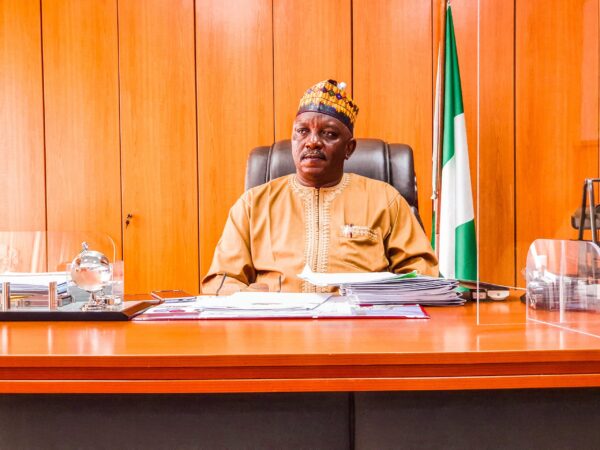

The Federal High Court sitting in Abuja has convicted a former Minister of Power, Saleh Mamman, of fraud involving N33.8 billion.
Judge James Omotosho convicted him on all 12 counts, holding that the Economic and Financial Crimes Commission (EFCC) proved its case against the former minister beyond reasonable doubt.
The judge rebuked the convict for living large as minister, at the expense of Nigerians, saying that his action was part of what kept Nigerians in darkness.
He handed down the verdict on Thursday in the absence of Mr Mamman, who was granted bail and attended his trial from home.
Following a request by the prosecution counsel, Rotimi Oyedepo, a Senior Advocate of Nigeria (SAN), the court issued a warrant for the arrest of the convict.

Earlier, the convict’s lawyer, Mohammed Ahmed, told the court that he had no access to his client since Tuesday, when he received the notice of the judgement.
He said one of the associates of the convict informed him that the former minister was unable to attend Thursday’s proceedings because he was sick.
Mr Oyedepo urged the court to issue a warrant for the former minister’s arrest, as the defence failed to provide credible evidence, like a medical report, to back his claim of ill health.
Granting the request, the judge ordered that the state should look for the convict, arrest him and produce him in court for sentencing, having been convicted of the offences brought against him by the anti-graft agency.
Mr Omotosho fixed 13 May for sentencing.
Court’s findings
In the judgement, Mr Omotosho held that the EFCC proved the amended 12 counts beyond reasonable doubt.
He said, “The prosecution has established that, at least, N22 billion was siphoned by the defendant and his cronies,” the judge said. that “This is sufficient to sustain the charge.”
However, the judge held that the defence failed to rebut the prosecution’s evidence.
He explained that “the defence did not offer any credible evidence to rebut the evidence of the prosecution.”
Mr Omotosho condemned the diversion of funds meant for the Zungeru and Mambilla hydroelectric power projects and noted that “the sheer greed of the defendant and his comrades in crime is nothing but a downright shameful thing.”
The judge said Mr Mamman occupied a critical office but chose to divert public funds instead of addressing Nigeria’s electricity crisis.
“The defendant was living large at the expense of ordinary Nigerians who had suffered from the consequence of his malfeasance,” the judge said.
He explained that the former minister used proxy companies and associates to conceal the transactions.
However, the diligent investigation of the prosecution was able to link him to the said funds
Mr Omotosho commended the EFCC for what he described as a detailed and coherent investigation.
Trial background
Mr Mamman served as minister of power between 2019 and 2021, during the administration of former President Muhammadu Buhari.
The former minister recently declared interest in the 2027 Taraba State governorship race on the platform of the All Progressives Congress (APC).
The EFCC arraigned him in July 2024 on 12 amended charges of money laundering and conspiracy.
The commission accused him of conspiring with ministry officials and private companies to divert N33.8 billion meant for the Zungeru and Mambilla hydroelectric power projects.
Mr Mamman pleaded not guilty.
During the trial, the EFCC called 17 witnesses and tendered 43 exhibits through Mr Oyedepo, who is also the Director of Public Prosecutions of the Federation.
The defence, led by Femi Atteh, did not call any witness.
He raised three issues in its final written address filed on 1 April.
The defence questioned whether the trial complied with fair hearing principles, whether the amended charges were valid, and whether the prosecution proved the charges beyond reasonable doubt.
In response, the EFCC argued in its final address filed on 14 April that the evidence of its witnesses and exhibits sufficiently established the case against the defendant.
In his judgement, Mr Omotosho resolved all three issues against the former minister.
The judge criticised the defence’s attempt to recall the prosecution’s second witness, Abdulkarim Ozi Ibrahim, as a defence witness after he had already testified and been discharged.
“This is a ridiculous notion which this court will not accord any dignity to,” the judge said.
“The intention of the defence is not to clear ambiguities but to rubbish the evidence of PW-2 and waste the time of this court.”
Mr Ibrahim was a director in the Federal Projects Financial Management Department at the Office of the Accountant-General of the Federation.
On the issue of documents allegedly withheld by the prosecution, the judge ruled that the defence failed to establish the legal basis for relying on secondary evidence.
He also held that the prosecution had the discretion to determine the evidence it intended to tender.
Mr Omotosho further ruled that the prosecution acted within the law by amending the charges under Sections 216 and 217 of the ACJA.
Witness’ accounts
The judge reviewed evidence from several prosecution witnesses linking the former minister to the transactions.
One witness, Abdullahi Suleman, a bureau de change operator identified as the ninth prosecution witness (PW-9), told the court that transactions linked to the defendant and associated companies ran from 2019 to 2024.
The witness said the transactions were worth about N22 billion.
According to the judge, Mr Suleman said one Maina Goje regularly obtained account details from him to facilitate dollar purchases.
The witness also said a man identified as Misbahu Idris, also known as “Yaro” or “Yaron Minister,” usually acted on behalf of the former minister.
“He added that the ‘minister’ referred to by the nickname, ‘Yaro’ or ‘Yaron Minister’ was the defendant, Saleh Mamman,” the judge said.
Another witness, Misbahu Idris, who testified as the 10th prosecution witness (PW-10), told the court that the former minister was his uncle.
Mr Idris, an accountant with the Niger Delta Power Holding Company and former personal assistant to the ex-minister, testified that Mr Mamman directed him to collect money from Maina Goje.
READ ALSO: N33.8bn Fraud Trial: Ex-minister Mamman voluntarily gave statements in presence of lawyers – EFCC witness
According to the judge, the witness said he received dollars and naira transfers and usually informed the defendant about the funds.
“PW-10 said he usually informed the defendant about these monies and the defendant said he would tell him how to spend the money,” the judge said.
The witness also testified that he refunded N190 million to the EFCC on behalf of the former minister.
Mr Omotosho held that evidence from several witnesses, including PW-1, PW-9, PW-10 and PW-11, clearly linked Mr Mamman to the offences.
Although the prosecution did not establish the exact sum of N33.8 billion, the judge said the discrepancy was immaterial because the prosecution had still proved the offences beyond reasonable doubt.
Stolen project
Mr Mamman was accused of diverting funds meant for the Zungeru and Mambilla projects, which are key Nigerian hydroelectric initiatives.
The Zungeru project with capacity to generate 700MW is located in Niger State. The project is said to be completed and near operational.
The Mambilla with capacity to generate 3,050MW is in Taraba State. It is a massive, long-delayed project, now under Senate investigation due to legal disputes and lack of progress.
Despite investments in the sector, power supply remains poor in the country, and corruption has been identified as one of the causes of the problem.
Mr Mamman is not the first former power minister to face trial regarding their actions in office.
One of Mr Mamman’s successors, Olu Agunloye, is facing trial over his activities as the power minister during the administration of former President Olusegun Obasanjo.
Several officials of the Rural Electrification Agency (REA) are also facing charges at the Federal High Court, Abuja, for stealing billions of naira meant for electrification projects.