
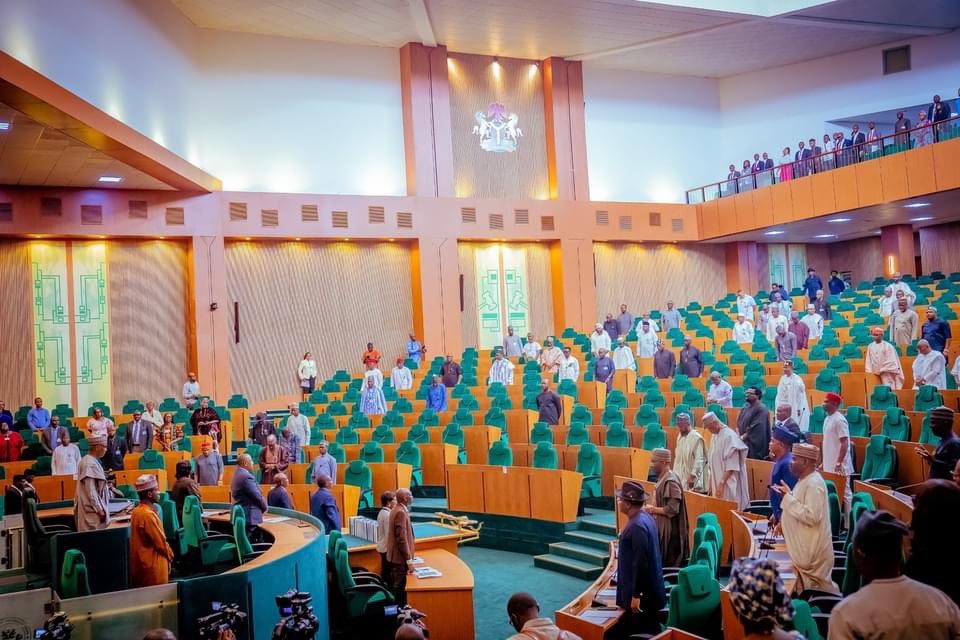

A wave of defections hit the House of Representatives on Tuesday, as 17 lawmakers dumped the African Democratic Congress (ADC) for the fast-rising Nigeria Democratic Congress (NDC), while one member crossed over to the All Progressives Congress (APC).
The Deputy Speaker, Benjamin Kalu, who presided over plenary, formally announced the defections, signalling a fresh realignment within Nigeria’s opposition space ahead of the 2027 general elections.
The lone defector to the APC is Leke Abejide, a two-term lawmaker representing Yagba Federal Constituency of Kogi State. His defection, though earlier disclosed last Friday, was officially communicated to the House during plenary.
Mr Abejide attributed his decision to what he described as protracted internal crises within the ADC, citing lingering legal disputes, leadership uncertainty, and alleged deliberate efforts to frustrate his political ambitions. His exit underscores the widening cracks within the party, which has struggled to maintain cohesion in recent months.
Mass movement to NDC
The 17 lawmakers who defected to the NDC include:

Datti Umar (Kano), Harris Okonkwo (Anambra), Sani Wakili (Kano), Attah Thaddeaus (Lagos), George Ozodinobi (Anambra), Orogbu Obiageli (Anambra), Seyi Sowunmi (Lagos), Peter Aniekwe (Anambra), Mukhtar Zakari (Kaduna), George Olawande (Lagos), Omoruyi Murphy (Edo), Manuchim Umezuruike (Rivers), Emeka Idu (Anambra), Jessie Onuakalusi (Lagos), Ifeanyi Uzokwe (Anambra), Afam Ogene (Anambra), and Abdulhakeem Ado (Kano).
Most of the defectors had only recently joined the ADC earlier this year, riding on the political momentum generated by prominent political figures, including former Anambra State Governor Peter Obi in December 2025 and former Kano State Governor Rabiu Kwankwaso in March 2026.
At the time, their entry was widely seen as a turning point that could strengthen ADC as a formidable third force ahead of the 2027 general elections.
However, that momentum appears to have waned, although the ADC is still expected by many to be the main opposition to the ruling APC.
ADC crisis
The ADC has been engulfed in multiple layers of internal conflict. These include disputes over party leadership, parallel factions claiming legitimacy, and a series of legal battles over control of party structures.
At the heart of the crisis is a leadership tussle that produced parallel factions, each laying claim to the party’s national structure. The situation escalated when the electoral commission, INEC, declined to fully recognise one of the factions, citing inconsistencies in the party’s leadership records and failure to comply with regulatory requirements.
The commission’s position effectively created uncertainty over which faction controls the party’s machinery, including candidate nominations and official communications.
The dispute soon spilt into the courts, with rival groups filing multiple suits seeking judicial recognition as the authentic leadership of the ADC. Conflicting court orders at different stages further complicated the situation, with some rulings affirming interim leadership arrangements and others calling for the maintenance of the status quo pending final determination.
This legal back-and-forth left the party paralysed, weakening its ability to function as a cohesive opposition platform. However, following a recent Supreme Court ruling, a faction led by David Mark was recognised as the authentic faction by INEC, although the Supreme Court also asked that cases in the high courts should continue.
Obi, Kwankwaso exit
The turning point came on Sunday, when Mr Obi and Mr Kwankwaso formally exited the ADC, citing irreconcilable differences and the inability of the party to resolve its internal disputes.
Both politicians were seen as major boosts to the ADC’s national appeal. However, disagreements over party structure, control and 2027 permutations deepened divisions within the party.
Their departure effectively triggered a chain reaction, with many lawmakers who had followed them into the ADC now retracing their steps into the newly formed NDC. Critics, however, say both men left because they realised they could not win the ADC’s presidential ticket in the party’s primaries.
Rise of the NDC
The NDC, a relatively new political platform, is rapidly emerging as a major force in Nigeria’s evolving political landscape.
The party is led by former Bayelsa Governor and serving Senator Seriake Dickson, who currently serves as its national leader. Since its formation, the party has positioned itself as an alternative, promising internal democracy, inclusiveness, and a break from the entrenched structures associated with both the APC and the Peoples Democratic Party (PDP).
The speed at which the NDC is attracting influential politicians, including former governors, lawmakers, and grassroots mobilisers, signals a strategic realignment ahead of the 2027 elections.
The party’s appeal appears to lie in its timing and messaging. With growing dissatisfaction within existing parties, the NDC is capitalising on discontent among political actors seeking a more stable and predictable platform.
Vacancy declared in Kano.
Meanwhile, Mr Kalu also announced the vacancy for the Dawakin Kudu/Warawa Federal Constituency seat in Kano State following the death of the constituency’s lawmaker, Danjuma Hassan, in April.
The Independent National Electoral Commission (INEC) is expected to conduct a bye-election to fill the vacant seat in line with constitutional provisions.