
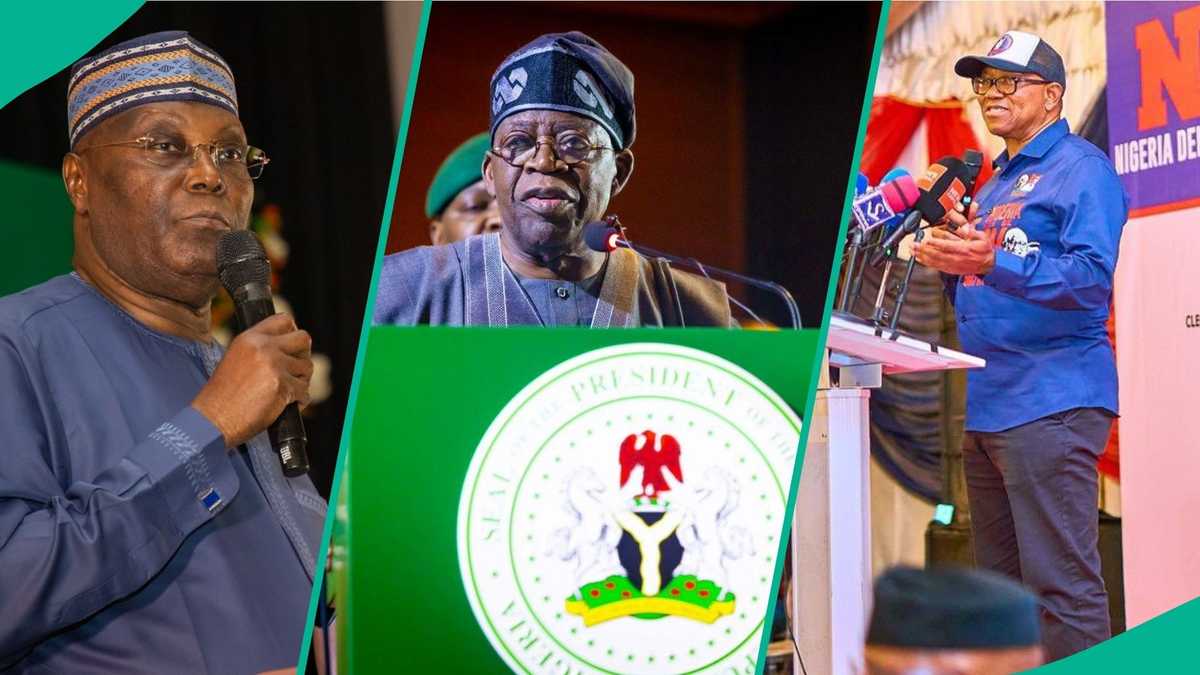

- The formal 2027 presidential campaign began this week, with President Bola Tinubu declaring his bid for a second term
- The APC enters the race with a commanding hold on 31 of Nigeria’s 36 governorships, giving it a wide structural edge
- Opposition figures are trying to unite behind a single candidate, banking on public frustration over the economy and insecurity
Nigeria’s 2027 presidential race formally kicked off on Wednesday, August 19, with President Bola Tinubu announcing his intention to seek a second term while opposition politicians scramble to find a candidate capable of mounting a credible challenge.
Top challengers to President Tinubu are Atiku Abubakar of the African Democratic Congress (ADC) and Peter Obi of the Nigeria Democratic Congress (NDC).

Photo Credit: @atiku, @officialABAT, @PeterObi
Source: Twitter
APC’s structural grip on Nigeria
The ruling All Progressives Congress (APC) heads into the contest from a position of considerable strength. The party controls 31 of Nigeria’s 36 governorships, a reach that gives it deep roots in state-level politics, access to organisational machinery, and the kind of ground presence that is difficult for any opposition grouping to match within a single election cycle.

That dominance in the states translates to influence over local party structures, campaign logistics, and voter mobilisation in most parts of the country.
What the opposition has that APC cannot buy
The opposition’s case, however, rests on something the APC cannot build overnight, which is public discontent.
Economic hardship continues to weigh heavily on ordinary Nigerians, with the cost of living, fuel prices, and insecurity ranking among the top grievances heading into the campaign season. For many voters, the question going into 2027 is not whether they are satisfied with the direction of the country, but whether the opposition can offer them a convincing reason to vote in a different direction.
Opposition figures are working to consolidate around a common challenger, recognising that a divided field would almost certainly hand Tinubu a second term regardless of the mood of the electorate.
The critical distinction, though, is that dissatisfaction with an incumbent government does not automatically translate into support for whoever stands against it. Voters unhappy with the present administration still need to believe in an alternative before they shift their support.

That gap between grievance and conviction may prove to be the defining factor of the 2027 election.
2 forces that may decide 2027 election
Legit.ng earlier reported that as Nigeria inches closer to the 2027 general elections, a striking pattern is beginning to take shape as the most consequential decisions are being made not inside party secretariats, but around coalition tables.
On one side, opposition leaders are in active discussions about fielding a single presidential candidate, a move that would require setting aside individual party interests in favour of a unified challenger. On another, the G-100, a group of influential figures pressing for opposition solidarity, has been pushing the same message: fragmented parties cannot win alone.
Meanwhile, Nyesom Wike, the Federal Capital Territory Minister, has been openly talking about assembling a large political coalition to back President Bola Tinubu’s re-election bid. His framing suggests that the strength of any presidential run in 2027 will rest on the breadth of its political architecture, not its party platform.
Source: Legit.ng