
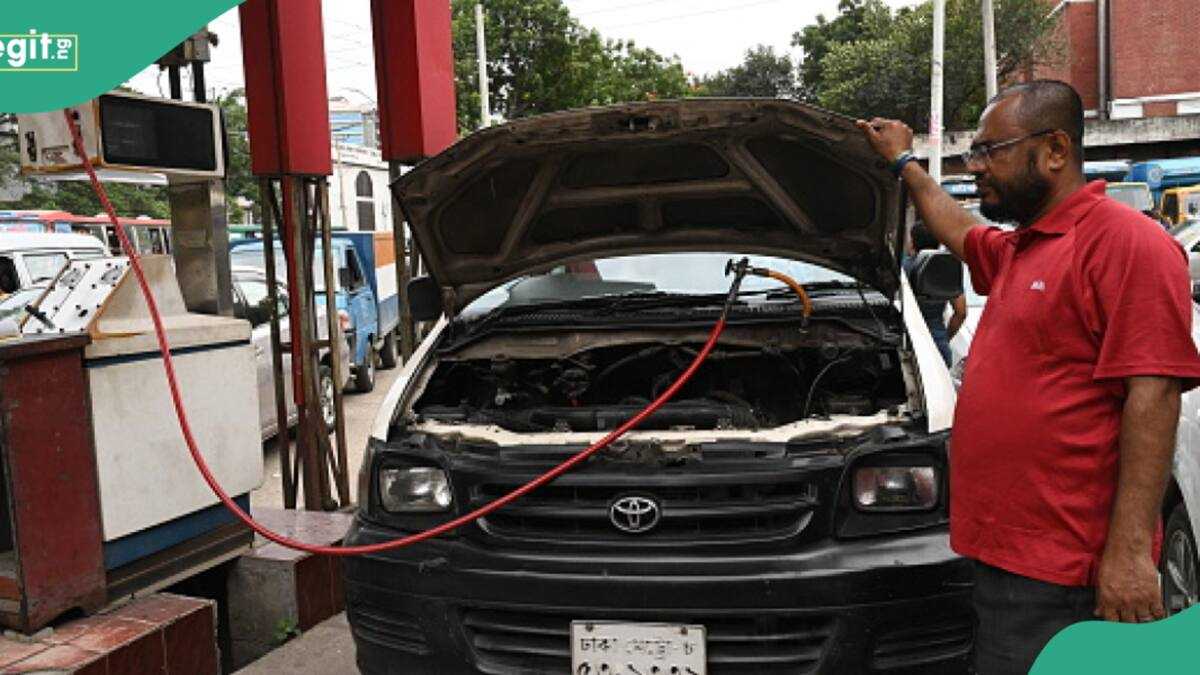

- CNG conversion workshops offer profitable opportunities for Nigerian motorists amid rising petrol prices
- Starting a CNG conversion business requires some capital, but the profit is juicy as Nigeria races to adopt CNG en masse
- Proper location and quality equipment are essential for successful CNG conversion operations in Nigeria
Pascal Oparada is a journalist with Legit.ng, covering technology, energy, stocks, investment, and the economy for over a decade.
As petrol costs continue to put pressure on Nigerian motorists and transport operators, compressed natural gas (CNG) conversion is emerging as a potentially lucrative automotive business opportunity.
The Nigerian government is aggressively pursuing the adoption of CNG as an alternative to petrol following the removal of fuel subsidies in 2023.
Since then, several CNG conversion centres have sprung up across Nigeria, with the government carrying out free training for Nigerians.
A lean but professional CNG conversion workshop can be established with an estimated ₦10 million in startup capital, covering workspace, conversion kits, diagnostic equipment, safety gear, registration, permits and initial marketing.


Credit: Novatis
Source: UGC
The business earns revenue by helping vehicle owners convert compatible petrol-powered cars to CNG, while also creating opportunities for recurring income through maintenance and safety inspections.
How the ₦10 million startup capital can be used
A significant portion of the startup budget would go into securing a suitable workshop and purchasing conversion equipment.
About ₦2.5 million can be allocated to a one-year workshop lease, preferably for an accessible roadside location with adequate roofing, ventilation and space for vehicle installation.
Another ₦4.5 million could cover five initial sequential CNG conversion kits. Diagnostic scanners, tuning equipment, wrenches and gas leak detection tools may require about ₦1.8 million.
Safety equipment, including fire extinguishers, gas sensors, protective gear and workshop signage, could cost approximately ₦500,000.
Registration, permits and related compliance expenses may take ₦350,000, while another ₦350,000 could be reserved for launch marketing, banners, flyers and digital advertising.
Together, these expenses bring the estimated startup requirement to ₦10 million.

Read also
Power supply under threat as vandals destroy 20 electricity transmission towers in Nigeria
Register the business and get certified
The first step is to establish a legal business structure. Entrepreneurs can register the company with the Corporate Affairs Commission (CAC) and obtain the necessary tax registration.
Because CNG involves high-pressure gas systems, technical competence and safety compliance are critical.
Prospective operators should pursue relevant automotive and CNG training, including programmes associated with the National Automotive Design and Development Council (NADDC), while obtaining applicable fire safety and local environmental approvals.
Choose the right workshop location
Location could determine how quickly the business attracts customers.
A workshop close to busy transport corridors, commercial hubs, filling stations or areas with large numbers of ride-hailing and commercial vehicle operators could provide stronger visibility.
The facility should have good ventilation, a concrete floor, sufficient ceiling height and clearly separated areas for vehicle inspection, installation, testing and maintenance.
Build a reliable supply chain
Quality equipment is central to the business. Operators should source certified CNG cylinders, sequential injection kits and related components from reputable manufacturers and suppliers.

Using substandard components could create serious safety risks and damage customer confidence. Every installation should therefore meet applicable technical and safety requirements.
Turn conversions into recurring revenue
The core business involves selling the conversion package, installing the equipment and carrying out electronic calibration and testing.
However, workshop owners can expand revenue by targeting logistics companies, ride-hailing drivers, transport operators and corporate fleets seeking to reduce fuel expenses.

Credit: Novatis
Source: UGC
Additional income can come from periodic system inspections, maintenance, filter replacements, diagnostics and safety checks.
With fuel costs remaining a major concern for motorists, a professionally operated CNG conversion workshop could position itself at the intersection of automotive services, energy transition and cost-saving solutions.
FG opens portal for Nigerians to get CNG tricycles
Legit.ng earlier reported that the Nigerian government has launched a portal that allows youths to access compressed natural gas (CNG)- powered tricycles, popularly known as Keke.
The Minister of State for Youth Development, Ayodele Olawande, disclosed this on Monday, October 7, 2024.
Activating the portal follows the Nigerian government’s launch of 2,000 CNG tricycles on October 1, 2024.
Source: Legit.ng