
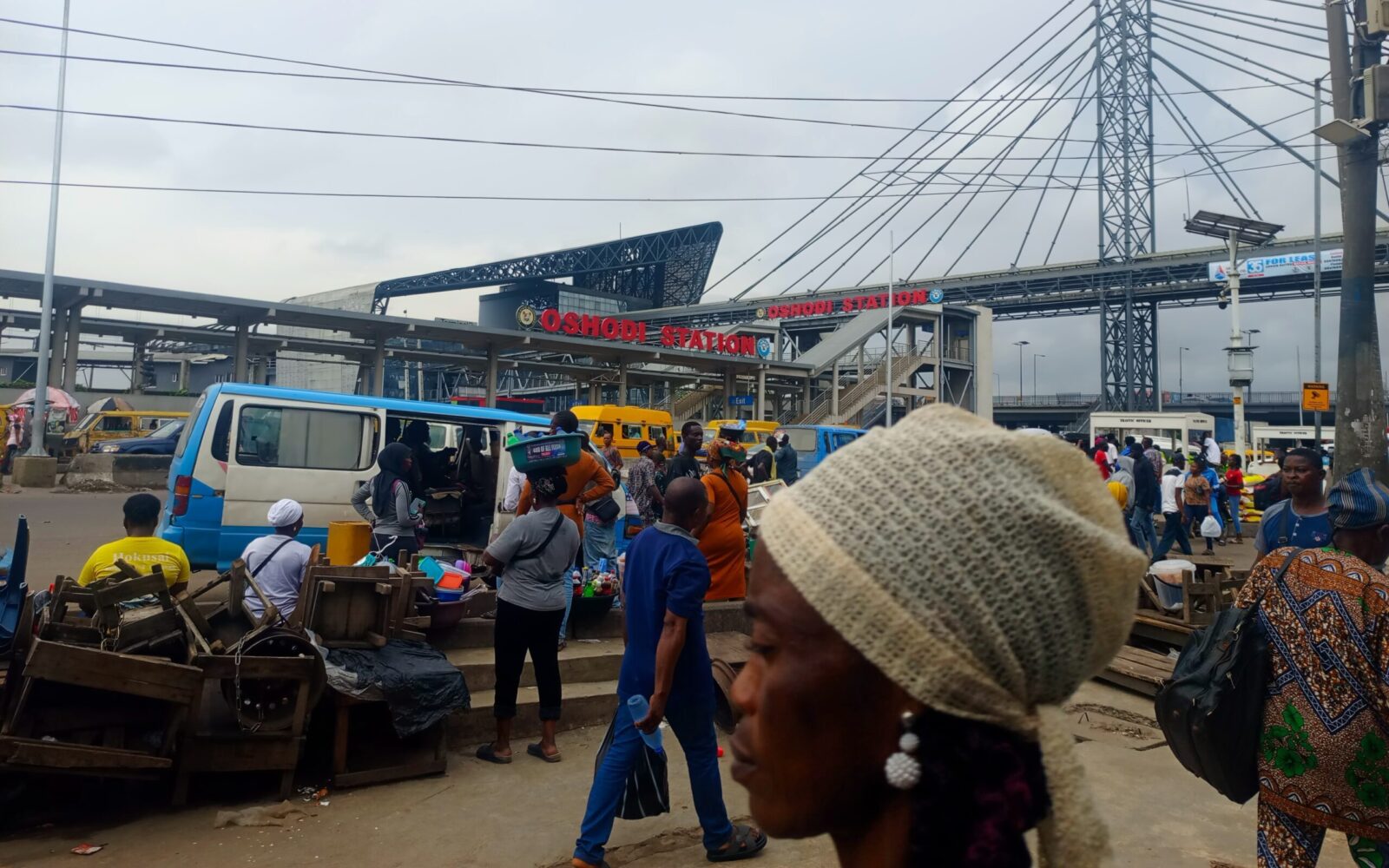


Commercial activities gradually resumed in Oshodi, a major, densely populated transportation and commercial hub of Lagos State, on Monday after floodwaters that inundated parts of the bustling commercial district following Sunday’s heavy rainfall receded.
When PREMIUM TIMES visited the area, commercial buses, taxis and private vehicles moved freely along major roads that had been submerged less than 24 hours earlier. Customers had also begun returning to the market as the floodwaters disappeared, although many shops remained closed.
The closures, however, were not linked to the flooding. Traders told PREMIUM TIMES they stayed away from the market to mourn the death of the Iyaloja of Oshodi, Sikirat Adeyanju, popularly known as Socopau.
According to them, the floodwaters had receded before Monday morning, allowing movement and commercial activities to gradually resume.


The development came less than 24 hours after several hours of heavy rainfall triggered widespread flooding across Lagos, inundating major roads and residential communities, disrupting traffic, forcing businesses to suspend operations and temporarily shutting the international terminal of the Murtala Muhammed International Airport (MMIA).
Oshodi was among the worst-hit areas, alongside Opeki Road in Mosan-Okunola Local Council Development Area (LCDA), Abesan Estate, Ilupeju Road, Mushin, Fashoro Street in Surulere, Akowonjo Road in Egbeda, Gbagada Expressway and Idi-Oro. Sunday’s flooding occurred about two weeks after the Lagos State Government warned residents of the likelihood of heavy rainfall, flash floods and rising water levels across several parts of the state.
Residents recount experiences
A customer, Ifeanyi Moses, said he postponed his visit to the market until he was certain the roads were passable.
“The rain fell yesterday, so I decided to come around today to buy some items in the market because the water has gone,” he stated.
A clothing seller, Paul Arinze, explained that floodwater entered his shop during Sunday’s downpour but caused only minor damage.
“We were able to clean up because the water inside the shop was not as bad as what was on the road. We have also raised the frontage of the shop with blocks because flooding happens almost every year here,” he said.

Although normal activities had resumed in Oshodi, residents and traders who spoke with PREMIUM TIMES said the latest flooding had once again exposed the city’s persistent drainage challenges.
They called for improved drainage infrastructure and better waste management to minimise the impact of future downpours.
Earlier, PREMIUM TIMES reported that the flooding also disrupted operations at the temporary international terminal of the Murtala Muhammed International Airport (MMIA).
Floodwaters inundated the departure hall, boarding gates, airline offices and other parts of the facility, forcing the Federal Airports Authority of Nigeria (FAAN) to suspend operations there. Airlines, including Air France-KLM, Ethiopian Airlines and Fly Gabon, were relocated to Terminal Two after water reportedly reached the terminal’s powerhouse, prompting airport authorities to switch off electricity as a safety precaution.
The incident came only months after FAAN closed the old international terminal for a reconstruction project estimated at more than N600 billion. Earlier this year, parts of the same terminal were damaged by fire.
FAAN spokesperson Henry Agbebire attributed the flooding to ongoing reconstruction work around the airport.
“It was the construction works that affected the drainage. And for operational reasons, we have moved airlines operating from that terminal to Terminal 2, and the development has not really affected their operations.
“There were no cancellations at all. We have taken immediate action to fix that problem to the extent that it doesn’t happen again. You can rest assured of that,” he said.
Government explains flooding
Reacting to Sunday’s flooding, the Lagos State Commissioner for the Environment and Water Resources, Tokunbo Wahab, urged residents not to panic, describing the incident as flash flooding that would naturally recede after the rainfall.

He said such flooding is common in coastal cities during periods of intense rainfall, noting that high lagoon water levels sometimes prevent stormwater from emptying into the lagoon until the tide subsides.
Mr Wahab said the state had continued year-round drainage maintenance and flood control measures but urged residents to stop dumping refuse into drains and carrying out illegal developments on drainage setbacks and wetlands. He added that investments in drainage infrastructure and stricter environmental enforcement had helped reduce the severity of flooding in recent years despite increasing rainfall.
Earlier warning
Sunday’s flooding occurred about two weeks after the Lagos State Government warned that several parts of the state were at risk of heavy rainfall, flash floods and rising water levels.
The advisory, based on flood predictions by the Federal Ministry of Environment, identified Apapa, Badagry, Epe, Eti-Osa, Ikeja, Ikorodu, Ikoyi, Lagos Island, Lekki, Ojo, Orile-Agege, Surulere, Agege, Alimosho and Kosofe as areas facing a high flood risk.
Residents in vulnerable communities were advised to remain alert, identify safe evacuation routes and avoid activities that could obstruct drainage channels.
The widespread flooding has renewed concerns about the effectiveness of drainage maintenance and waste management in Africa’s largest city as the peak of the rainy season approaches.