
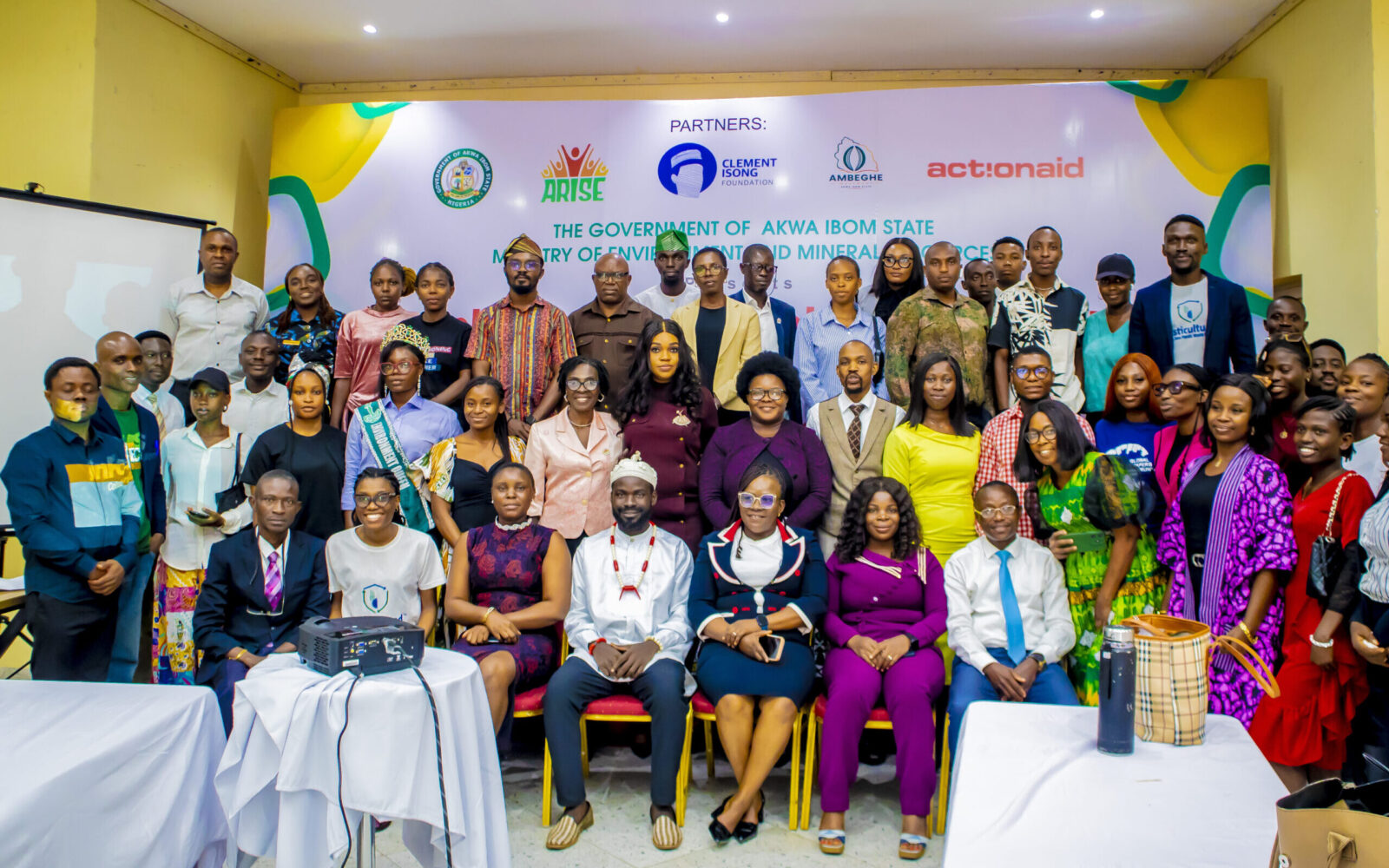


Government officials, civil society organisations, development partners, private sector actors, youth groups, and environmental advocates under the umbrella of Stakeholders’ Roundtable on Green Jobs and Enterprise Development in Akwa Ibom State have asked the Akwa Ibom State Government to develop a climate change policy and establish a dedicated framework for green jobs in the state.
They said this action would be a significant effort geared towards tackling unemployment, strengthening environmental resilience, and positioning the state within Nigeria’s emerging green economy.
The recommendations were contained in a communiqué issued at the end of a stakeholders’ roundtable organised by the Akwa Ibom State Ministry of Environment and Mineral Resources in collaboration with the Clement Isong Foundation (CIF) through the Ambeghe Movement in Uyo on 23 June.
The meeting brought together government officials, civil society organisations, development partners, private sector actors, youth groups, and environmental advocates to discuss strategies for promoting green jobs, climate-smart enterprises, and sustainable livelihoods in the state.
Participants said Akwa Ibom possesses significant natural and human resources that could drive growth in the green economy but noted that policy gaps, limited financing, and weak institutional coordination have constrained progress.

They identified green skills development, circular economy enterprises, and climate-smart livelihoods as viable pathways for youth employment and economic inclusion.
Climate change and economic opportunities
According to the communiqué, participants acknowledged that the state government’s ARISE Agenda already contains climate-responsive priorities that align with the green economy, including erosion control, flood management, coastal protection, solar energy transition, and recycling initiatives.
They noted that these priorities could serve as entry points for investments capable of generating employment while addressing environmental challenges.
“Green jobs and enterprise development represent both an environmental necessity and an economic opportunity,” the communiqué stated, adding that deliberate policy commitment and stronger partnerships would be required to unlock the sector’s potential.
The stakeholders also highlighted the state’s vulnerability to flooding, coastal erosion, and ecosystem degradation, stressing the need to integrate climate resilience into enterprise development planning.
Key resolutions
Among the major resolutions adopted at the meeting was a call for the Akwa Ibom State Government to develop a comprehensive Climate Change Policy with green skills development, green jobs, and the circular economy as central pillars.
Participants also recommended the creation of a Green Jobs Framework that would identify priority sectors, map skills with the highest employment and funding potential, and establish pathways for young people and entrepreneurs to access opportunities in the green economy.
The communiqué further urged the Ministry of Environment and Mineral Resources to institutionalise an annual Green Enterprise Exhibition and Innovation Fair to provide visibility, market access, and investment opportunities for youth-led green businesses.
Stakeholders also called for the strategic use of the Host Community Development Trust framework established under the Petroleum Industry Act 2021 as a financing mechanism for green skills development and enterprise support in oil-producing communities.
In addition, they recommended the establishment of a multi-stakeholder platform to monitor progress, mobilise funding, and facilitate data sharing on green job initiatives across the state.
Inclusion and partnerships
The participants emphasised the need for inclusive implementation of green economy programmes, calling on policymakers to ensure that persons with disabilities are integrated into training, financing, and market-access initiatives.
They also advocated adapting structured environmental employment schemes that could provide immediate job opportunities for young people while strengthening environmental compliance and urban sustainability.
PREMIUM TIMES previously reported that Akwa Ibom State is among the states with the highest unemployment rates in Nigeria.
The stakeholders stressed the importance of partnerships between government institutions, private investors, development finance institutions, and civil society organisations to mobilise resources for green enterprise development.
They further endorsed the exhibition of youth-led green enterprises held during the roundtable, describing it as a practical demonstration of the innovation and entrepreneurial potential among young people in the state.
The meeting commended the Clement Isong Foundation, the Ambeghe Movement, and ActionAid Nigeria for supporting the initiative and advancing discussions on sustainable economic development in Akwa Ibom.
Committee inaugurated
As part of the outcomes of the event, participants inaugurated a Committee on Green Jobs, Climate Action and Sustainable Enterprise Development to drive implementation of the resolutions and coordinate future engagements.
They expressed optimism that sustained collaboration among stakeholders would help translate policy discussions into concrete programmes capable of creating jobs, attracting investment, and improving environmental outcomes.
The communiqué concluded that a green economy is essential to Akwa Ibom State’s long-term prosperity and resilience, noting that the success of the transition would depend on turning commitments into measurable and accountable action.