
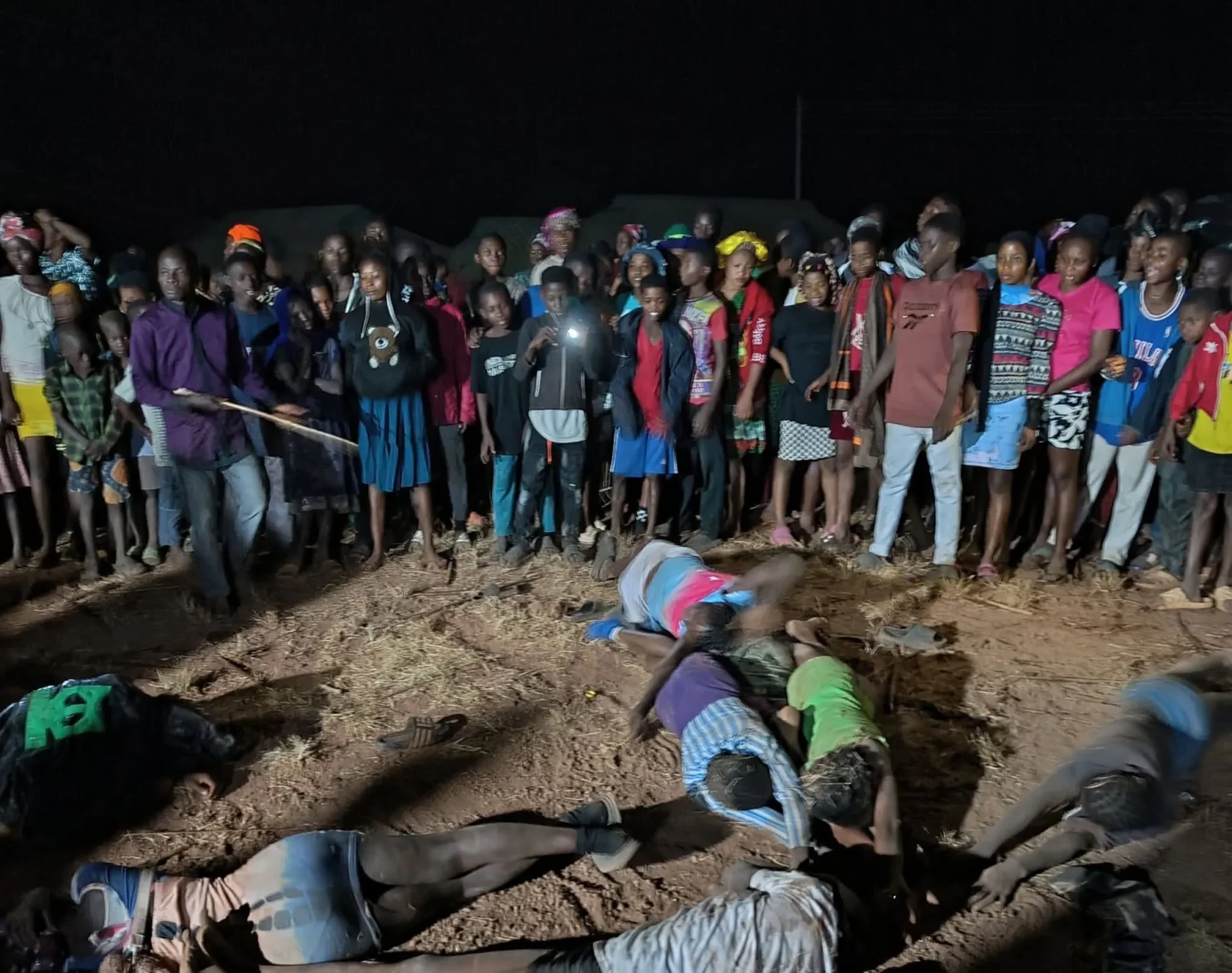


On the night of 13 March, under dim lights and the sound of worship songs, a crowd gathered at a crusade ground in Onyadama community, Obubra Local Government Area of Cross River State, in the south-southern part of Nigeria.
What followed, according to video evidence and witness accounts obtained by PREMIUM TIMES, was not deliverance but a sustained mob assault.
The victim of the attack was Grace Ekoi, a woman who appeared to be in her 50s. She survived. But another person, according to community sources, died.
Several weeks later, no one has been arrested for the assault. There is no indication that a full investigation has begun.
Night of violence
Footage reviewed by PREMIUM TIMES shows at least eight individuals taking turns to flog a woman with long canes.

As the beating intensified, the woman attempted to run into the crowd. More men, women, and people of various ages joined in the assault.
A man’s voice could be heard on the microphone singing in the background as the congregants continued to clap.
The woman broke free at one point, ran towards the road. Voices shouted in Pidgin English, “She don run o.” She was chased, caught and beaten again, this time until she became motionless.
At some point a man approached with a bottle of what appeared to be olive oil, which many Pentecostal pastors in Nigeria use for “anointing” and “deliverance”. The man briefly halted the assault, poured the oil on her, and directed that she be lifted. Moments later, the beating resumed.
‘They called me a witch’
Ms Ekoi later stated in an interview that she attended the crusade to seek healing for her 14-month-old child, who could not walk.
“We went for crusade from Tuesday to Friday,” she said. “As I was breastfeeding my baby, they called me, ‘Come, come.’”

A church worker took the baby from her and handed the infant to another child.
“They said, ‘Stand here, witch!’ I said, ‘Witch how? I am not a witch. I thought you called me to pray for my baby.’”
She said the pastor presiding over the crusade ordered the attack.
“That crusade pastor said, ‘Beat her.’ Many people beat me with sticks. I kept screaming that I was not a witch.
“They used their legs to march me. He held microphone, ordered that I should be beaten.”
Her hands were later tied behind her back.
“It was a mass beating. All they kept saying was that I was a witch and that they would kill me.”
At some point, she said, she swore an oath in desperation: if she was a witch, she should not see the next day.
Pattern of humiliation, assault
Investigations by PREMIUM TIMES identified the crusade organiser as Usetu Bassey, who operates under the name Kabod International Church.

A review of his social media activity shows frequent night crusades across northern Cross River, particularly in Ugep, Yakurr Local Government Area.
Photos posted on his Facebook page over the past three years show similar patterns of women lying on bare ground during services, with young men holding canes nearby. In a 10 December 2024 Facebook post, at least seven women were seen lying on the ground while others stood and watched. Another image from 2 April 2023 showed a woman who lay on the floor appearing unconscious during a crusade session.
When contacted, Mr Bassey dodged the questions PREMIUM TIMES asked.
He said community leaders were present at the crusade in Onyadama.
“I did a five days crusade at Onyadama which the chief/clan head was present and every other leaders. Do you think I will just go to a community and ask them to beat their own?”
He did not address the allegations that he incited the violence against the assaulted woman.
Silence from community leaders
Onyadama is a farming community, where most residents depend on yam and cassava cultivation, as well as sand and gravel extraction, for their livelihoods.
The community is perhaps best known for its longstanding land and boundary dispute with the neighbouring Nko community in Yakurr Local Government Area. Over the years, the conflict has led to repeated outbreaks of violence, prompted government interventions and commissions of inquiry, and several attempts at peace settlements.
The community also has a place in Cross River’s political history. Between 2011 and 2015, it produced Moses Onor, who served as majority leader of the Cross River State House of Assembly.
Onyadama is Obubra Local Government Area, which has an estimated population of about 262,800 people and hosts the permanent National Youth Service Corps orientation camp for Cross River State, bringing thousands of corps members to the area every year.
The village head of Onyadama, Enang Erim, declined comment when contacted by PREMIUM TIMES, saying he could only speak with authorisation from the clan head.
Vincent Erena, the clan head, did not respond to calls from our reporter.
In a formal media enquiry, PREMIUM TIMES asked whether the community sanctioned the crusade and labeling of some community members at witches, whether leaders were present during the assault, and why no intervention occurred.
Mr Erena had yet to respond at the time of filing this report.
Police response raises questions

On 18 March, the police in Cross River told PREMIUM TIMES they had begun an investigation into the matter.
“The DPO visited Onyadama community to verify a reported brutal murder during a crusade,” said the police spokesman in Cross River, Eitokpah Sunday, said.
He added that the community chief denied knowledge of the incident.
Several weeks later, there has been no arrest or public information on investigations into the matter.
PREMIUM TIMES sent an enquiry on 26 March to the police, seeking for clarifications on what action had been taken on the case. A reminder on 6 April elicited a response.
Mr Sunday, an assistant superintendent of police, said Ms Ekoi was attacked following claims from a church prophecy labelling her a witch. He said she received treatment and was later moved to another facility in Calabar.
However, the police did not address key questions, including whether any suspects had been invited or identified.
Pattern of witchcraft branding, abuse in Cross River
Rights advocates say the incident reflects a wider crisis in the state.
“This is just one of the cases that has come to light,” said James Ibor, principal counsel at a human rights group, Basic Rights Counsel Initiative and member of Advocacy for Alleged Witches.
“There are many that are never reported. It has been about a month since this happened and not even one arrest.”
He blamed the attacks on people accused of witchcrafts on a mix of poverty, weak institutions and what he described as “religious profiteering.”
“The religious merchants constantly serve fear to maintain their grip on vulnerable populations,” he said.
Mr Ibor said his organisation has filed a petition to the police, but that they were yet to receive a response.
He said there are similar cases in Cross River which have not been resolved. Mr Ibor mentioned a lady in Akamkpa Local Government Area whose relative threatened several times to kill her after alleging that she is a witch and later the woman went missing.
He said another woman still in Akamkpa was burnt to death in broad daylight over accusations of witchcraft engineered by a religious leader and till date no one is standing trial.
“We have written to the police but they are yet to take any action,” he said.
Religious events organised to brand and attack people accused of witchcraft are not peculiar to Cross River. PREMIUM TIMES had reported how a group asked the Nigeria Police Force and the State Security Services to stop a Nigerian pastor from going ahead with an “anti-witch” programme in Imo State tagged “that witch must die”.
What the law says
Nigeria’s Criminal Code explicitly criminalises trial by ordeal and witchcraft-related violence.
Section 208 provides that anyone who directs or presides over an unlawful trial by ordeal resulting in death is liable to capital punishment. Section 209 prescribes imprisonment for those present.
READ ALSO: CISLAC, Transparency International fault UK court verdict acquitting Diezani
Mr Ibor, a lawyer, says the events in Onyadama—where a public accusation led to collective punishment— fall within these provisions.
No justice, yet
For Ms Ekoi, survival came at a cost.
After the beating, she said she was taken home by some youths and later to a hospital. Unable to afford continued treatment, her family resorted to home care.
Her child cried throughout the ordeal, she said.
As of 11 June, there has been no confirmed arrest and prosecution of suspects. Authorities have not publicly acknowledged any death linked to the incident, despite accounts from community sources.
What remains is a trail of questions about responsibility, belief, and the cost of silence.
And in Onyadama, a night that began with prayers has created fears of the consequences of being named a witch by a religious leader, and victims are still waiting for justice.