
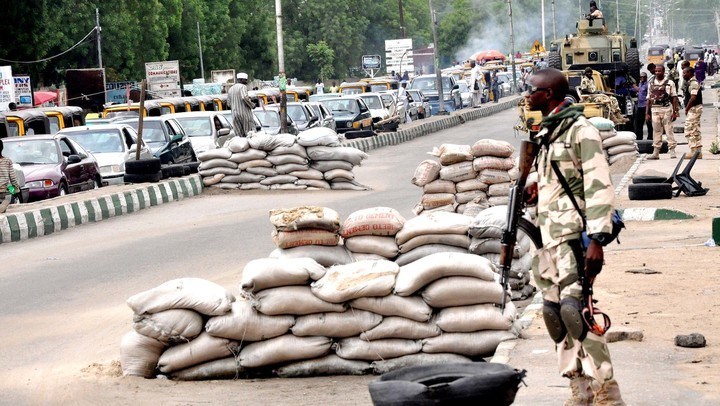


A lawyer, Chinedu Agbodike, has sued Nigerian authorities over alleged “oppressive and excessive” military checkpoints in the Nigeria’s South-east.
Mr Agbodike filed the lawsuit at the Enugu State High Court on 17 June, according to a court document sighted by PREMIUM TIMES. Aloy Ejimakor, the former special counsel to the now-convicted leader of the outlawed Indigenous People of Biafra, Nnamdi Kanu, uploaded the court documents to his X handle on Tuesday.
According to the filing, the suit was brought pursuant to the Fundamental Rights (Enforcement Procedure) Rules, 2009, and relevant sections of the 1999 Constitution of the Federal Republic of Nigeria (as amended) and the African Charter on Human and Peoples’ Rights Act.
PREMIUM TIMES reports that there have been multiple military checkpoints on major roads across the five South-east states: Enugu, Anambra, Ebonyi, Imo, and Abia. While the checkpoints were initially deployed as part of efforts to curtail frequent attacks linked to separatist groups in the region, military personnel manning them have been accused of engaging in extortion, harassment, and intimidation. This has caused untold hardship for road users, such as forcing travellers to disembark from their vehicles and trek for miles past the checkpoints.
Applicant and respondents
Mr Agbodike, who sued on behalf of himself and the five states in the South-east, is listed as the sole applicant. The Chief of Army Staff, the Nigerian Army, the Attorney-General and Minister of Justice, and the Federal Government of Nigeria are listed as respondents.

Prayers
Mr Agbodike has asked the court to declare that the alleged “indiscriminate deployment, establishment, operation, and maintenance of military checkpoints and roadblocks” in the South-east by the respondents constitutes a violation of the fundamental human rights of residents, as guaranteed under both local and international laws and regulations.
He stated that the checkpoints have resulted in the harassment, extortion, arbitrary arrest, unlawful detention, torture, degrading treatment, enforced disappearances, and extrajudicial killings of residents in the region.
The lawyer also prayed the court to declare that the establishment of checkpoints and roadblocks is unconstitutional and unlawful, and therefore constitutes an abuse and violation of residents’ fundamental human rights. He further argued that the Chief of Army Staff and the Nigerian Army’s alleged assumption of internal policing functions—vested in the Nigeria Police Force under Section 214 of the Constitution—amounts to an unlawful usurpation of powers.
Mr Agbodike also asked the court to declare that the alleged “excessive militarisation” of Anambra, Enugu, Ebonyi, Abia, and Imo states constitutes an unjustifiable and disproportionate interference with residents’ constitutional rights to freedom of movement and personal liberty.
Furthermore, he is seeking a declaration that the alleged discriminatory profiling and targeting of citizens by the military at various checkpoints—on account of their ethnicity, age, mode of dressing, hairstyle, language, or physical appearance—is unconstitutional, oppressive, and a violation of their constitutional rights.
READ ALSO: Police intercept truck carrying military camouflage, drugs, arrest four in Lagos
The lawyer prayed the court to order the first and second respondents to dismantle all checkpoints and roadblocks on roads within the South-east. He further pleaded for an order compelling the third respondent to develop mechanisms to investigate and prosecute all military personnel implicated in incidents of brutality, torture, extortion, extrajudicial killings, and other misconduct committed at military checkpoints in the region from 2018 to date.
Mr Agbodike consequently asked the court to award N500 billion in exemplary, aggravated, and general damages against the respondents, “jointly and severally, for the widespread and continuing violation of rights” of South-east residents. He also prayed for an order compelling the respondents to issue a formal public apology to South-east indigenes in three national newspapers and on television stations.
The lawyer requested an order of perpetual injunction restraining the respondents and their agents from establishing, deploying, or maintaining checkpoints and roadblocks in the region, except as authorised by the Constitution or an Act of the National Assembly.
The court has yet to set a date for the hearing.
Legal team
Apart from Mr Ejimakor, five other lawyers are part of the legal team handling the matter: P.N. Agazie, B.C. Anyi, B.K. Agazie, Chinwe Agazie, Eguzoribe Ozioma, E.C. Eze, and Florence Iloanya.