
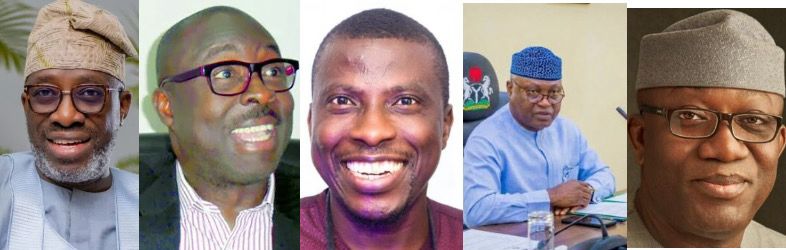


As Ekiti voters prepare to elect a governor on Saturday, one of the most remarkable features of the campaign season has been the unprecedented alignment of the state’s political heavyweights behind incumbent Governor Biodun Oyebanji.
For the first time since the state was created in 1996, all four former elected governors—Niyi Adebayo, Ayodele Fayose, Segun Oni and Kayode Fayemi—have publicly rallied behind the same governorship candidate.
In a state known for intense political rivalry and shifting alliances, the development has been striking. The endorsements have strengthened the narrative that the election is less a conventional political contest and more a referendum on Mr Oyebanji’s performance over the past three and a half years.
Yet beyond the symbolism of political unity, a critical question remains: How much influence do these former governors still command? Can their collective backing shape the election’s outcome?
Niyi Adebayo: Pioneer elected governor

Niyi Adebayo occupies a unique place in Ekiti’s political history.

As the state’s first elected governor in the Fourth Republic, serving a single term between 1999 and 2003, Mr Adebayo, son of a former military governor of the defunct Western State, Adeyinka Adebayo, established many of the administrative and institutional foundations upon which subsequent governments have built.
Although he has largely retreated from frontline partisan politics, he remains one of the state’s most respected political elders. His influence today may not be measured by campaign rallies or political structures but by the respect he commands among traditional rulers, professionals, civil servants and older members of the progressive political family.
His administration is credited with stabilising the newly created state, earlier run by the military, and laying the groundwork for governance structures that have endured for more than two decades.
Like many political leaders, however, his tenure on the Alliance for Democracy ticket was not without challenges. He lost his re-election bid in 2003 amid public dissatisfaction over economic conditions and governance concerns.
Today, analysts believe his endorsement carries significant symbolic value.
For many conservative and elite voters, Mr Adebayo’s support serves as reassurance that Mr Oyebanji represents continuity within the state’s progressive tradition.
Ayo Fayose: The grassroots force

If Mr Adebayo embodies institutional authority, Ayodele Fayose represents grassroots political energy.
No former governor arguably enjoys the same level of name recognition among ordinary Ekiti residents as Mr Fayose.
The two-term governor, who served from 2003 to 2006 and again from 2014 to 2018, built his political brand around direct engagement with the masses. His political style often transcended party lines, earning him supporters beyond his party, the Peoples Democratic Party (PDP), where he remains one of the state’s most influential figures.
His administrations are remembered for road construction projects, social intervention programmes and a political style that emphasised accessibility to ordinary citizens.
His career, however, has also been marked by controversies, including political confrontations, governance disputes and his impeachment during his first tenure—an action later nullified by the court.
For this reason, his endorsement of Mr Oyebanji has generated the greatest attention.
Despite remaining a PDP chieftain, Mr Fayose has repeatedly declared support for the APC governor, arguing that performance should take precedence over party affiliation.
Speaking during a recent radio programme broadcast across Ekiti State, the former governor made his position unmistakably clear.
“Ekiti comes first before any political affiliation. We were Ekitis before any political party. If you believe in me and believe I represent your interests, come out on June 20 and vote for Governor Biodun Oyebanji to complete his second term. He is a gentleman who has performed very well.”
Mr Fayose dismissed suggestions that his support was motivated by political patronage, insisting that his endorsement was based solely on what he described as the governor’s achievements in office.
He also revealed plans to campaign across the state’s three senatorial districts in support of Mr Oyebanji.
“I remain a member of the PDP. Whether we support him or not, Oyebanji will win, and the APC will be the greatest beneficiary. I have built an image in this state and have supporters who should vote for this governor.”
A lawyer and APC stakeholder, Babatunde Kolawole, believes Mr Fayose’s endorsement could have significant electoral implications.
“No former governor arguably commands grassroots recognition in Ekiti like Fayose,” Mr Kolawole told PREMIUM TIMES.
“If any former governor can still move substantial numbers of voters independently, Fayose is arguably the strongest.”
That assessment is shared by many observers who believe the former governor remains one of the few politicians capable of influencing voter sentiment across party boundaries.
Segun Oni: The consensus builder
Segun Oni’s tenure as governor may have been brief, but his political relevance has endured.
Mr Oni governed Ekiti between 2007 and 2010 before losing office following a prolonged legal battle that eventually led to Kayode Fayemi being declared the winner of the disputed election.
His tenure may not have existed in the eyes of the law; however, unlike many politicians known for combative styles, Mr Oni built a reputation around moderation, civility and political inclusiveness.
His administration focused on education, rural development and extending infrastructure beyond the state capital.
Mr Kolawole describes him as a leader whose achievements are often understated.
“Segun Oni was a quiet governor,” he said.
“That doesn’t mean he wasn’t working. He wasn’t as loud as Fayose, but he was effective. He built on existing projects and expanded development beyond Ado-Ekiti.”
Over the years, Mr Oni has remained politically relevant despite moving between political parties.
Today, he has emerged as one of the most vocal advocates of Mr Oyebanji’s re-election.
At campaign events across the state, the former governor has repeatedly argued that the incumbent has demonstrated the qualities required to unite Ekiti’s diverse political interests.
Recently, Mr Oni predicted that Mr Oyebanji could become the first governor in the state’s history to secure consecutive electoral victories.
“Governor Oyebanji is set to make history,” he declared during a campaign event.
His support carries particular weight among technocrats, professionals and moderate voters who value consensus politics.
Kayode Fayemi: The strategist

If Mr Fayose brings grassroots appeal, Kayode Fayemi contributes organisational strength and strategic influence.
The former governor and one-time Minister of Mines and Steel Development remains one of the APC’s most influential figures nationally.
Mr Fayemi governed Ekiti from 2010 to 2014 and again from 2018 to 2022, leaving behind a legacy of governance reforms, infrastructure development, educational investments, and social security initiatives.
His first tenure ended in disappointment when he lost re-election in 2014 despite entering the contest as the incumbent governor.
Yet he returned four years later to reclaim the office, reinforcing his status as one of the state’s most formidable political figures.
Mr Kolawole credits him with introducing significant innovations in education.
“Fayemi modernised the education sector,” he said.
“Students and teachers had access to laptops, and he brought innovation into the system.”
Unlike some former governors whose influence is largely personal, Mr Fayemi retains a substantial political structure within the APC.
His support for Mr Oyebanji has been unwavering.
In a message posted during the governorship campaign flag-off, Mr Fayemi praised the governor’s leadership style and commitment to continuity.
“Governor Oyebanji has, in many respects, justified the confidence reposed in him,” he wrote.
“His steady leadership, inclusive approach, and focus on development have helped consolidate the progress we set in motion.”
For many APC loyalists, Mr Fayemi’s endorsement signals continuity within the progressive movement that has dominated Ekiti politics for much of the Fourth Republic.
Why the endorsements matter
The significance of the endorsements extends beyond mere symbolism.
Collectively, all four former governors represent virtually every major political tradition that has shaped Ekiti politics since 1999.
They command networks among traditional rulers, party leaders, civil servants, professionals, religious leaders and grassroots supporters.
Perhaps more importantly, they represent both sides of Ekiti’s long-standing political divide.
Mr Fayose remains one of the PDP’s most recognisable faces, while Messrs. Adebayo and Fayemi are pillars of the APC tradition. Mr Oni, meanwhile, enjoys credibility across partisan lines.
Political analyst Akinwale Adesina believes the coalition sends a powerful message to voters.
“In a state where politics is often highly polarised, seeing Fayose, Fayemi, Oni and Adebayo on the same side is extraordinary,” he told PREMIUM TIMES.
“It tells voters that the election has moved beyond party lines and has become a judgement on Governor Oyebanji’s performance.”
According to him, the endorsements also make it significantly harder for opposition forces to construct a broad anti-incumbent coalition.
“Once you have major figures from opposing political traditions endorsing the same candidate, the opposition loses one of its strongest arguments—that voters should reject the incumbent simply because of party affiliation,” he said.
Can they swing the election?
The short answer is yes—but only to an extent.
Ekiti’s political history suggests that endorsements alone do not win elections.
The state’s electorate has consistently demonstrated an independent streak, often rewarding or punishing incumbents based on perceived performance rather than elite consensus.
Indeed, both Mr Adebayo and Mr Fayemi lost re-election bids despite enjoying the backing of influential political structures at the time.
Yet the collective weight of the four former governors cannot be dismissed.
Together, they provide Mr Oyebanji with a rare political asset: bipartisan legitimacy.
Mr Fayose offers grassroots appeal and cross-party reach. Mr Fayemi contributes to party structure and elite influence. Mr Oni brings moderation and broad acceptability. Mr Adebayo adds elder statesman authority.
READ ALSO: #EkitiDecides2026: Police assure Ekiti residents of adequate security, restrict movement
Mr Kolawole believes turnout may ultimately prove more important than endorsements.
“What we are trying to achieve is not just victory,” he said.
“The goal is to make a statement. People must come out and vote because voting is the only way to demonstrate approval of a governor’s performance.”
That may ultimately be the defining challenge for Mr Oyebanji and his supporters.
While the endorsements have undoubtedly strengthened his political position, the governor’s fate will still be determined by voters assessing his record in office against the alternatives on offer.
The support of four former governors may provide him with an unprecedented political shield. Still, on Saturday, as has always been the case in Ekiti politics, the final verdict will belong to the electorate.