
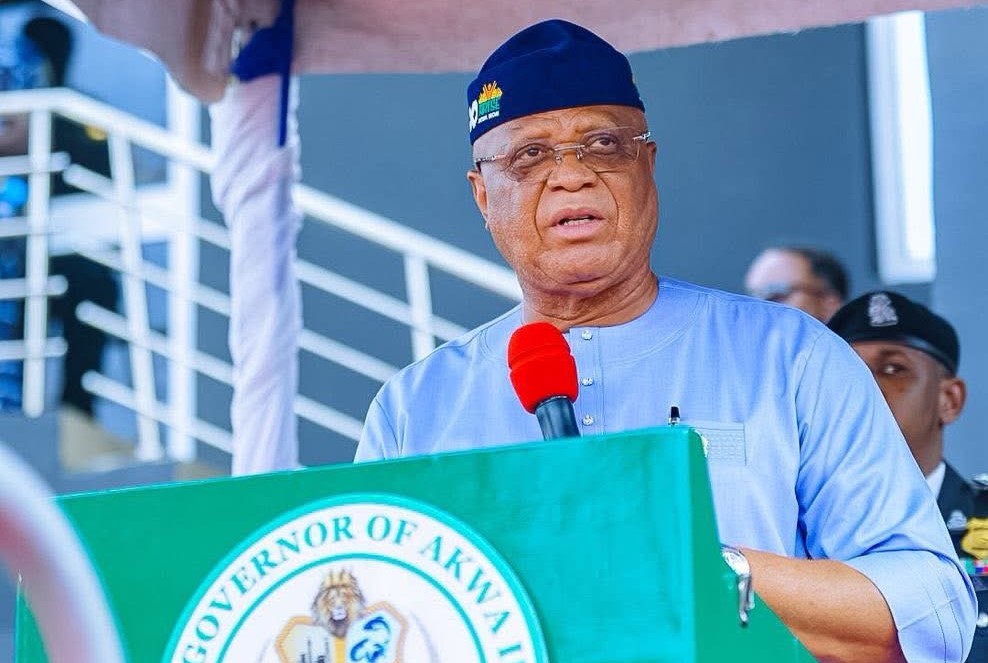


When Governor Umo Eno reconstituted Akwa Ibom’s Direct Labour Committee in March 2024 and named himself chairman, few anticipated the scale of projects that would come under its watch. Today, the committee oversees some of the state’s most expensive public projects and stands to gain new powers that could evade accountability under a proposed procurement law.
The committee took charge of the construction of model primary healthcare centres spread across local government areas. It oversaw the construction of model schools and the administration’s widely publicised ARISE Compassionate Homes. Now, it is supervising the rehabilitation of the Akwa Ibom State House of Assembly Complex.
Yet one question lingered in the background: under what law was the committee awarding or supervising contracts that ordinarily fall within the mandate of ministries and agencies governed by the state’s procurement law?
Now, a bill before the Akwa Ibom State House of Assembly appears set to answer that question.
A PREMIUM TIMES review of the proposed Akwa Ibom State Public Procurement Regulatory Agency (Establishment) Bill shows that the legislation would create a legal framework for the Direct Labour Committee and grant it powers to procure goods, works and services without passing through what the bill describes as “stringent procurement tendering process.”

The provision sits at the centre of a proposed law that has moved through the House with unusual speed.
Introduced alongside 11 other executive bills on 2 June, it passed its first reading the same day. By 9 June, it had scaled its second reading and was sent to the House Committee on Appropriation and Finance. A public hearing was held on 15 June to gather input on the bill.
But behind the routine legislative process is a proposal that could reshape how billions of naira in public contracts are awarded in Akwa Ibom.
Law that changes little except one thing
At first glance, the bill looks familiar as large sections mirror the existing Akwa Ibom State Public Procurement Law, Cap 122, Laws of Akwa Ibom State, 2022, which the new legislation seeks to repeal.
The content, architecture, and regulatory structures remain the same, except that the regulatory authority is proposed to be called an agency rather than the bureau currently in place. The key change is the formal introduction of the Direct Labour Committee.
Under Section 31, the governor would chair the committee. Other members include the Secretary to the State Government, the Commissioner for Finance, the Accountant-General, a Senior Special Assistant to the Governor on Special Duties, or a representative of the Ministry of Special Duties, members of the state’s Project Monitoring and Evaluation Team, and the Secretary of the Committee.
The most consequential provision appears in Section 31(3). It authorises the committee to engage resource persons and service providers for the procurement of goods, works, and services categorised as “special intervention” projects, without having to undergo the stringent procurement procedures required elsewhere under the law.
The phrase appears only once in the bill, and its meaning is unexplained. The legislation contains no definition of what qualifies as a special intervention project. It sets no limits on the type of projects that can be classified under the category and establishes no monetary ceiling.
Instead, the bill leaves the determination of spending thresholds to procurement circulars that would be issued later by a regulatory agency whose leadership would be appointed by the governor.
The questions raised by the proposed legislation prompted PREMIUM TIMES to seek clarifications from the Akwa Ibom State Government.
In separate enquiries sent to the Commissioner for Information, Aniekan Umanah, and the Attorney-General and Commissioner for Justice, Uko Udom, PREMIUM TIMES asked why the government considered it necessary to create a procurement pathway exempt from stringent tendering procedures when the state’s existing procurement law already provides mechanisms for emergency and restricted procurement under specified conditions.
The newspaper also sought explanations for the bill’s failure to define what constitutes a “special intervention” project, despite making such projects eligible for procurement outside conventional bidding processes.
Officials were further asked to explain the legal authority under which the Direct Labour Committee had been undertaking procurement-related functions on major projects before the introduction of the proposed legislation.
PREMIUM TIMES also requested clarification on why the bill leaves the committee’s procurement spending thresholds to future circulars rather than specifying them in law, as well as the safeguards that would prevent abuse of the proposed exemptions.
The Attorney-General, a Senior Advocate of Nigeria, was specifically asked how the proposed law ensures adequate checks and balances, given that the governor would chair the Direct Labour Committee while also appointing officials of the proposed regulatory agency responsible for issuing procurement guidelines and thresholds.
Neither official had responded as of the time this report was filed.
Following the money
The gravity of that omission becomes clearer when examined against the projects already being handled by the Direct Labour Committee.
One of them is the N15.47 billion rehabilitation of the Akwa Ibom State House of Assembly Complex.
PREMIUM TIMES earlier reported that the contract was awarded to a company incorporated less than 10 months before securing the project and with no publicly available history of executing major public infrastructure contracts.
Months after work commenced, substantial portions of the project remain incomplete, and repeated questions to the government about the procurement process have gone unanswered.
The state government had not disclosed the process used to select the contractor.
The proposed bill would, for the first time, provide a statutory framework for such controversial “interventions.”
Yet, the rehabilitation of the assembly complex is one of many projects handled by the committee, with no public knowledge of how the procurement process was followed.
Budget documents reviewed by PREMIUM TIMES show that model healthcare centres across the state were executed with allocations ranging from N340 million to N500 million each, excluding equipment costs.
A primary healthcare centre along Wellington Bassey Way was allocated N500 million. Another facility in Eyulor, Urue-Offong/Oruko Local Government Area, which investigations show was poorly executed, received N340 million.
The state’s model schools carry even larger project sums. The revised 2024 budget document s show allocations ranging from N350 million to N800 million per school.
Then there is the ARISE Compassionate Homes programme. Mr Eno recently announced that 205 homes had been completed and said his administration aims to build 500 before the end of its first term.
Budget records for 2024-2026 show that N12.5 billion has been earmarked for the projects.
Simple arithmetic yields an average cost of about N25 million per housing unit.
Under the proposed legislation, projects involving expenditures of that magnitude would be procured through a process exempt from the competitive tendering guardrails that ordinarily govern public spending.
Procurement expert warns against expanding direct labour
Lead Director of the Centre for Social Justice and a long-time procurement and legal reform advocate, Eze Onyekpere, said the concept of direct labour is recognised in procurement practice but only under limited circumstances.
“There is a default method of procurement which is open competitive bidding,” he told PREMIUM TIMES.
“The direct labour method is not strange. It is not inherently wrong. But it depends on the conditions under which it is allowed.”
According to him, direct labour is typically reserved for relatively small projects, especially where government agencies already possess the technical capacity and equipment needed to undertake the work themselves.
He cited examples such as minor repairs or low-value procurements in which the cost of conducting a full procurement process may exceed the contract’s value.
But he drew a distinction when it comes to projects running into hundreds of millions or billions of naira.
“Doing a contract of multi-million naira or billions of naira is out of the question,” he said. “Such contracts are candidates for open competitive bidding.”
The renovation of a state assembly complex, construction of model schools and establishment of healthcare centres, he said, are precisely the kinds of projects that should attract open competition.
“Building model schools, health centres and renovating the assembly complex do not fall under direct labour,” he said. “They are not projects that people would refuse to bid for.”
READ ALSO: SPECIAL REPORT: The secrecy, unanswered questions about Akwa Ibom Assembly’s N15.47bn project
He insisted that the thresholds and the types of special interventions the committee can undertake must be stated in the proposed law, not left to the agency to decide.
Bill that raises more questions
The debate over the proposed legislation extends beyond legal drafting. The thrust of the debate is transparency and accountability.
For more than a year, the Direct Labour Committee has played an increasingly visible role in projects worth billions of naira. The proposed law arrives after some of those projects have been executed, and others are already underway. Whether that timing is coincidental or deliberate is likely to dominate discussions at the public hearing and beyond.
Yet, what stands out is that if the legislation is passed into law, the way the executive drafted it would create a procurement gap unlike any currently contained in Akwa Ibom’s existing law: one that places substantial contracting authority in a committee chaired by the governor himself, while leaving key safeguards to future regulations yet to be written and scheduled to be drafted by those he appoints.