
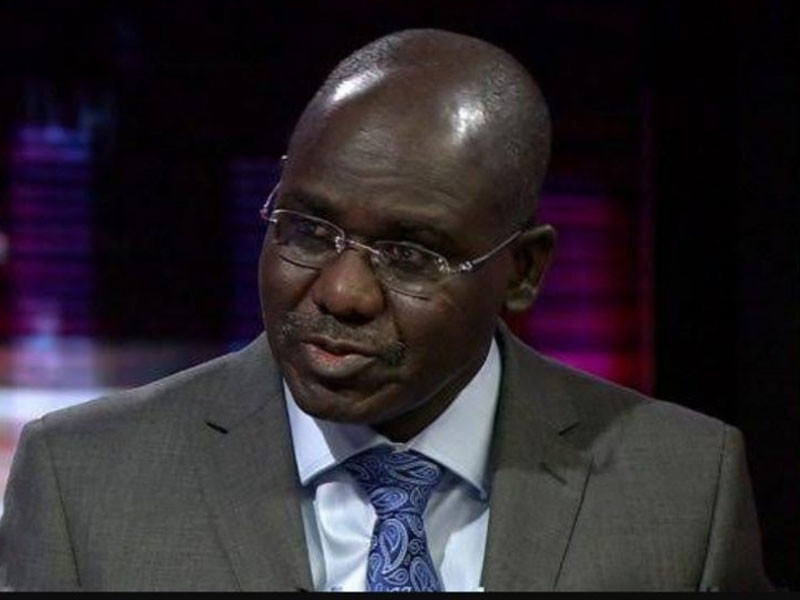


Nigeria’s former Chief of Army Staff, Tukur Buratai, under whom terrorists and other armed groups killed thousands of people and displaced many more, has proposed strategies to tackle the nation’s security crises.
Mr Buratai, who led the Nigerian Army between 2015 and 2021 during some of the most violent phases of the Boko Haram conflict and the expansion of armed criminal groups across northern Nigeria, made the remarks on Monday in a statement shared with PREMIUM TIMES.
His tenure was marked by military offensives that reclaimed territory from insurgents, but also by persistent insecurity, repeated mass kidnappings and allegations of human rights abuses, including the massacre of over 300 Shiites and the secret burial of their corpses in mass graves. These claims were consistently denied by the military.
He may have been unable to bring the insecurity to an end while in office, but Mr Buratai has now proposed solutions to it.
The retired general said the country is now witnessing the confirmation of a warning he issued in 2021, when he predicted that insurgency and banditry could last for two decades without decisive intervention.

According to him, the capture, torture and eventual killing of senior military officer, Rabe Abubakar, is “not merely a tragedy” but “marks a dangerous threshold.”
Mr Rabe, a retired major general and former defence spokesperson, was abducted on 30 May alongside his wife, Amina, while travelling along a rural road in Katsina. He later died in captivity two weeks later. The Katsina State Government confirmed his death on Saturday, after which his body was retrieved and buried.
The deceased’s wife is still in captivity.
‘When generals fall’
At least six serving senior officers, including Mr Abubakar, have been killed by terrorists this year alone. About 14 have lost their lives since the Boko Haram insurgency began.
“When a general falls into the hands of non-state actors, it signals a serious erosion of tactical deterrence,” said Mr Buratai, whose tenure as army boss witnessed the loss of no fewer than eight senior military officers to insurgents and bandits.
He warned that continued insecurity could place even top political leaders at risk.
“Let me be clear: if this trend continues unchecked, the next targets may not be soldiers or civilians alone. They could include ministers, senators, and even state governors. No leader will be immune,” he warned.
Describing the development as another wake-up call, he questioned how many more warnings Nigeria could afford to ignore.
His ‘frank advice’
Offering what he described as “frank advice” to the federal and state governments, Mr Buratai urged authorities to acknowledge the shortcomings of the current security strategy.
“Bandits and insurgents now operate with intelligence, heavy weaponry, and audacity that rival conventional forces,” he said, adding that “the current reactive strategy, paying ransoms and negotiating with criminals, must end.”
He called for “a full-scale, coordinated military and intelligence offensive,” noting that significant successes were recorded between 2015 and 2019 through sustained operations.
He also suggested that “a security lockdown of insurgent- and bandit-infested states should be considered to clear their hideouts and remote enclaves.”
Mr Buratai further advocated the establishment of a National Emergency Command, describing insecurity as “a national emergency” rather than a regional problem.
“The Federal Government should establish a unified command with direct authority over all security agencies operating in high-risk states, eliminating bureaucratic delays,” he said.
The proposed command, he added, should report directly to the president and be given “a clear, time-bound mandate to dismantle terrorist and bandit strongholds.”
On the issue of criminal networks, Mr Buratai stressed that armed groups survive through the support of financiers and collaborators.
“Bandits do not survive on AK-47s alone. They rely on networks of corrupt middlemen, illegal miners, ransom negotiators, and local collaborators,” he said.
He urged authorities to ensure such individuals are “identified, arrested, and prosecuted,” insisting that “the cost of supporting terrorism should be made unbearable.”
READ ALSO: Sultan on why citizens must hold leaders to account over insecurity
The former army chief also challenged state governors to assume greater responsibility for security in their domains.
“It is no longer acceptable for state governors to leave security responsibilities entirely to the military,” Mr Buratai said, recommending that state policing initiatives, properly vetted local vigilante groups and community intelligence networks be strengthened and integrated into the broader security framework.
While expressing hope that political leaders would not become direct targets, the former army chief warned that “the coming months may witness direct attacks on political leaders.”
He advised that security arrangements for senior government officials be strengthened through enhanced counter-ambush training and real-time intelligence sharing, while emphasising that authorities must dismantle “the criminal ecosystem that enables such attacks.”
Speaking on his motivation for issuing the warning, Mr Buratai declared: “I am a patriot. I fought for this nation, and I have no interest in scoring political points.”
He cautioned that failure to radically change the country’s approach to insecurity could have dire consequences.
“If we do not radically change our approach today, the headlines of tomorrow may make today’s tragedy seem like only a warning,” he said.
Mr Buratai concluded by stressing that while “the abduction of ministers or governors is not inevitable,” it could become “a real possibility if we continue with business as usual.”
“Let the death of Maj. Gen. Rabe Abubakar be the last preventable sacrifice,” he added.