
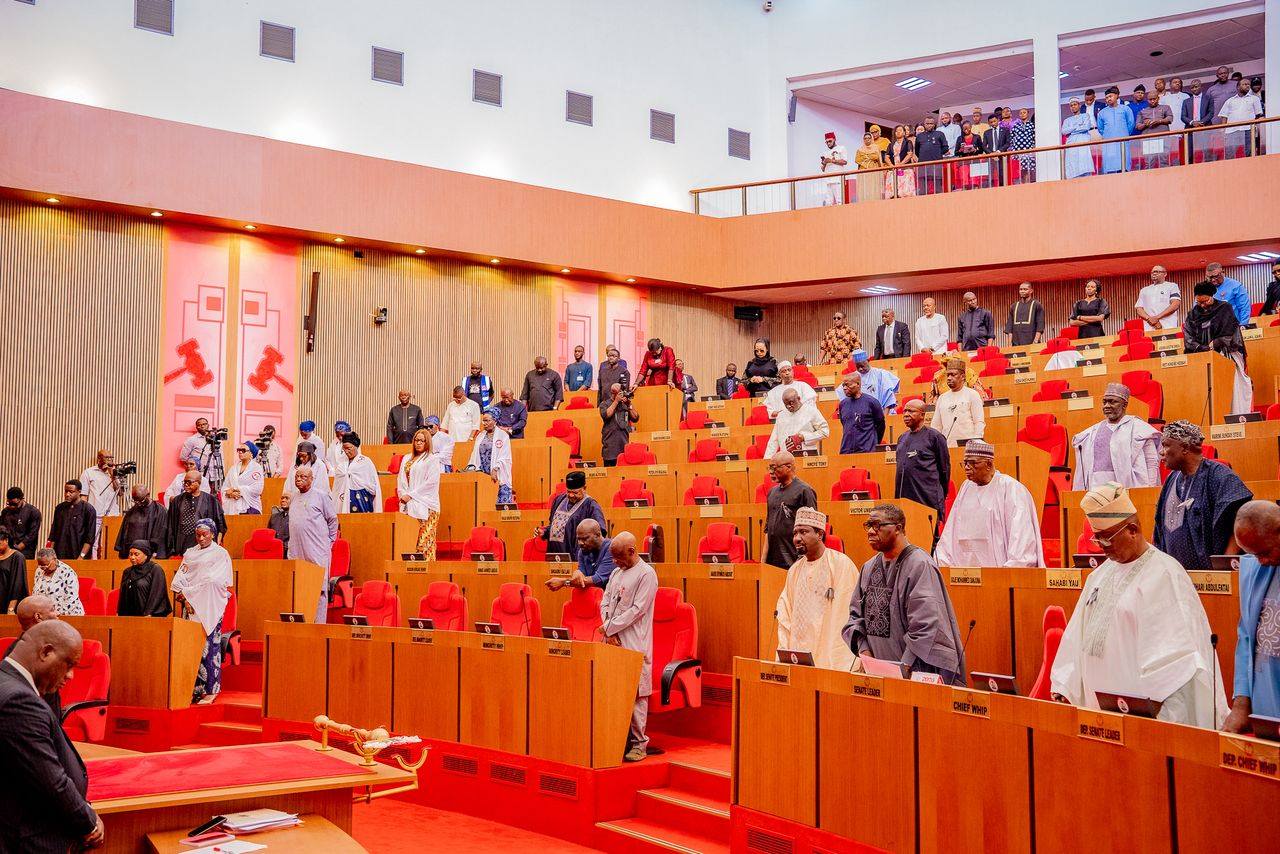


Last week, the Senate debated several key issues, including the establishment of state police, a proposed ban on textile imports, regulation of cryptocurrency, an increase in the number of Federal High Court judges and Court of Appeal justices, and the extension of the implementation timeline for the 2025 budget.
Senate moves to create State Police
State policing was initially expected to dominate Senate discussions following comments by the Senate Leader, Opeyemi Bamidele, who told journalists last Monday that the Senate would pass the bill during the week.
However, the proposal was not debated until Thursday, when it passed second reading and was referred to the Senate Committee on Constitution Review for further legislative scrutiny, including public hearings to gauge citizens’ views on the proposed policing system.
Sponsored by Mr Bamidele, the bill seeks to devolve policing powers to subnational governments as part of efforts to strengthen Nigeria’s internal security architecture.
The proposed legislation also seeks to modernise the country’s policing framework by establishing State Police Service Commissions responsible for recruitment, training, and oversight of personnel.

In addition, it proposes moving policing from the Exclusive Legislative List to the Concurrent Legislative List, thereby allowing both federal and state governments to exercise policing powers.
Although a date for the public hearing has yet to be announced, the committee is expected to receive submissions from stakeholders, including the Inspector-General of Police, Olatunji Disu, and the Attorney-General of the Federation, Lateef Fagbemi.
Lawmakers want total ban on textile imports
On Tuesday, the Senate, during plenary, called for a total ban on the importation of textile products to enable Nigeria’s local textile industry to thrive, create jobs and generate more revenue.
The upper chamber also urged the federal government to provide additional funding through the Bank of Industry (BOI) to revive the struggling textile sector.
The resolutions followed the adoption of a motion sponsored by Kaduna South Senator, Sunday Katung, on the need to revive the country’s struggling textile industry.
The motion was co-sponsored by Natasha Akpoti-Uduaghan (PDP, Kogi Central), Adams Oshiomhole (APC, Edo North), Ibrahim Khalid (APC, Kaduna North), Tahir Monguno (APC, Borno North) and Mustapha Khabeeb (APC, Jigawa South-west).
Mr Katung, who presented the motion on behalf of the senators, lamented that the unregulated importation of textile products had led to Nigeria losing its position as one of the largest employers of labour in the sector.
Senate plans cryptocurrency regulation
Also on Tuesday, the Senate passed a bill seeking to regulate cryptocurrency, protect investors and strengthen Nigeria’s digital economy for a second reading.
The bill was referred to the Senate Committee on Capital Market for further legislative consideration and a public hearing, with a directive to report back within four weeks.
The bill, sponsored by the Deputy Senate President, Barau Jibrin, seeks to establish a comprehensive regulatory and supervisory framework for virtual assets, digital assets and Virtual Asset Service Providers (VASPs). It also proposes mandatory licensing, transparency and compliance requirements for cryptocurrency exchanges operating in the country.
The Chief Whip, Tahir Monguno, however, presented the lead debate of the bill on behalf of Mr Jibrin during the session.
Mr Monguno, while leading the debate on the bill, said that Nigeria has lagged behind several African countries in regulating the digital finance ecosystem despite recording one of the highest rates of cryptocurrency adoption on the continent.
The senator maintained that the absence of a clear legal framework has exposed investors to risks and enabled illicit activities to thrive in the sector.
Lawmakers query SEDC over unaccounted N4bn
The Senate Committee on the South East Development Commission (SEDC) on Tuesday queried the commission’s management over its inability to account for more than N4 billion spent from its 2025 budget.
The Managing Director of the SEDC, Mark Okoye, appeared before the committee alongside Sylvester Okonkwo, a former chief of staff to the Senate President, Godswill Akpabio, to defend the commission’s expenditure for the year.
The committee chairman, Orji Kalu, questioned the commission’s contribution to the development of the South-east and demanded details of how its budget had been utilised.
Mr Kalu, who represents Abia North Senatorial District, asked the managing director how much remained in the commission’s account and how the funds had been spent.
However, Mr Okoye was unable to provide a comprehensive account of the spending, prompting the committee to direct him and other officials to return on Tuesday with detailed documentation of the commission’s financial activities.
Increase in federal high court Judges and Court of Appeal Justices
Two separate bills seeking to expand the capacity of Nigeria’s judiciary passed second reading in the Senate on Wednesday.
One bill seeks to increase the number of judges of the Federal High Court from 70 to 90, while the other proposes raising the number of Court of Appeal justices from 70 to 110.
The bills, sponsored separately by the Senate Leader, Opeyemi Bamidele, were passed during Wednesday’s plenary session.
After the passage, the bills were referred to the Senate Committee on Judiciary, Human Rights and Legal Matters.
The Federal High Court amendment bill aims to address delays in the administration of justice by increasing the number of judges available to hear cases.
The Court of Appeal amendment bill seeks not only to increase the number of justices but also to ensure equitable representation of all states and the Federal Capital Territory in the court’s composition.
It also seeks to clarify issues relating to seniority and ranking among justices, strengthen the court’s administrative functions and improve the efficiency of appellate adjudication.
National Assembly building on fire
A section of the Senate wing of the National Assembly was gutted by fire on Wednesday shortly after members of the Senate Committee on the Niger Delta Development Commission (NDDC) concluded the screening of Zainab Marwa as the North-east representative on the commission’s board.
The fire emanated from the kitchen area attached to Hearing Room 107, where the Senate Committee on the NDDC conducted the screening exercise.
The incident was triggered by the explosion of a microwave oven left unattended in the kitchen compartment of the committee room.
No casualties were recorded, and no documents or valuable property were destroyed before the fire was successfully extinguished.

Committee threatens arrest warrant against Mele Kyari, Senate overrules
On Wednesday, the Senate Committee on Public Accounts threatened to issue an arrest warrant against former Group Chief Executive Officer of the Nigerian National Petroleum Company Limited (NNPC Ltd), Mele Kyari, to compel his appearance before the committee.
READ ALSO: Again, Senate extends the 2025 federal budget
The committee issued the threat after Mr Kyari failed to honour several invitations to explain the alleged N210 trillion discrepancy flagged in reports submitted by the Auditor-General of the Federation covering the period between 2017 and 2023.
Chairman of the committee, Ibrahim Dankwambo, issued the warning during the committee’s meeting at the National Assembly on Wednesday.
Mr Dankwambo, a former governor of Gombe State, said the committee had little choice but to proceed because Mr Kyari had repeatedly failed to appear before lawmakers despite being invited on several occasions.
However, when the Senate reconvened on Thursday, some lawmakers distanced themselves from the committee’s threat to issue an arrest warrant.
The upper chamber held that the power to authorise such a measure rests solely with the presiding officer of the Senate, in line with its rules and constitutional provisions.
Consequently, the Senate withdrew the threat of arrest against Mr Kyari and directed that no committee should issue such a directive in the future without the Senate president’s approval.
Extension of 2025 budget again
The Senate also extended the implementation period for the capital component of the 2025 budget from 30 June to 30 September to allow the government to complete projects covered by the appropriation law.
That was the third time the lawmakers had extended the capital component of the 2025 budget, despite repeated assurances by the Tinubu administration that Nigeria would no longer operate overlapping budgets.
The bill seeking the extension was sponsored by the Senate Chief Whip, Tahir Monguno, during plenary.
Mr Monguno, who represents Borno North District, said the extension was necessary to ensure adequate funding for the implementation of government programmes, projects, and activities.